

When a company moves production to a contract manufacturer, it is making more than a sourcing decision. It is choosing a production ecosystem: the suppliers, technical capabilities, workforce, logistics connections and regulatory environment that will determine whether goods can be produced consistently and delivered on time.
Contract manufacturing can help companies access specialised capabilities or increase production flexibility without building every facility themselves. But shifts in supplier location are rarely explained by labour cost alone. Reliability, quality, trade access and the depth of the supplier network can matter just as much.
Follow The Products And Inputs Across Borders
Trade data offers a useful starting point for identifying changes in manufacturing relationships. Rising exports in a product category may indicate that a country is gaining production activity, while changes in imported components can reveal how its manufacturing ecosystem is developing.
The OECD’s Trends in Global Value Chains, published in 2026, found that global value-chain trade remained near historical highs in 2024. Its analysis highlights the continued importance of cross-border inputs and changing sourcing structures rather than a simple retreat from international production.
This matters for contract manufacturing because a finished product may cross several borders during production. Components, subassemblies, testing services and final assembly can be distributed across multiple economies.
Analysts should examine finished-goods exports alongside intermediate-goods imports, sector production, supplier investment and destination-market demand. Looking at only one trade category can lead to the wrong conclusion about where value is being created.
Why Supplier Locations Change
A contract manufacturer may gain business when it offers a combination of competitive costs, reliable quality, available capacity and access to customers. Conversely, suppliers can lose orders when lead times lengthen, compliance requirements change or customers seek greater geographic diversification.
Four factors commonly shape these decisions:
- Production Capability: Technical expertise, quality systems, tooling and ability to scale.
- Total Delivered Cost: Labour, materials, freight, duties, inventory and coordination costs.
- Supply-Chain Depth: Access to components, specialist suppliers and alternative sources.
- Market Access: Trade agreements, product standards, customs requirements and proximity to customers.
The best sourcing location depends on the product. Electronics, textiles, industrial machinery and consumer goods have different requirements for capital, skills, components and production flexibility.
Read Trade Flows Carefully
contract manufacturing is not always directly visible in standard trade statistics. Customs records usually identify the goods crossing borders, not the commercial relationship between the brand owner and the factory producing them.
Researchers should therefore combine product-level trade data with company disclosures, supplier announcements, factory investment records, industry production data and procurement information where available.
The OECD’s Trade in Value Added database can add context by estimating how much domestic and foreign value is embodied in exports. Its 2025 edition covers 80 economies and 50 industries through 2022, helping researchers examine the upstream contributions behind gross export figures.
This distinction is important. A country may export a high-value finished product while relying heavily on imported components. Another may supply critical intermediate goods without appearing prominent in finished-product exports.
Build A Supplier Location Shortlist
A sourcing assessment should compare locations against the requirements of the product and the business, not against a generic ranking of low-cost manufacturing countries.
Supplier selection should account for five factors.
- Capability determines whether suppliers can meet the required technical specifications and quality standards.
- Capacity establishes whether they have sufficient production space and can scale output as demand grows.
- Cost involves assessing total landed costs under realistic scenarios, including production, transport and other associated expenses.
- Resilience requires evaluating the availability of alternative suppliers and transport routes in case of disruption.
- Compliance means verifying that suppliers meet applicable labour, environmental and product regulations.
A supplier’s quoted price is only one component. Qualification costs, tooling, production yields, defect rates, working capital and the risk of interruption can change the final economics substantially.
Nexdigm’s Contract Manufacturing Sourcing Framework
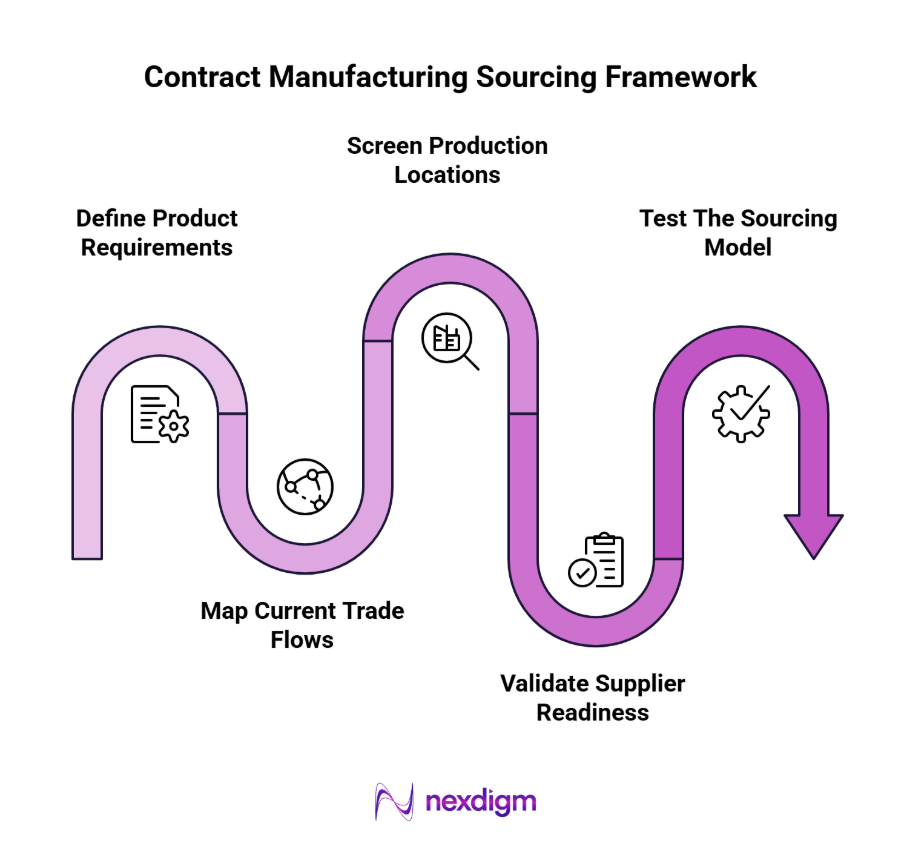
- Define Product Requirements: Specify quality, volumes, technical needs and delivery expectations.
- Map Current Trade Flows: Identify supplier countries, component origins and export destinations.
- Screen Production Locations: Compare capability, cost, infrastructure and market access.
- Validate Supplier Readiness: Assess quality systems, available capacity, compliance and financial stability.
- Test The Sourcing Model: Compare total cost, continuity risks and the feasibility of a dual-source strategy.
Sourcing Decisions Need More Than a Cost Comparison
Contract manufacturing shifts should be evaluated through trade flows, production capability and supplier-level evidence. Combining these sources helps businesses identify credible alternatives, understand where value is created and avoid moving production into a market that lacks the capacity or reliability the business requires.
Nexdigm’s Case Study: Diversifying A Component Supply Base
A consumer electronics company relies on one contract manufacturer for a critical assembly. Trade and supplier research identifies a second production location with relevant capabilities but different component dependencies. The company qualifies the alternative supplier and gradually allocates a portion of production to reduce concentration risk.
To take the next step, simply visit our Request a Consultation page and share your requirements with us.
Harsh Mittal
+91-8422857704