

Contract warehousing price competitiveness has become a decisive factor for third- party logistics (3PL) providers managing long-term client agreements in an increasingly dynamic supply-chain environment. Businesses now emphasize contract warehousing price competitiveness and data-driven pricing analysis to optimize operational efficiency and maintain sustainable partnerships.
Effective pricing strategies depend on factors such as storage utilization, labor costs, inventory turnover, service-level agreements, and regional demand patterns. Through comprehensive pricing analysis, 3PL providers can benchmark rates, identify cost-saving opportunities, and enhance value creation across long-term warehousing contracts.
Recent industry assessments indicate that leading 3PL providers using advanced pricing analysis frameworks have improved contract renewal rates by nearly 18% and reduced warehousing cost variations by approximately 12%, demonstrating how stronger contract warehousing price analysis positively influences long-term client relationships and operational performance.
Comparative Pricing Analysis for Long-Term 3PL Warehousing Contracts
Comparative pricing analysis evaluates how 3PL providers structure long-term warehousing contracts, revealing cost differences, service trade-offs, and value drivers across operational, commercial, technological, geographic, and risk-related dimensions effectively. Some important dimensions of the same are:
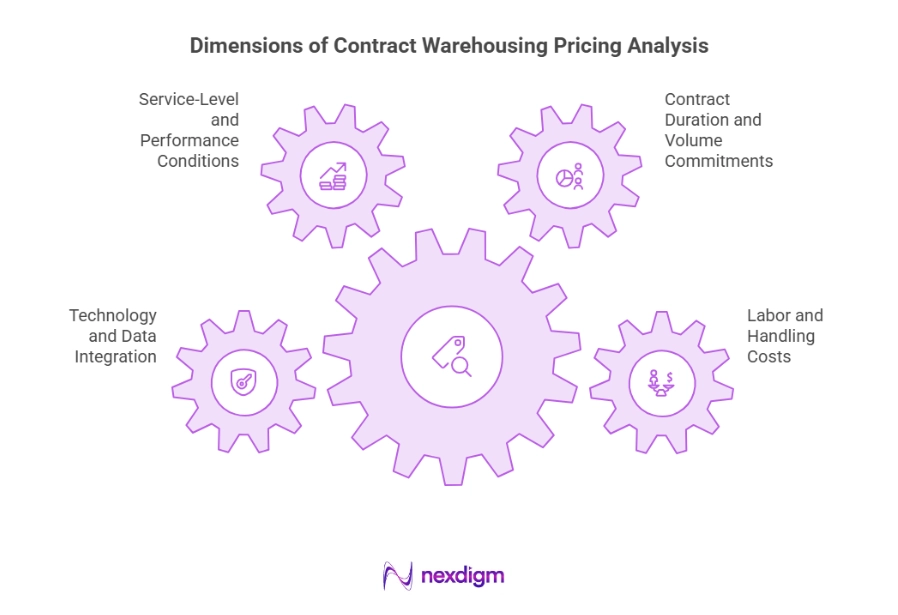
- Labor and Handling Costs: Analysis covers receiving, picking, packing, loading, and value-added labor charges, highlighting how workforce productivity, automation levels, and regional wage structures influence long-term contract pricing competitiveness.
- Contract Duration and Volume Commitments: This dimension examines how agreement length, minimum volume guarantees, growth projections, and renewal terms affect rate discounts, pricing stability, commercial flexibility, and total warehousing expenditure over time.
- Technology and Data Integration: Pricing comparisons assess charges for warehouse management systems, reporting dashboards, inventory visibility, integrations, and automation, determining whether technology fees generate measurable efficiency, accuracy, and service improvements.
- Service-Level and Performance Conditions: This dimension evaluates pricing against delivery accuracy, order-cycle targets, inventory control, response times, penalties, and incentives, ensuring lower rates do not compromise required operational performance or accountability.
Nexdigm’s Strategic Pricing Advisory for Contract Warehousing Competitiveness
Nexdigm delivers strategic advisory services that enable businesses to strengthen contract warehousing competitiveness through comprehensive pricing analysis, 3PL benchmarking, warehouse cost optimization, and contract pricing strategies. By evaluating market rates, storage costs, service-level commitments, and operational efficiencies, Nexdigm helps organizations improve pricing transparency, identify cost-saving opportunities, and optimize long-term warehousing agreements while enhancing overall supply-chain performance and profitability.
Nexdigm’s Strategic Architecture for 3PL Pricing Analysis and Benchmarking
Nexdigm’s strategic architecture combines market intelligence, cost diagnostics, and contract benchmarking to help organizations evaluate 3PL pricing and establish competitive, sustainable warehousing agreements across diverse operational environments. Key strategies of the model are:
- Cost Decomposition Strategy: This strategy separates storage, labor, handling, technology, and overhead charges, enabling precise cost comparisons and revealing hidden pricing gaps across competing long-term 3PL contract proposals.
- Total Cost Benchmarking Strategy: This strategy considers direct and indirect warehousing expenses, including inventory loss, technology integration, administration, and service failures, to establish a realistic comparison of total contract costs.
- Contract Renewal Strategy: Nexdigm reviews historical pricing, service performance, market movements, and future requirements before renewal, helping clients determine whether to renegotiate, restructure, extend, or retender contracts.
- Cost-to-Serve Evaluation Strategy: Nexdigm evaluates the complete cost of serving each warehousing account, including storage, handling, labor, technology, and overheads, to identify pricing gaps and improve contract profitability.
Nexdigm’s Case
Nexdigm supported a logistics provider through advanced analytics and distribution-center benchmarking, improving order-processing efficiency by 24%, reducing fulfilment delays and increasing overall network productivity by 15% through targeted, data-driven operational optimization strategies and performance monitoring.
To take the next step, simply visit our Request a Consultation page and share your requirements with us.
Harsh Mittal
+91-8422857704