

Contract warehousing has become an important part of supply chain strategy as businesses seek specialised storage, fulfilment, and distribution capabilities. According to recent research result, India’s logistics and industrial real estate market recorded 36.2 million sq. ft. of leasing in H1 2026, an 18% year-on-year increase. Its report also found that third-party logistics (3PL) providers accounted for 34% of total leasing demand.
While another study reported 34.8 million sq. ft. of industrial and logistics absorption during the same period, with 3PL contributing 23%. These trends highlight the growing role of outsourced logistics infrastructure. Businesses must therefore evaluate fulfilment capabilities, service-level agreements, operational flexibility, and commercial terms. Contract warehousing supplier benchmarking helps organization’s compare providers and identify partnerships aligned with their supply chain requirements.
Why Contract Warehousing Partnerships Require Careful Evaluation
Contract warehousing partnerships involve long-term operational and commercial commitments. Businesses depend on external providers to manage inventory, fulfil orders, and maintain distribution continuity. However, differences in infrastructure, workforce capabilities, technology, and service standards can influence overall performance. Evaluating these factors before finalising agreements helps organisations select partners that can meet operational expectations while accommodating changing business requirements.
Considerations When Comparing Contract Warehouse Providers
A combined assessment of service delivery, commercial terms, and operational flexibility helps businesses understand the overall suitability of contract warehouse providers. Comparing these factors enables procurement teams to identify capable partners, evaluate potential cost efficiencies, anticipate operational constraints, and select warehousing arrangements that support current fulfilment needs and future supply chain requirements.
How Nexdigm Evaluates Contract Warehouse Providers
Nexdigm can support businesses in comparing contract warehousing suppliers through structured market research, commercial benchmarking, and operational assessments. Our analysis can cover four important areas:
- Supplier Landscape Assessment: Identify relevant warehouse operators, geographic presence, industry specializations, facility networks, and service portfolios.
- Fulfilment Capability Benchmarking: Compare inventory management, order processing, picking accuracy, dispatch operations, and returns handling.
- Commercial and SLA Evaluation: Examine pricing models, contractual commitments, service-level targets, performance penalties, and additional charges.
- Capacity and Flexibility Assessment: Evaluate providers’ ability to accommodate seasonal demand, changing storage volumes, specialized handling, and business expansion.
This approach helps procurement teams understand supplier differences and shortlist providers according to operational and commercial priorities.
Nexdigm’s Industry-specific Insights for Contract Warehousing Decisions
Nexdigm’s contract warehousing supplier benchmarking can help businesses assess provider suitability across industries with distinct logistics requirements. The analysis considers sector-specific needs such as temperature-controlled storage for pharmaceuticals, inventory traceability for automotive components, high-volume fulfilment for retail, and flexible distribution for consumer goods. These insights help businesses identify providers whose capabilities align with industry requirements and operational priorities.
Why Contract Warehousing Supplier Benchmarking Matters
As warehousing requirements evolve, businesses need greater visibility into supplier capabilities, commercial competitiveness, and service performance. Contract warehousing supplier benchmarking helps organisations address three important priorities:
- Managing Operational Costs: Compare storage, handling, fulfilment, and additional service charges to identify cost differences and potential savings.
- Maintaining Service Consistency: Evaluate SLA commitments, fulfilment accuracy, inventory reliability, and turnaround times to assess provider performance.
- Preparing for Business Growth: Identify suppliers with scalable infrastructure, flexible capacity, and capabilities to support changing distribution requirements.
These insights help businesses make informed sourcing decisions and establish warehouse partnerships that remain commercially and operationally relevant.
Nexdigm’s Framework for Contract Warehousing Supplier Assessment
Nexdigm’s experts follow a structured, multi-step approach to evaluate contract warehouse providers and identify the most suitable partners. The steps for the same are:
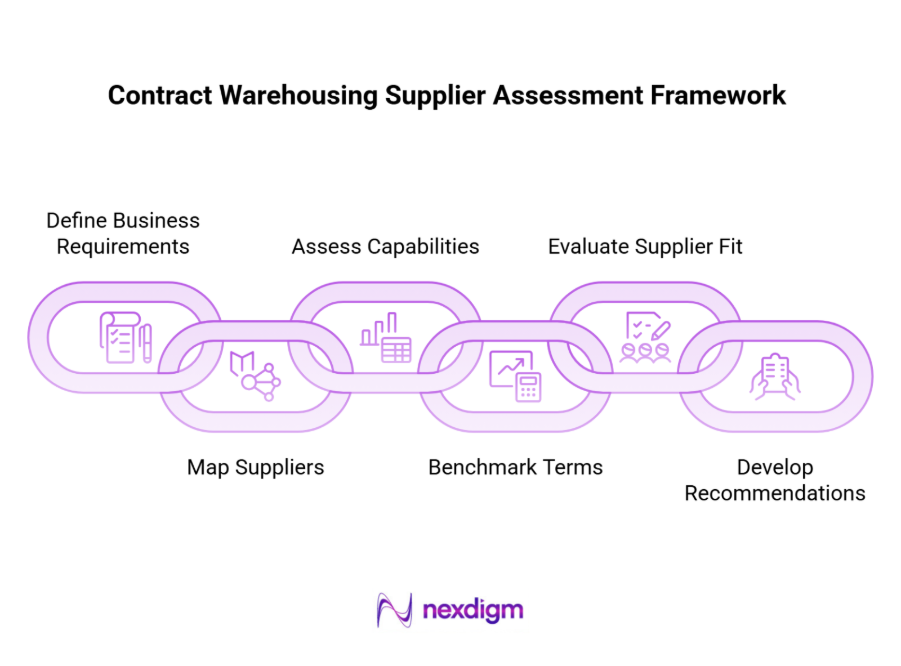
- Step 1 Define Business Requirements: Understand storage volumes, inventory profiles, fulfilment needs, geographic coverage, and service expectations.
- Step 2 Map the Supplier Landscape: Identify relevant warehouse operators based on industry focus, facility networks, service portfolios, and regional presence.
- Step 3 Assess Operational Capabilities: Evaluate inventory management, order accuracy, fulfilment processes, technology infrastructure, and SLA performance.
- Step 4 Benchmark Commercial Terms: Compare storage rates, handling charges, minimum commitments, contract structures, and additional costs.
- Step 5 Evaluate Supplier Fit: Assess scalability, operational flexibility, service reliability, and alignment with future business requirements.
- Step 6 Develop Sourcing Recommendations: Consolidate findings into supplier comparisons, prioritized shortlists, and actionable recommendations.
This systematic approach helps businesses make consistent supplier evaluations and select contract warehousing partners aligned with their operational and commercial priorities.
Nexdigm’s Case
A consumer goods company sought to improve warehouse fulfilment and control outsourcing costs. Nexdigm’s assessment compared supplier pricing, SLA performance, and capacity flexibility, identifying 15% potential cost savings, 18% scope for improving fulfilment efficiency, and 20% better capacity alignment. These findings helped refine supplier selection and strengthen warehouse contract planning.
To take the next step, simply visit our Request a Consultation page and share your requirements with us.
Harsh Mittal
+91-8422857704