

Core banking modernization is moving from a long-term technology ambition to an increasingly immediate business priority. Recent research notes that bank CIOs are accelerating modernization as institutions move workloads from monolithic systems toward digital platforms. Meanwhile, a 2026 banking technology survey found that 69% of banking leaders believe their organizations need to modernize platforms to bring new or enhanced products and services to market, up from 46% in 2025.
The technology decision is also becoming more complex. Everest Group estimates the global core banking technology market at approximately $13–14 billion in 2025, with the market projected to reach $23–24 billion by 2030. Its 2026 research highlights cloud-native, API-first, modular, and AI-ready architecture as increasingly important characteristics.
For banks, selecting a core platform therefore involves more than comparing product features. Core banking software vendor analysis needs to examine architecture, deployment models, functionality, integration, scalability, implementation requirements, and enterprise fit.
Core Modernization Is Expanding the Vendor Decision
Core banking decisions now extend beyond transaction processing to architecture, connectivity, modernization, and operational continuity. Banks increasingly need platforms that can support evolving digital and regulatory requirements while fitting into existing enterprise environments.
- Modern Technology Requirements: Evaluate APIs, cloud readiness, modular architecture, real-time processing, data integration, and automation capabilities to support future banking services and technology evolution.
- Migration & Integration Considerations: Assess legacy dependencies, migration complexity, interoperability, implementation requirements, and integration risks before selecting a replacement or modernization platform.
Ultimately, the vendor decision needs to balance modernization potential with implementation practicality, operational resilience, and enterprise compatibility.
Technology Architecture Can Shape Long-Term Vendor Fit
A core platform’s architecture can determine how easily banks integrate new capabilities, scale operations, and adapt to future technology requirements. Modular design, APIs, cloud compatibility, data architecture, and interoperability can therefore influence long-term suitability. Evaluating these elements helps institutions understand whether a platform can support modernization while working effectively with existing systems and reducing future integration or migration constraints.
Nexdigm’s Role in Assessing Architecture and Vendor Fitness
Because architecture influences a platform’s long-term flexibility, Nexdigm’s experts can assess how each vendor’s technology stack supports the bank’s current environment and future modernization needs. The analysis can examine:
- APIs: Check how easily the platform can connect with digital channels, payments, data platforms, and third-party applications.
- Modularity: Assess whether components can be changed, upgraded, or added without requiring major changes to the entire core.
- Interoperability: Determine how effectively the platform works with the bank’s existing applications and technology ecosystem.
- Data flows: Understand how information moves between the core platform and other enterprise systems.
- Cloud compatibility: Assess whether the platform supports the bank’s preferred cloud, hybrid, or other deployment environment.
This approach therefore helps banks understand not only whether a platform is technically advanced, but whether its architecture can support integration, modernization, scalability, and long-term flexibility within the existing enterprise environment.
What Differentiates Nexdigm’s Core Banking Vendor Fitness Assessment
Nexdigm’s approach can go beyond comparing core banking platforms on feature lists or technology specifications. Our expertise combines several areas to examine how a platform fits the bank’s broader transformation context by conducting:
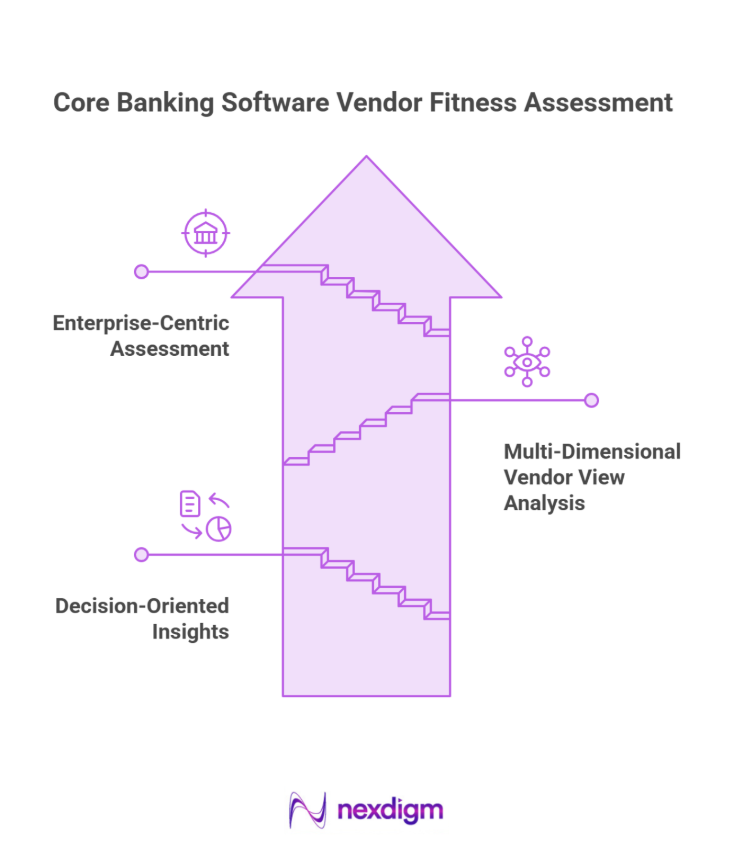
- Enterprise-Centric Assessment: Evaluate vendors against the bank’s architecture, operating model, modernization roadmap, integration requirements, and business priorities rather than using generic criteria.
- Multi-Dimensional Vendor View Analysis: Consider technology, functionality, deployment, scalability, implementation complexity, commercial positioning, and enterprise fit together to develop a more balanced assessment.
- Decision-Oriented Insights: Translate vendor research into practical implications for shortlisting, due diligence, modernization pathways, implementation planning, and commercial discussions.
This approach helps make core banking software vendor analysis more contextual, connecting vendor capabilities with the practical requirements and transformation objectives of the financial institution.
Strategic Value Delivered by Nexdigm’s Assessment Approach
Nexdigm’s assessment can help banks turn detailed vendor and technology analysis into decisions with longer-term strategic relevance. The value extends beyond identifying a suitable vendor and platform by offering following benefits of:
- Greater Decision Confidence: Our structured assessment gives technology, business, and procurement teams a common evidence base for comparing vendors and understanding trade-offs.
- Lower Transformation Uncertainty: Evaluating architecture, integration, deployment, scalability, and implementation considerations early can help identify potential constraints before major platform commitments.
- Stronger Modernization Alignment: Linking vendor capabilities with the bank’s transformation roadmap helps ensure the selected platform can support evolving products, operating models, and technology requirements.
- Better Commercial Positioning: A clear understanding of vendor strengths, alternatives, and implementation implications can strengthen negotiations and support more informed commercial decisions.
Hence, our core expert led assessment helps banks make core platform decisions that remain relevant beyond the immediate procurement or selection exercise.
Nexdigm’s Case
Nexdigm assessed core banking platforms for a financial institution, comparing architecture, deployment models, functionality, integration, scalability, and commercial fit. 27% progressed to detailed evaluation, while 20% showed stronger alignment with the target architecture and 13% required deeper migration assessment. The analysis helped focus due diligence on platforms with stronger enterprise and modernization fit.
To take the next step, simply visit our Request a Consultation page and share your requirements with us.
Harsh Mittal
+91-8422857704