
Corn demand in India is no longer being shaped by feed consumption alone. Poultry, aquaculture, starch processing, and grain-based ethanol are competing for the same supply pool, while production can move sharply between surplus and deficit depending on the season and region.
USDA estimates place India’s MY 2025/26 corn production at a record 48.5 million tonnes, up about 12% year on year, before forecasting a decline to 44 million tonnes in MY 2026/27. At the same time, ethanol production is creating an additional demand pool for grain. For buyers, the commercial question is becoming increasingly geographic: where will demand emerge, and which production corridors can supply it at competitive delivered cost?
Feed Remains the Anchor, but Ethanol Is Changing the Balance
Poultry and livestock feed account for an estimated 55% to 58% of domestic corn consumption, equivalent to roughly 25–27 million tonnes. Commercial poultry, dairy, and aquaculture feed demand is expected to continue expanding, with faster-growing segments registering annual growth of approximately 5% to 8%.
Ethanol introduces a different source of demand. The E20 blending target has encouraged investment in grain-based and dual-feed distilleries, with corn utilisation projected at around 6–9 million tonnes annually.
This creates direct competition between feed mills and distilleries for procurement volumes. A feed manufacturer that previously relied on historical mandi relationships may therefore face a very different supply environment as industrial buyers enter the same sourcing regions.
One Tonne of Corn Can Support Several Competing Markets
The commercial value of corn depends on what happens after procurement.
Poultry and livestock businesses evaluate grain through nutritional value, delivered price, availability, and substitution economics. Ethanol producers evaluate feedstock cost, conversion economics, policy incentives, and byproduct value. Wet millers evaluate quality, consistency, location, and processing yields.
Starch and industrial processing currently account for an estimated 12% to 14% of production, or roughly 5.5–6 million tonnes, with applications across food ingredients, paper, packaging, textile finishing, and related industries.
DDGS adds another layer. Grain distilleries produce a protein-rich feed ingredient that can enter poultry and cattle rations. This means a demand forecast needs to consider both the diversion of corn into ethanol and the resulting supply of alternative feed ingredients.
Geography Could Matter More Than the National Demand Number
Corn production is highly uneven across India. Bihar’s rabi crop can generate substantial surplus volumes, while parts of eastern Madhya Pradesh and Karnataka also contribute to major supply corridors. Southern poultry centres, including Namakkal and the Hyderabad cluster, can face structural deficits and therefore depend on grain movement from other regions.
Transport costs can materially change procurement economics. The research estimates rail freight from central and eastern surplus zones to southern processing hubs at roughly ₹2,200–₹3,200 per tonne.
For large buyers, this creates an opportunity to move from fragmented spot procurement toward multi-origin sourcing, direct aggregation, rail-linked logistics, and longer-term contracting.
Three Signals Can Reveal Where Demand Is Moving
- Feed production: Poultry, aquaculture, and dairy output provides the underlying demand signal for recurring feed consumption.
- Ethanol capacity: Existing and planned grain-based distilleries indicate where industrial procurement pressure could increase.
- Processing clusters: Starch, food ingredient, and industrial facilities identify locations where consistent-quality corn has a specific downstream buyer.
Trade and import parity should be monitored alongside these domestic signals. If production falls while industrial demand continues increasing, import access and policy decisions can influence domestic price formation.
Nexdigm Turns Demand Forecasting into Procurement Strategy
A quantitative corn market demand forecast can connect end-use demand with regional supply, freight, processing capacity, policy, and procurement economics. Nexdigm can assess where new demand is emerging, which supply corridors can serve it, and how buyers can structure procurement across multiple origins.
The assessment can examine demand across feed, ethanol, starch, food, and trade; surplus and deficit zones under different production scenarios; delivered-cost parity across transport modes; procurement requirements for new capacity; DDGS substitution; and exposure to policy and seasonal volatility.
The outcome is not simply a national demand estimate. It is a procurement and investment map showing where supply should be sourced, where infrastructure may be required, and where future demand could create pressure on existing corridors.
Nexdigm’s Corn Market Assessment Framework
Nexdigm can structure the analysis around five connected layers tracking the movement of corn from production to final demand:
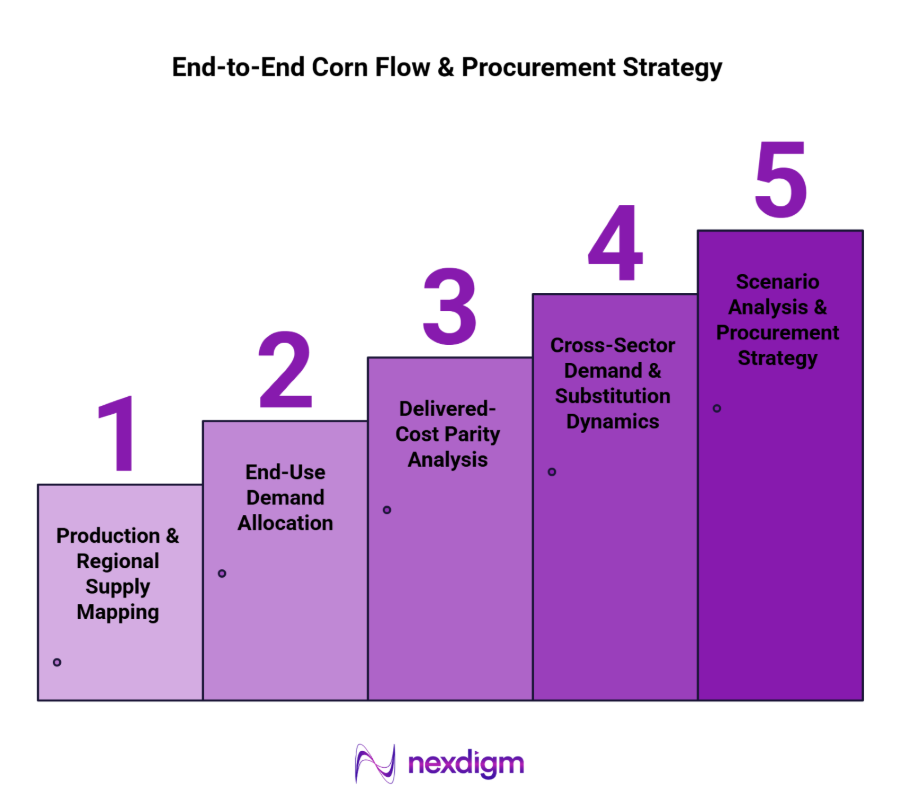
- Production & Regional Supply Mapping: Maps production volumes, acreage trends, yields, seasonality, grain quality, and regional surpluses to identify core origin basins.
- End-Use Demand Allocation: Maps consumption across poultry, livestock feed, ethanol, and industrial processing, linking each demand pool directly to its underlying growth drivers.
- Delivered-Cost Parity Analysis: Combines farm-gate pricing with aggregation, handling, storage, road or rail freight, and destination charges to establish the true economics of inter-regional grain movement.
- Cross-Sector Demand & Substitution Dynamics: Models competing off-take across feed, ethanol, and industrial wet millers, incorporating the supply and pricing of DDGS as an alternative feed protein.
- Scenario Analysis & Procurement Strategy: Stress-tests supply shocks, ethanol blending policies, import parity, freight volatility, and seasonal price swings to guide buyers toward multi-origin sourcing, contract strategy, storage planning, and processing capacity decisions.
Nexdigm Building a Lower-Cost Corn Supply Corridor
A direct agricultural commodity sourcing intervention covered 12,000 hectares of contracted corn production. The model established rail-linked aggregation centres and reduced dependence on congested local APMC yards. The reported outcome was an 18% reduction in delivered raw-material cost compared with prevailing spot mandi procurement rates.
Demand assessment becomes commercially useful when it is connected to sourcing architecture, logistics, and direct procurement rather than stopping at consumption forecasts.
To take the next step, simply visit our Request a Consultation page and share your requirements with us.
Harsh Mittal
+91-8422857704