

Corn markets continue to grow as demand expands across food, feed, and biofuel value chains. Corn is widely used in processed foods, livestock feed, starch, sweeteners, ethanol, and industrial applications, making it a strategic crop for traders, processors, and agribusinesses.
Companies entering this market must evaluate consumption trends, feed demand, biofuel policies, production capacity, pricing volatility, logistics infrastructure, and buyer requirements. A strong market entry strategy helps identify attractive regions, manage supply risks, and assess commercial viability. A detailed Corn market entry feasibility study supports informed decisions by mapping demand, trade flows, competition, and growth opportunities.
Global cereal utilization is expected to reach 2,946 million tonnes in 2025/26, up 2.5%, with feed use and food consumption supporting demand. Maize remains central to feed and ethanol value chains, while corn for fuel ethanol is forecast at about 5.6 billion bushels in 2026. These figures support a Corn market entry feasibility study by highlighting demand depth, biofuel exposure, supply planning, and pricing risks.
Impact of Biofuel Policies on Corn Market Expansion Opportunities
Biofuel policies influence corn demand by shaping ethanol production, feedstock requirements, pricing trends, investment decisions, and trade flows, creating market expansion opportunities for corn suppliers and processors:
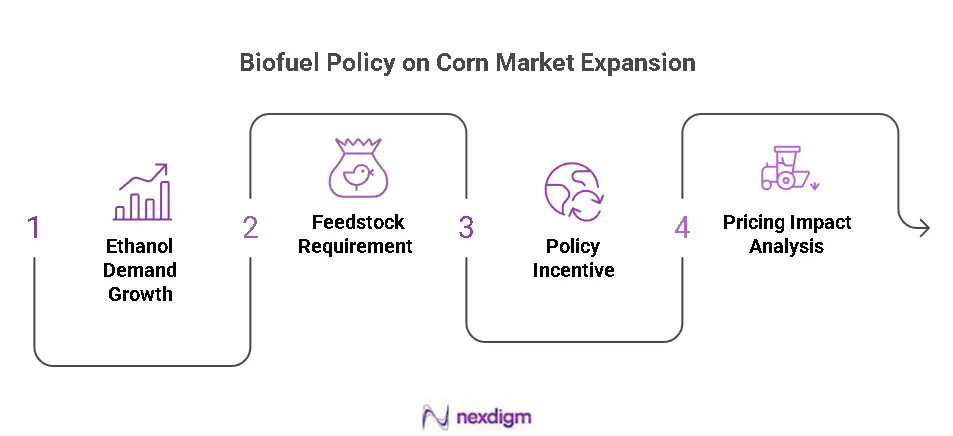
-
Ethanol Demand Growth
Assess how blending mandates and renewable fuel targets increase corn demand for ethanol production.
-
Feedstock Requirement Review
Evaluate corn usage requirements across biofuel plants to estimate supply needs and procurement opportunities.
-
Policy Incentive Assessment
Review subsidies, tax benefits, and renewable energy programs that support corn-based biofuel expansion.
-
Pricing Impact Analysis
Analyze how biofuel demand affects corn prices, margins, procurement timing, and market entry feasibility.
Nexdigm Ethanol Value Chain Opportunity Assessment for Corn Suppliers
Nexdigm can help corn suppliers assess ethanol demand, biofuel policy support, feedstock requirements, processing capacity, pricing trends, and procurement opportunities. This assessment supports market entry strategy by identifying high-potential ethanol value chain segments, supply risks, logistics needs, and partnership opportunities across corn-based biofuel markets.
Nexdigm Biofuel Policy Assessment for Corn Market Expansion
Nexdigm can assess blending mandates, renewable fuel policies, incentives, ethanol capacity, compliance needs, and demand impact to support corn market expansion across biofuel-driven value chains.
-
Blending Mandate Review
Assess ethanol blending rules and renewable fuel targets influencing corn demand across biofuel markets.
-
Policy Incentive Analysis
Review subsidies, tax benefits, and support programs that improve corn-based ethanol market opportunities.
-
Ethanol Capacity Mapping
Evaluate existing and planned ethanol plants to identify regions with strong corn feedstock demand.
-
Compliance Requirement Review
Assess documentation, sustainability standards, fuel regulations, and reporting obligations affecting biofuel market participation.
Nexdigm’s case:
Nexdigm supported a corn supplier assess biofuel policy impact for market expansion. The analysis identified regions with 20–25% ethanol demand growth potential, 15% feedstock supply gaps, and 10–12% logistics cost variation across ethanol value chains. These insights helped the company prioritize biofuel-driven markets, assess compliance needs, evaluate ethanol partnerships, and develop a focused corn market expansion roadmap.
To take the next step, simply visit our Request a Consultation page and share your requirements with us.
Harsh Mittal
+91-8422857704