

Corn is a strategically important commodity across food processing, animal nutrition, starch manufacturing, and biofuel production. The USDA’s November 2026 WASDE report estimates global corn production at approximately 1.29 billion metric tons for 2026/27, with global exports projected at 209.38 million metric tons. In India, APEDA reports maize production of 43.41 million tonnes in 2024–25 and exports of 1.25 million metric tons in 2025–26.
Meanwhile, the FAO reported that international maize quotations eased in October 2026 after reaching a three-year high in September. These developments make supplier selection increasingly important. Corn sourcing vendor landscape research helps businesses understand supplier markets, compare capabilities, and identify vendors suited to specific application and procurement requirements.
How Corn Suppliers Serve Different Industry Requirements
Corn suppliers operate across different parts of the agricultural value chain, from farming and aggregation to grain trading, processing, and export. Their capabilities vary according to the grades, volumes, storage infrastructure, and processing requirements they serve. Food manufacturers may prioritize food-grade quality and traceability, while feed producers focus on nutritional consistency and bulk availability. Industrial buyers often require specific starch, moisture, and processing characteristics.
Factors That Shape the Corn Supplier Landscape
Identifying relevant vendors requires an understanding of the characteristics that differentiate suppliers across applications and sourcing markets:
- Product and Grade Specialization: Examine food-grade, feed-grade, industrial maize, and specialty corn offerings based on quality specifications and intended applications.
- Operational and Supply Capabilities: Consider procurement networks, storage infrastructure, processing capacity, seasonal availability, and ability to fulfil bulk requirements.
- Market Reach and Commercial Positioning: Review supplier locations, export experience, distribution networks, pricing structures, and access to key consuming industries.
These factors help businesses establish relevant supplier categories before conducting detailed market and vendor assessments.
Nexdigm’s Market Mapping: Understanding Who Supplies Which Corn Markets
Our experts help businesses develop a structured view of the corn supplier ecosystem across selected producing and consuming markets. Our research identifies participants across the value chain, including farmers’ aggregators, grain merchants, commodity traders, processors, exporters, and integrated agricultural businesses.
Rather than presenting suppliers as one broad category, our experts examine their market roles, product focus, operating locations, customer segments, and distribution presence. This helps organizations understand which vendors participate in food, feed, and industrial supply chains and identify relevant companies for further assessment.
Segmenting Vendors by Application with Nexdigm
The suitability of a corn supplier depends on the requirements of the industry it serves. Our corn sourcing vendor landscape analysis helps businesses categorize vendors according to their product portfolios and application capabilities by focusing on these areas:
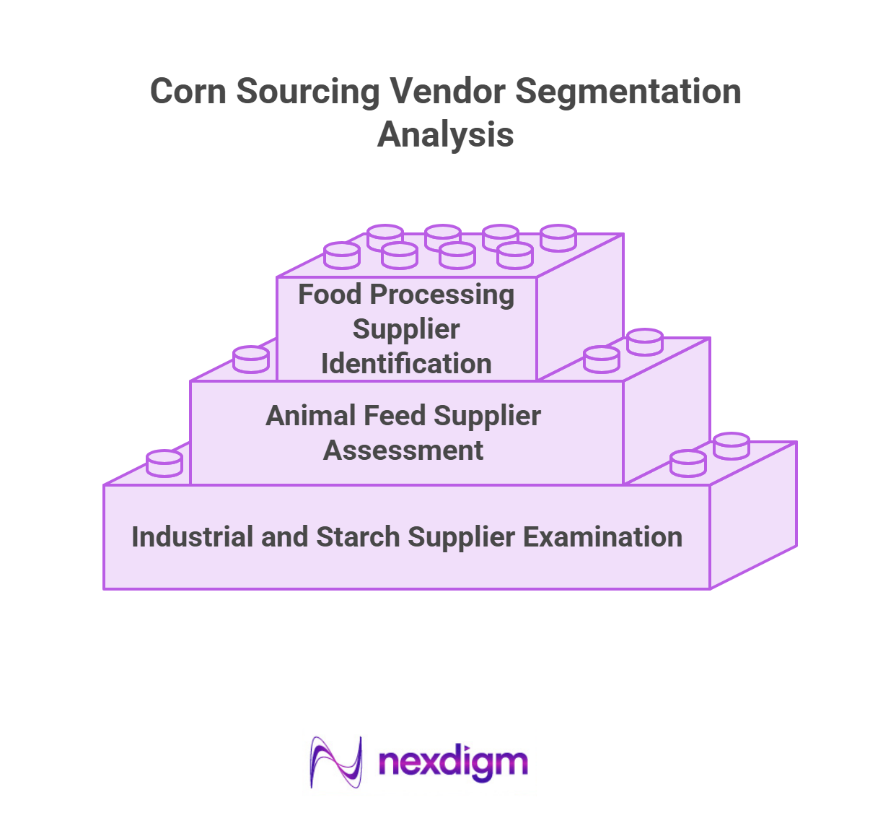
- Food and Food Processing Suppliers: Identify vendors offering maize suitable for flour, snacks, breakfast cereals, and other food applications, considering grade specifications and quality requirements.
- Animal Feed Suppliers: Assess suppliers serving poultry, cattle, and livestock feed markets, with attention to bulk availability, nutritional specifications, and supply consistency.
- Industrial and Starch Suppliers: Examine vendors serving starch, glucose, ethanol, and other industrial applications, including their processing capabilities and product specifications.
This segmentation helps buyers avoid comparing suppliers with fundamentally different operating models and commercial capabilities.
Business Benefits of Nexdigm’s Application-Based Corn Supplier Segmentation
Segmenting suppliers according to their end-use markets helps businesses make more relevant comparisons and align procurement decisions with operational requirements. Our analysis supports this through several benefits:
- More Relevant Supplier Identification: Identify vendors whose product grades, capabilities, and supply models align with specific food, feed, or industrial requirements.
- Improved Supplier Comparability: Compare businesses within relevant application categories rather than evaluating suppliers with different product and operational capabilities.
- Better Quality and Specification Alignment: Understand differences in product characteristics and quality parameters relevant to each intended application.
- Focused Procurement Planning: Prioritize suppliers based on application suitability, supply availability, and commercial considerations.
- Informed Supplier Shortlisting: Develop targeted vendor lists for further technical validation, due diligence, and commercial discussions.
This approach helps businesses connect supplier selection more closely with their product requirements and sourcing priorities.
Nexdigm’s Case
An animal nutrition manufacturer sought to expand its corn supplier network across domestic and international markets. Nexdigm assessed 27 vendors across sourcing access, storage, quality specifications, and bulk supply capabilities. The study found that 30% had limited seasonal supply flexibility, while 26% lacked sufficient information on quality-control practices. The company prioritized vendors for further technical and commercial evaluation.
To take the next step, simply visit our Request a Consultation page and share your requirements with us.
Harsh Mittal
+91-8422857704