

Corporate banking needs are expanding beyond traditional lending as businesses seek better liquidity, faster payments, stronger trade support, and more sophisticated treasury capabilities. McKinsey estimates that global transaction banking revenue could reach approximately $1 trillion by 2032, compared with about $650 billion in 2023.
This shift creates opportunities across credit, cash management, trade finance, payments, and treasury services. For banks, fintech companies, and investors, the challenge is identifying which needs are growing fastest, which customer segments are driving demand, and where commercial value can be captured.
A Corporate banking market opportunity analysis helps evaluate these opportunities through customer demand, industry trends, transaction activity, competitive positioning, and market economics. Nexdigm connects these dimensions through corporate customer analysis, market intelligence, competitive research, and opportunity mapping.
How Nexdigm Maps Corporate Growth
Nexdigm begins by separating corporate banking growth into distinct demand areas instead of treating the market as one opportunity. The assessment covers corporate credit, working capital, cash management, trade finance, payments, foreign exchange and digital banking.
This assessment compares demand across company size, industry, geography, and business activity. This helps financial institutions understand whether growth is coming from large corporations, mid-market companies, SMEs, exporters, importers, or specific high-growth industries.
Nexdigm in Grouping Corporate Customers
Corporate banking demand is not uniform. A multinational corporation may require sophisticated treasury and cross-border solutions, while an SME may prioritize working capital and payments. Nexdigm segments corporate customers according to their financial requirements.
- Large Corporates: The analysis focuses on complex financing, liquidity, treasury, trade, and cross-border requirements.
- Mid-Market Companies: Nexdigm evaluates working capital, expansion finance, payments, and cash-management opportunities.
- SMEs: The focus includes credit access, business accounts, digital payments, and simplified cash-management services.
- Exporters and Importers: The assessment examines trade finance, foreign exchange, guarantees, and international payment requirements.
This segmentation helps banks prioritize customers according to demand, relationship value, and growth potential.
How Nexdigm Connects Corporate Banking Products
Corporate customers rarely have only one financial requirement. Nexdigm examines how different products interact to identify opportunities for deeper relationships. A typical opportunity path involves:
Credit → Cash Management → Payments → Treasury
Another could be:
Trade Finance → FX → Working Capital → Cash Management
By examining existing product relationships, Nexdigm identifies services that customers currently obtain from competing banks or specialized providers. This creates opportunities to increase share of wallet without depending entirely on new customer acquisition.
Nexdigm’s Corporate Banking Market Opportunity Framework
Nexdigm assesses corporate banking markets through a comprehensive Corporate banking market opportunity analysis framework that examines the core financial needs of businesses and the factors shaping demand. By evaluating four interconnected opportunity areas, Nexdigm helps financial institutions identify growth areas, by assessing:
- Credit Potential: Nexdigm evaluates borrowing demand, working-capital requirements, company profiles, sector growth, and competitive lending to identify attractive credit opportunities.
- Cash Potential: Thorough examination of payment flows, receivables, payables, liquidity requirements, and account structures to identify transaction-banking opportunities.
- Trade Potential: Nexdigm studies trade corridors, import-export activity, supply chains, and financing needs to identify markets with stronger trade-service potential.
- Treasury Potential: Assessment of liquidity, FX, risk management, cash forecasting, and treasury technology requirements to identify higher-value corporate opportunities.
These four dimensions provide a holistic view of corporate banking demand and market potential. This enables institutions to understand where client needs are evolving, which opportunities are gaining momentum, and where strategic investments can generate the greatest long-term value.
Benefits of Nexdigm’s Corporate Banking Market Opportunity Framework
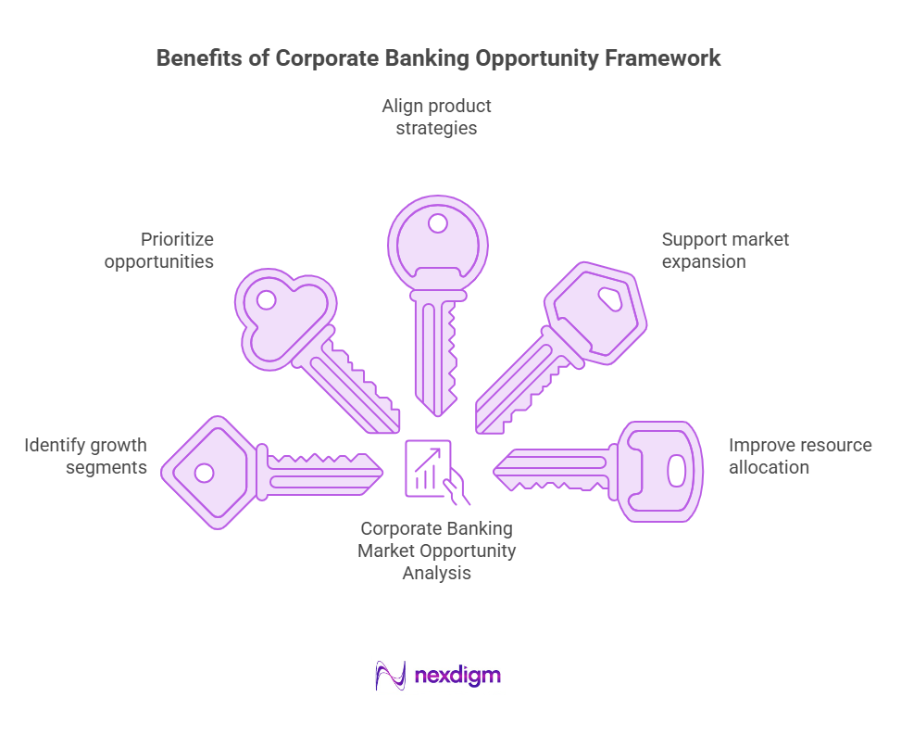
Nexdigm’s framework helps financial institutions move beyond broad market indicators to identify the specific drivers of corporate banking demand. By evaluating credit, cash management, trade, and treasury opportunities together, organizations can make more targeted investment decisions and allocate resources more effectively.
Its key benefits include:
- Identifying high-potential growth segments across industries, business sizes, and markets.
- Prioritizing opportunities based on demand, profitability, and competitive intensity.
- Aligning product strategies with evolving corporate client needs.
- Supporting market entry and expansion decisions with data-driven insights.
- Improving resource allocation by focusing investments on the most attractive opportunity areas.
This integrated approach provides a clearer understanding of where value is being created and how institutions can capture it effectively.
Nexdigm’s Case
A commercial bank used Nexdigm’s Corporate banking market opportunity analysis to identify credit, cash-management, trade, and treasury opportunities. Within 12 months, qualified corporate leads increased 30%, cross-product adoption rose 22%, treasury-service penetration improved 18%, and relationship revenue increased 16%, supporting stronger corporate growth and client retention.
To take the next step, simply visit our Request a Consultation page and share your requirements with us.
Harsh Mittal
+91-8422857704