

Corporate training budgets are under pressure to prove their value. A programme may receive positive feedback from employees, yet still struggle to secure another year’s funding if managers cannot connect it to performance, compliance or business priorities.
The spending opportunity is shifting towards training that solves an identifiable workforce problem. For providers, the task is to understand which gaps employers are trying to close, who controls the budget and what evidence will justify continued investment.
Corporate Training Market Trends: What Is Driving Employer Demand?
The World Economic Forum’s Future of Jobs Report 2025 found that 63% of surveyed employers considered skills gaps a major barrier to business transformation between 2025 and 2030. Employers also expected 39% of workers’ existing skill sets to change or become outdated over that period.
These findings help explain why workforce development is becoming a strategic concern rather than a discretionary employee benefit. Businesses introducing new software, automating processes or changing operating models need employees who can use those systems effectively. Hiring alone may not close the gap quickly enough.
Training priorities differ by sector. Financial services may focus on cybersecurity, regulatory requirements and data analysis. Manufacturers may need automation, maintenance and quality-control capabilities. Customer-facing businesses may invest in digital sales, customer experience and frontline management.
The demand signal is not simply that organisations want more training. They need specific capabilities within a defined timeframe.
Where Corporate Training Budgets Are Most Likely to Go
Several categories warrant close attention when assessing employer demand.
- AI and digital skills: Practical training in AI tools, data literacy, cybersecurity and digital workflows, particularly where new systems are being introduced.
- Role-specific technical capability: Training in equipment, software, industry standards and specialised operational tasks.
- Leadership and change management: Preparing managers to lead teams through technology adoption, restructuring and new ways of working.
- Compliance and risk: Mandatory learning linked to regulatory obligations, information security, workplace safety or professional standards.
- Communication and problem-solving: Skills that support collaboration, customer interactions and decision-making across increasingly digital workplaces.
These categories should not be treated as equally attractive. Mandatory compliance training may offer recurring demand but face intense price competition. Specialised technical programmes may command higher fees but require expert instructors and more expensive content development.
Employer size matters, too. Large organisations can support structured learning programmes and enterprise licences. Smaller companies may prefer short courses, external training partners or practical workshops that minimise time away from work.
Corporate Training Market Opportunity Analysis: Understanding the Buyer
A Corporate training market opportunity analysis should examine the purchasing process, not just the number of employees who might need training.
The budget owner could sit in human resources, learning and development, IT, operations, compliance or a business unit. Each has different criteria. HR may focus on workforce capability and participation, while an operations head may require evidence of fewer errors, better productivity or faster onboarding.
Providers should establish how training needs are identified, whether budgets are centralised, how vendors are approved and what outcomes buyers expect. Procurement cycles can be lengthy, especially when programmes involve sensitive company data, customised content or multiple locations.
The delivery model affects profitability. Live instructor-led sessions can be effective but require scheduling and trainer capacity. Self-paced learning can reach more employees at lower marginal cost, provided engagement remains strong. Blended programmes combine flexibility with human support, although they introduce additional coordination costs.
Corporate Training Sales Strategy Framework
The Corporate Training Market Entry Framework helps providers concentrate on employer segments with credible purchasing potential.
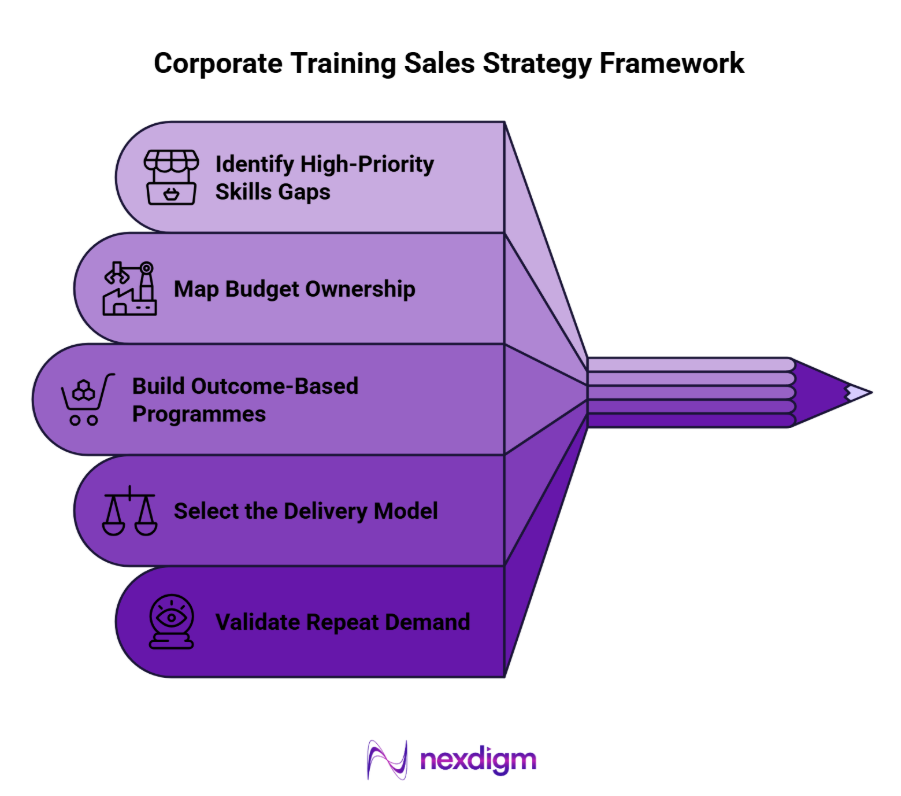
- Identify High-Priority Skills Gaps: Link training needs to digitalisation, business plans, regulatory requirements and role changes.
- Map Budget Ownership: Determine who commissions training, who approves expenditure and how vendors are selected.
- Build Outcome-Based Programmes: Define measurable goals such as time to proficiency, assessment performance or reduced operational errors.
- Select the Delivery Model: Compare instructor-led, digital and blended formats against cost, scale and learner requirements.
- Validate Repeat Demand: Assess renewal potential, employee coverage, ongoing skill needs and customer acquisition costs.
The most attractive opportunity is often a recurring business problem rather than a broad training category. Providers that understand the problem can design a more relevant offer and make a stronger case for continued spending.
Nexdigm Case Study: Identifying Corporate Training Priorities
Nexdigm assessed training opportunities across 32 employers in manufacturing, financial services and technology. Digital skills, cybersecurity and role-specific technical training emerged as recurring requirements. Of 15 programme concepts reviewed, seven met the initial criteria for buyer demand, delivery feasibility and measurable outcomes, forming the shortlist for commercial validation.
To take the next step, simply visit our Request a Consultation page and share your requirements with us.
Harsh Mittal
+91-8422857704