

Cost benchmarking shipping and logistics operations is a key competitive intelligence approach that helps companies compare their cost structures, freight rates, route expenses, warehousing costs, fuel impact, vendor pricing, and operational overheads against competitors and industry peers. By analyzing where competitors achieve lower costs or higher efficiency, businesses can identify pricing gaps, margin improvement opportunities, and cost-control levers.
This enables logistics companies to optimize vendor contracts, improve route planning, reduce avoidable expenses, and strengthen profitability while maintaining service quality. In a cost-sensitive logistics market, benchmarking provides actionable insights for better pricing, operational efficiency, and competitive positioning.
Recent data highlights the pressure on logistics profitability. U.S. business logistics costs reached USD 2.58 trillion in 2025, equal to 8.8% of GDP, up from USD 2.45 trillion. Transportation remains the largest cost component, accounting for about 63% of total logistics costs. These figures show why cost benchmarking shipping and logistics operations is critical for identifying freight-rate gaps, vendor inefficiencies, and cost-saving opportunities.
Competitive Pricing Intelligence for Shipping and Logistics Profitability
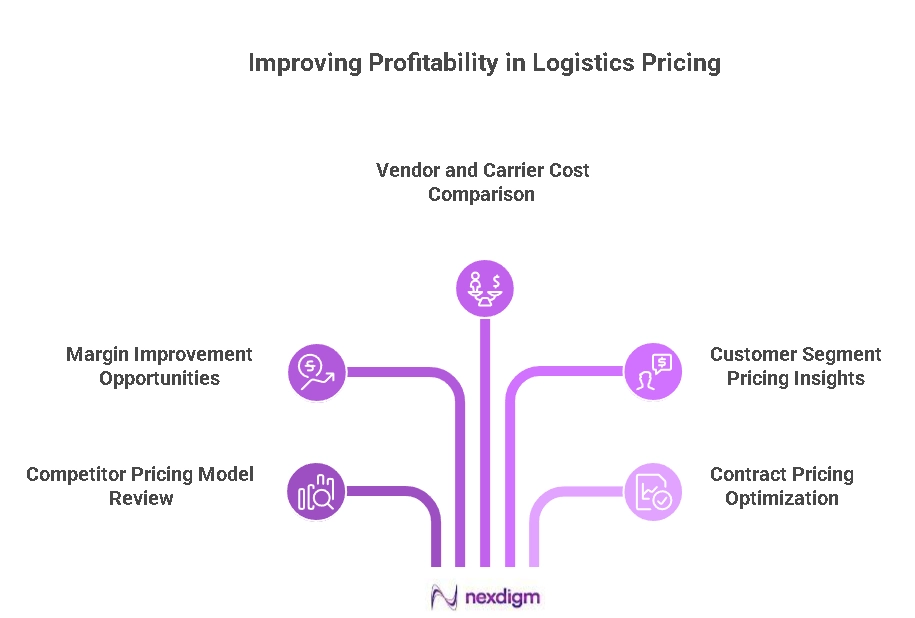
Competitive pricing intelligence for shipping and logistics profitability analyzes competitor pricing, freight rates, surcharges, and service costs to identify pricing gaps, improve margins, optimize contracts, and strengthen market competitiveness:
-
Competitor Pricing Model Review
Assesses how competitors structure pricing through fixed rates, dynamic pricing, volume discounts, and contract terms.
-
Margin Improvement Opportunities
Identifies underpriced services, high-cost routes, and pricing adjustments that can improve profitability.
-
Vendor and Carrier Cost Comparison
Benchmarks carrier, vendor, and third-party logistics costs to support stronger negotiation and sourcing decisions.
-
Customer Segment Pricing Insights
Evaluates pricing differences by customer type, shipment volume, geography, and service requirements.
-
Contract Pricing Optimization
Reviews contract rates, renewal terms, escalation clauses, and discount structures to improve revenue realization.
Nexdigm’s Actionable Insights for Vendor Negotiation and Cost Control
Nexdigm’s Actionable Insights for Vendor Negotiation and Cost Control helps logistics companies assess vendor pricing, contract terms, freight rates, surcharges, and service costs against market benchmarks. These insights support stronger negotiations, identify overpayments or cost leakages, improve vendor selection, and help businesses control logistics expenses while protecting margins and operational efficiency.
Nexdigm’s Strategic Cost Optimization Recommendations for Logistics Operations
Nexdigm’s Strategic Cost Optimization Recommendations for Logistics Operations help identify cost-saving opportunities across freight, warehousing, vendors, routes, and contracts to improve efficiency, reduce leakages, and protect margins.
-
Procurement Savings Levers
Identifies opportunities through vendor consolidation, competitive bidding, rate-card standardization, and improved procurement governance.
-
Billing Accuracy Review
Checks freight invoices, tax components, duplicate charges, incorrect rates, and billing exceptions to prevent avoidable overpayments.
-
Load and Capacity Utilization
Reviews truckload usage, container fill rates, shipment consolidation, empty runs, and capacity planning to reduce unit costs.
-
Service-Level Cost Alignment
Assesses whether premium services, faster delivery commitments, and special handling costs are justified by customer value.
-
Performance-Based Vendor Management
Links vendor payments, penalties, incentives, and renewals to delivery performance, claims, service quality, and cost efficiency.
Nexdigm’s case:
Nexdigm collaborated with a global logistics and healthcare client, where Nexdigm evaluated logistics operations and cost performance through benchmarking and analytics, identifying opportunities such as smarter palletization and inventory pruning. The engagement indicated potential 60% cost savings, 89% reduction in manual order-receiving costs, and over AUD 0.8 million in annual savings, supported by dashboards for real-time cost visibility.
To take the next step, simply visit our Request a Consultation page and share your requirements with us.
Harsh Mittal
+91-8422857704