

Courier pricing feasibility research helps delivery networks determine whether service rates can support profitable expansion across markets competing on speed, coverage, and customer expectations. Courier pricing feasibility research services combine pricing analysis with market benchmarking, route economics, demand forecasting, cost-to-serve assessment, delivery density, and competitor intelligence.
By assessing shipment volumes, last-mile costs, service tiers, geographic reach, and pricing structures, businesses can identify commercially viable models, strengthen margin protection, improve network planning, and develop scalable courier strategies aligned with changing consumer behavior and competitive delivery environments across regional and urban markets.
Recently, a courier network used pricing feasibility research and route-based pricing models to optimize delivery economics; results depicted increased on-time deliveries by 14% and reduced last-mile costs by 12%. The initiative strengthened coverage planning, quotation accuracy, and commercial pricing analysis across competitive markets.
Courier Pricing Analysis Strategies for Speed-Led Market Competition
Courier pricing analysis evaluates delivery urgency, route density, service costs, customer expectations, and competitor rates to establish profitable prices and support scalable network performance across markets. Some important aspects of courier pricing analysis are:
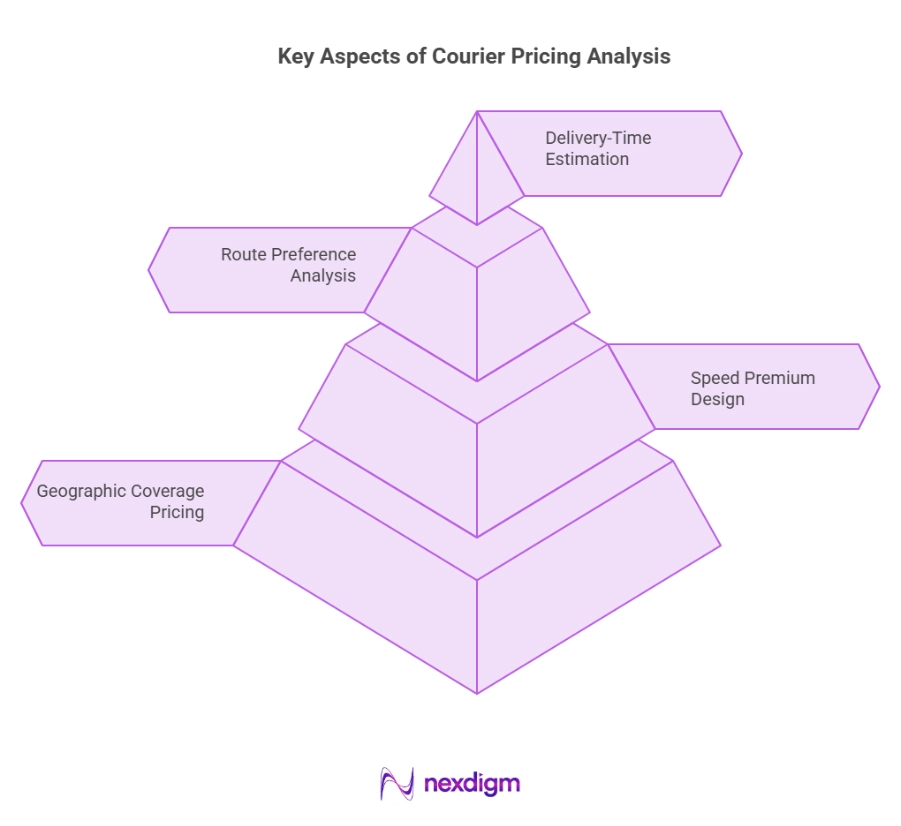
- Delivery-Time Estimation: Same-day, next-day, scheduled, and express services are compared by resource intensity, operational complexity, and customer value to establish differentiated prices for each delivery commitment.
- Route Preference Analysis: Shipment concentration, stop frequency, travel distance, and delivery clusters are analyzed to identify areas where higher route density supports competitive rates and stronger margins.
- Speed Premium Design: Faster pickup, priority sorting, dedicated capacity, and guaranteed delivery windows are translated into structured premiums that reflect additional operational effort and measurable customer value.
- Geographic Coverage Pricing: Pricing analysis analyzes urban centers, suburban zones, remote locations, where difficult service areas receive differentiated rates based on distance, accessibility, shipment density, and required delivery of resources.
Nexdigm’s Data-Led Guidance for Speed-Based Courier Pricing Analysis
Nexdigm combines courier market data, route economics, delivery-speed insights, and competitor benchmarks to develop responsive pricing that protects margins, strengthens service positioning, improves coverage, and supports scalable network growth sustainably. This strategic approach helps businesses with:
- Higher route profitability
- Better last-mile margins
- Faster quotation decisions
- Improved delivery-zone pricing
- Stronger competitor positioning
Such data-led guidance enables courier businesses to price delivery speed accurately, protect profitability, strengthen market competitiveness, and scale coverage through commercially disciplined decisions.
Nexdigm’s Integrated Speed-Based Courier Pricing and Coverage Framework
Nexdigm’s integrated framework combines delivery-speed economics, route intelligence, coverage analysis and pricing governance to strengthen courier margins, improve service differentiation, and support scalable network expansion across markets. Important features of the framework model are:
- Digital Convenience Valuation: Live tracking, automated notifications, delivery rescheduling, electronic proof, and self-service booking are evaluated as value features can support differentiated courier pricing.
- Failed-Delivery Recovery Model: Reattempts, address errors, recipient absence, returns, and redirection activities are incorporated into pricing rules, reducing margin leakage from unsuccessful first-time delivery outcomes.
- First-Attempt Success Measure: Address accuracy, recipient availability, communication quality, delivery timing, and location access are analyzed to improve first-attempt completion and reduce costly re-delivery requirements.
- Pickup Density Assessment: Collection volumes, pickup windows, customer locations, driver routes, and consolidation opportunities are assessed to reduce pickup costs and establish competitive origin-based pricing structures.
Nexdigm’s Case
Nexdigm supported a courier operator with route intelligence, capacity-based pricing, and service-tier optimization. The initiative reduced fuel costs by 15%, improved on-time arrivals by 35%, strengthened delivery reliability, enhanced route profitability, and supported more competitive pricing across expanding coverage areas.
To take the next step, simply visit our Request a Consultation page and share your requirements with us.
Harsh Mittal
+91-8422857704