

Courier procurement expenditure is often spread across multiple service types, delivery regions, business units and logistics providers. Organisations may use different vendors for express shipments, standard parcels, reverse logistics, document delivery and specialised consignments.
Although this arrangement can provide flexibility, it can also make spending difficult to monitor. Individual departments may negotiate separate rates, select different service levels or use overlapping providers without a consolidated view of total expenditure.
A structured courier procurement spend analysis consulting exercise helps organisations understand where their courier budgets are concentrated, identify cost variations and evaluate whether current supplier arrangements reflect actual delivery requirements.
Understanding Courier Spend Distribution
Courier expenditure is influenced by shipment volume, weight, dimensions, destination, delivery speed and service category.
Express shipments generally involve different pricing structures from standard deliveries. International consignments may include customs-related charges, documentation fees and destination handling costs. Reverse logistics can introduce additional expenditure through return pickups, failed deliveries and shipment reconciliation.
A useful spend analysis should classify courier expenditure across several dimensions:
- Service type: Express, standard, same-day, international, document and reverse logistics.
- Supplier: National courier companies, regional operators, specialised providers and integrated logistics businesses.
- Geography: Domestic zones, metropolitan markets, regional destinations and international trade lanes.
- Shipment profile: Weight, dimensions, parcel category, delivery frequency and handling requirements.
This classification helps procurement teams identify which services and suppliers account for the largest share of expenditure.
Identifying Spend Concentration Across Providers
Supplier concentration can influence both procurement costs and supply chain risk.
An organisation may depend on one national courier provider for most shipments, even when alternative suppliers offer competitive coverage in certain markets. In other cases, businesses may work with too many regional vendors, creating fragmented contracts and reducing their ability to negotiate volume-based rates.
A supplier-level analysis should compare total expenditure, shipment volumes, average cost per shipment, service mix and geographical coverage.
It should also identify whether the same provider is being used across business units under different commercial arrangements.
High spending with a single supplier is not automatically inefficient. The provider may offer superior service coverage or better rates at scale. However, concentration should be reviewed alongside supplier dependency and the availability of alternative providers.
Analysing Service Mix and Shipment Economics
One of the most useful areas of courier spend analysis is the relationship between service selection and actual delivery requirements.
Businesses may use express delivery for shipments that could be handled through standard services without affecting customer commitments. Conversely, selecting a low-cost service for time-sensitive consignments may result in delays, customer complaints or additional operational expenditure.
Shipment-level data can reveal these mismatches.
Procurement teams should examine the distribution of shipments across service categories, the average cost by weight and destination, and the proportion of shipments requiring additional handling.
Other important indicators include:
- Average cost per shipment by service type.
- Percentage of shipments using express delivery.
- Spend on remote-area and fuel surcharges.
- Return-to-origin and failed delivery expenditure.
- Average cost of international versus domestic consignments.
This analysis helps establish whether spending patterns are driven by genuine service requirements or inconsistent procurement practices.
Contractual Leakage and Additional Charges
Courier invoices often contain multiple charges beyond the base shipment rate.
These can include volumetric weight adjustments, fuel surcharges, remote-location fees, address correction charges, cash-on-delivery fees, return handling and additional delivery attempts.
If these charges are not monitored consistently, they can account for a meaningful share of total courier expenditure.
Procurement teams should compare contracted rates against actual invoices and examine whether billing practices align with agreed commercial terms.
They should also review minimum billing weights, rate escalation clauses, shipment exclusions and volume commitments.
A consolidated view of these charges can help identify invoice discrepancies, unnecessary service usage and opportunities for contract renegotiation.
Turning Spend Visibility into Procurement Action
Spend analysis should lead to clear decisions about supplier allocation and service procurement.
Businesses can use the findings to consolidate shipment volumes, negotiate revised rate cards, rationalise overlapping providers or allocate specific service categories to suppliers with stronger capabilities.
The objective is not necessarily to reduce the number of providers. A diversified supplier portfolio may be more appropriate when organisations operate across different geographical markets or require specialised delivery services.
The key is to understand what the organisation is purchasing, how much it is paying and whether the selected service delivers the required performance.
Courier Procurement Spend Analysis Framework
A structured courier procurement spend analysis consulting exercise should include:
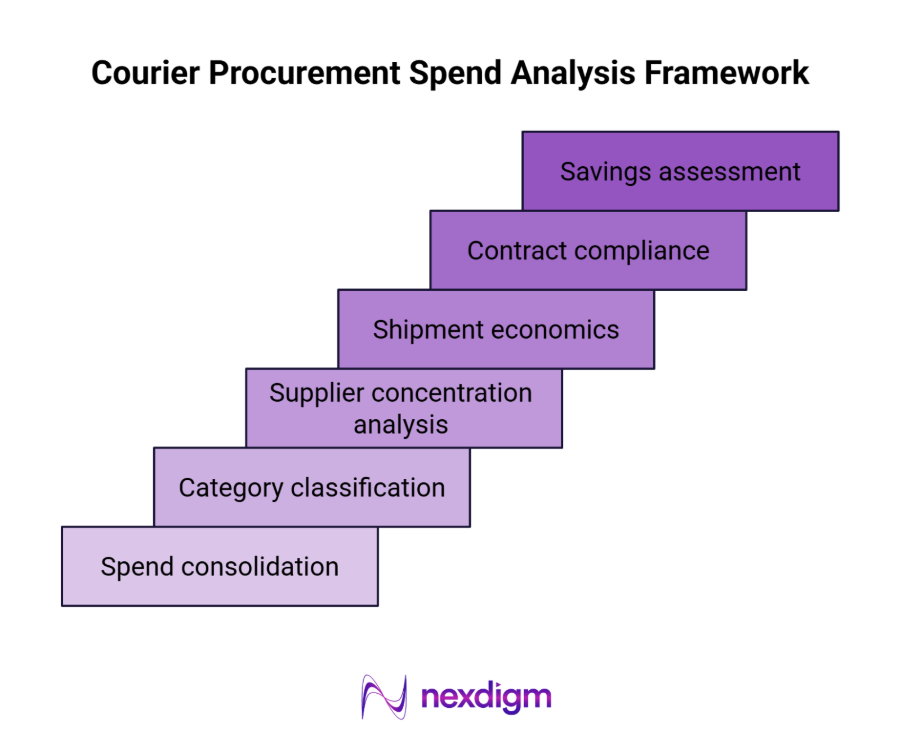
- Spend consolidation: Collect courier invoices, shipment records and contracts across business units.
- Category classification: Segment expenditure by provider, service type, geography and shipment profile.
- Supplier concentration analysis: Identify major providers, spending dependencies and overlapping service coverage.
- Shipment economics: Compare average shipment costs, service utilisation, surcharges and return expenses.
- Contract compliance: Review rate cards, invoice accuracy, volume commitments and additional charges.
- Savings assessment: Identify opportunities through service optimisation, supplier consolidation and commercial renegotiation.
Nexdigm can support organisations through courier spend analytics, supplier benchmarking, invoice-level cost assessments and procurement intelligence. These services help businesses establish spending visibility, identify cost leakage and improve the commercial efficiency of courier sourcing arrangements.
Nexdigm’s Case Study: Mapping Courier Spend and Cost Leakage
Nexdigm analysed courier expenditure across 6 business units, reviewing 18,000 shipments and 9 service categories. The assessment identified 4 major spending concentrations, detected a 12% variation in comparable shipment costs and prioritised 5 procurement optimisation opportunities.
To take the next step, simply visit our Request a Consultation page and share your requirements with us.
Harsh Mittal
+91-8422857704