

Courier networks processing millions of daily shipments require disciplined benchmarking to compare rates, service levels, surcharges, and delivery performance across markets. Effective courier service pricing benchmarking combines pricing analysis with route density, parcel characteristics, labor costs, fuel exposure, delivery speed, and regional demand patterns.
This approach identifies pricing inconsistencies, validates carrier quotations, and highlights opportunities for contract optimization. By aligning rates with cost-to-serve and service outcomes, businesses can maintain competitive delivery pricing across complex domestic and cross-border courier operations worldwide more efficiently.
A recent platform benchmark spanning more than 1.5 billion optimized deliveries reported 20% lower last-mile costs and SLA adherence, indicating that data-led courier pricing analysis can improve rate accuracy, efficiency, service consistency, and overall commercial performance across high-volume markets.
Courier Rate Benchmarking and Pricing Analysis Across Delivery Markets
Courier rate benchmarking and pricing analysis compare delivery charges, carrier performance, surcharges, and operating costs across markets to improve pricing transparency, strengthen negotiations, optimize margins, and support scalable courier networks. Key aspects of courier service pricing analysis are:
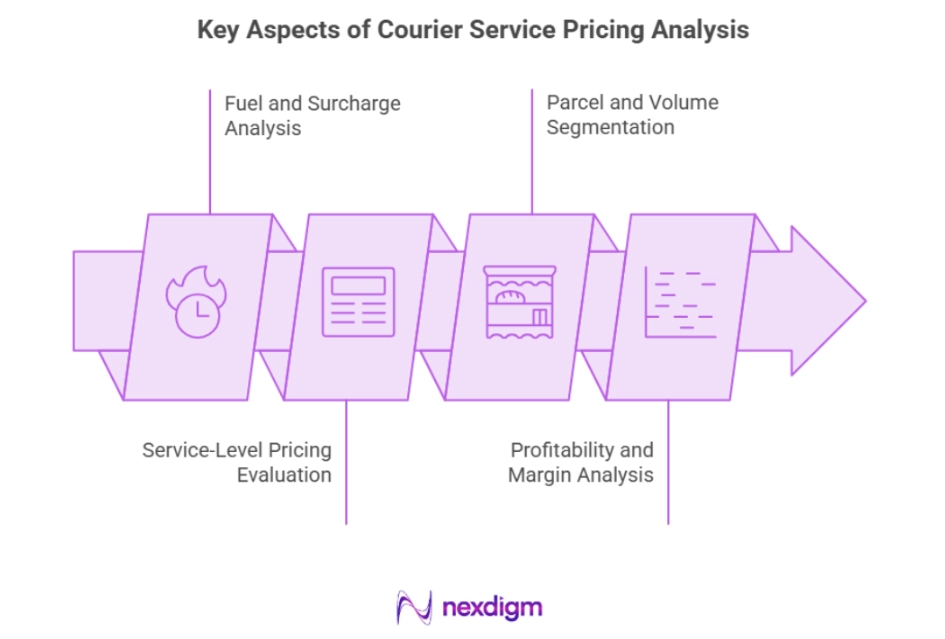
- Service-Level Pricing Evaluation: Courier rates are assessed against delivery speed, reliability, tracking capabilities, and customer expectations, ensuring pricing accurately reflects the value and quality of service provided.
- Fuel and Surcharge Analysis: Fuel costs, peak-demand charges, remote-area fees, and handling surcharges are analyzed to improve pricing accuracy and minimize unexpected expenses across courier operations.
- Parcel and Volume Segmentation: Shipments are categorized by size, weight, order volume, and delivery frequency, enabling businesses to develop pricing strategies tailored to different customer segments.
- Profitability and Margin Analysis: Courier pricing performance is measured across routes, customers, and markets to identify margin leakage and improve long-term commercial sustainability.
Nexdigm’s Commercial Advisory for Courier Service Pricing Analysis
Nexdigm combines pricing analysis, courier service pricing benchmarking, cost-to-serve modeling, market benchmarking, and contract assessment to help businesses optimize courier contracts and delivery rates. By evaluating carrier pricing, regional cost variations, surcharges, and operational performance, Nexdigm enables strategic pricing decisions, strengthens commercial negotiations, improves pricing transparency, and supports sustainable profitability across complex courier networks.
Nexdigm’s Courier Service Pricing Analysis Competitiveness Roadmap
Nexdigm’s courier pricing analysis roadmap combines market benchmarking, cost analysis, service evaluation, and contract intelligence to help businesses improve rate accuracy, strengthen negotiations, and sustain profitable delivery operations. Roadmap steps followed to achieve desirable results are:
- Identify Demand and Delivery Patterns: Nexdigm centralizes carrier rates, contract terms, surcharges, service data, and shipment volumes to create unified visibility across markets, providers, routes, and customer segments.
- Analyze Market Cost Variables: Regional wages, fuel prices, taxes, infrastructure constraints, and delivery density are adjusted to ensure courier rate comparisons reflect genuine efficiency differences rather than local cost distortions.
- Test Commercial Rate Structures: Pricing models are tested against volume shifts, fuel volatility, peak demand, service upgrades, and failed-delivery scenarios to identify contracts vulnerable to margin erosion.
- Redesign Carrier Allocation Outcome: Nexdigm evaluates provider strengths, route coverage, capacity, service consistency, and pricing to determine the most commercially efficient allocation of shipments across courier partners.
- Track Margin Recovery Reviews: Periodic reviews track rate leakage, customer profitability, carrier performance, and contract compliance, enabling businesses to recover lost margins and maintain competitive courier pricing over time.
Nexdigm’s Case
Nexdigm assisted a national courier company in benchmarking rates across markets, reducing surcharge expenses by 13%, shortening average delivery times by 19%, and improving shipment capacity by 24%, creating measurable gains in commercial performance and pricing transparency.
To take the next step, simply visit our Request a Consultation page and share your requirements with us.
Harsh Mittal
+91-8422857704