

Courier services have become an important part of business distribution, supporting e-commerce deliveries, document transportation, retail fulfilment and business-to-business shipments.As customer expectations around delivery speed and tracking increase, organisations must select courier partners capable of providing reliable coverage across their target markets. However, courier providers differ in their geographical reach, delivery infrastructure, shipment handling capabilities, technology platforms and pricing structures.
A supplier offering competitive rates within major cities may have limited coverage in smaller towns or remote delivery locations. For procurement teams, supplier selection requires a detailed understanding of service capabilities across different shipment categories and delivery regions.
Understanding the Courier Supplier Landscape
The courier market includes several provider categories, each serving different delivery requirements.
Express courier companies focus on time-sensitive shipments, offering scheduled delivery services and tracking capabilities. Standard parcel operators generally support broader delivery networks at different service speeds. Regional courier providers may offer stronger local coverage and more flexible arrangements within specific geographical markets.
Specialised providers also operate in segments such as temperature-sensitive shipments, high-value consignments, reverse logistics and document delivery.
In India, providers such as India Post, Blue Dart and DTDC operate across different service models and network structures. Their capabilities should be compared according to actual delivery requirements rather than brand recognition alone.
Comparing Geographical Reach and Delivery Performance
Network coverage is one of the most important considerations in courier procurement.
Organisations need to examine the number of serviceable PIN codes, regional delivery infrastructure, collection points, sorting facilities and last-mile delivery arrangements. Advertised coverage should be distinguished from actual service performance. A provider may accept shipments across a wide geographical area while depending on third-party partners for certain destinations.
Delivery performance should therefore be measured at the PIN-code or regional level wherever shipment data permits. Relevant indicators include on-time delivery percentage, first-attempt delivery success, average transit time, failed delivery frequency, return-to-origin rates and shipment damage.
Published delivery standards can provide an initial reference point, although actual supplier performance should be evaluated using shipment-level data.
Technology and Shipment Visibility
Courier technology influences both operational efficiency and customer experience.
A suitable provider should offer shipment booking, tracking, electronic proof of delivery, delivery notifications and exception reporting. Businesses managing large shipment volumes should also evaluate API connectivity and integration with order management, ERP and e-commerce platforms.
Technology assessment should consider whether shipment information is updated at meaningful operational milestones. A tracking system that provides only booking and final delivery updates offers limited visibility when shipments experience delays or failed delivery attempts.
Reverse logistics is another important requirement. Retailers and e-commerce businesses should evaluate return pickup scheduling, shipment reconciliation, customer notifications and return processing.
Commercial Fit and Supplier Reliability
Courier pricing varies according to shipment weight, dimensions, destination, delivery speed and service category.
Procurement teams should compare volumetric weight calculations, minimum billing weights, remote-area surcharges, fuel adjustments, cash-on-delivery charges and reverse logistics fees.
Contractual arrangements should also address shipment liability, claims procedures, delivery exceptions and service-level commitments.
For businesses with seasonal shipment peaks, capacity flexibility becomes particularly important. Suppliers should demonstrate how they manage additional collection volumes, sorting capacity and last-mile staffing during high-demand periods.
Courier Supplier Evaluation Framework
A structured courier supplier identification and research services exercise should include:
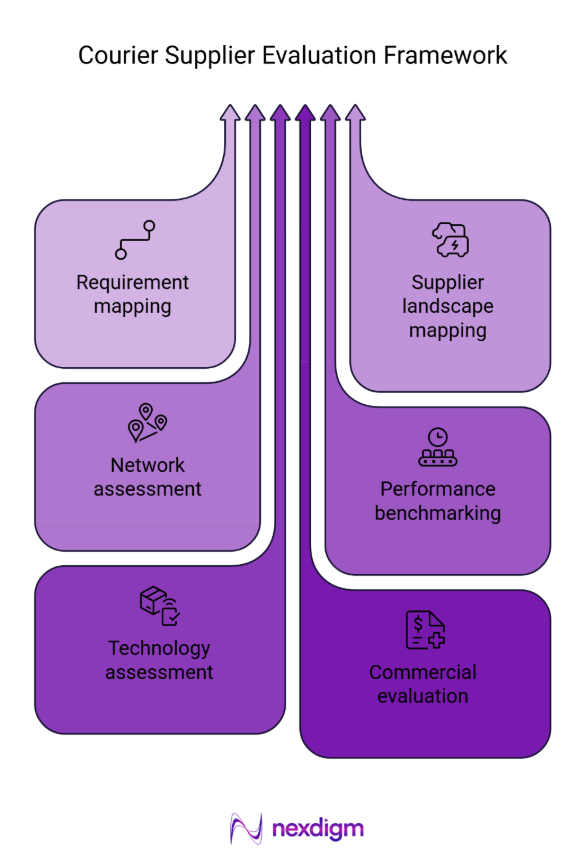
- Requirement mapping: Identify shipment volumes, delivery destinations, service speeds and parcel characteristics.
- Supplier landscape mapping: Identify national, regional, express and specialised courier operators.
- Network assessment: Compare PIN-code coverage, collection infrastructure and last-mile capabilities.
- Performance benchmarking: Evaluate delivery timelines, first-attempt success, damage rates and return-to-origin performance.
- Technology assessment: Review tracking, API integration, electronic proof of delivery and exception management.
- Commercial evaluation: Compare rate cards, surcharges, contractual commitments and claims provisions.
Nexdigm can support organisations through courier market research, supplier identification, geographical coverage analysis and commercial benchmarking.
These services help businesses understand differences between courier providers and identify partners aligned with their distribution requirements.
Nexdigm’s Case Study: Benchmarking Courier Network Performance
Nexdigm assessed 13 courier providers across 6 delivery regions, comparing network coverage, delivery timelines, technology and pricing. The research shortlisted 4 suppliers, identified a 16% variation in comparable shipment costs and established 8 delivery performance benchmarks for procurement decisions.
To take the next step, simply visit our Request a Consultation page and share your requirements with us.
Harsh Mittal
+91-8422857704