

A well-designed credit card fee pricing strategy directly influences customer acquisition, card activation, spending behavior, and long-term retention. Through comprehensive Pricing Analysis Services, issuers can evaluate annual fees, joining charges, late-payment penalties, foreign transaction costs, balance-transfer fees, waiver thresholds, rewards, and competitor offerings.
These insights reveal customer sensitivity, affordability barriers, revenue opportunities, and attrition risks across cardholder segments. Effective fee analysis supports competitive pricing benchmarking, customer value segmentation, portfolio profitability optimization, and retention planning. By aligning fees with benefits and customer expectations, issuers can strengthen applications, encourage usage, improve loyalty, protect margins, and sustain profitable credit card growth.
An illustrative 13% improvement in credit card fee accuracy can strengthen customer acquisition and retention. Pricing Analysis Services assess annual fees, waiver thresholds, penalties, rewards, and competitor offers, helping issuers increase applications, reduce attrition, protect margins, and optimize portfolio profitability.
Pricing Optimization for Card Fees and Customer Lifetime Value
Pricing optimization aligns card fees, customer value, competitive positioning, and portfolio profitability to improve acquisition, strengthen retention, maximize lifetime value, and support sustainable revenue growth through data-driven pricing decisions. Some major dimensions in focus are:
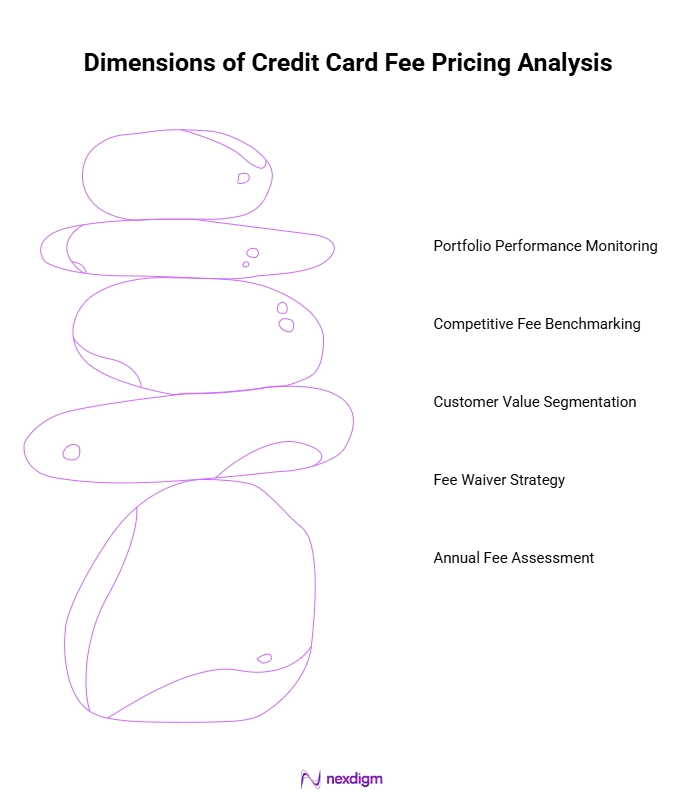
- Annual Fee Optimization: Assess annual fees against customer benefits, usage patterns, and competitor offerings. Benefits include stronger acquisition, higher perceived value, improved renewals, and sustainable fee revenue.
- Fee Waiver Strategy: Evaluate spending thresholds, loyalty criteria, and promotional waivers to encourage higher card usage. Benefits include increased engagement, improved retention, enhanced customer satisfaction, and greater lifetime value.
- Customer Value Segmentation: Segment cardholders by spending behavior, profitability, credit profile, and engagement levels. Benefits include personalized pricing, targeted offers, stronger loyalty, and optimized portfolio performance.
- Competitive Fee Benchmarking: Compare joining fees, renewal charges, foreign transaction fees, and service fees across issuers. Benefits include improved market positioning, competitive differentiation, stronger customer acquisition, and margin protection.
- Portfolio Performance Monitoring: Track fee income, card usage, renewal rates, attrition, customer lifetime value, and profitability. Benefits include continuous pricing refinement, improved retention, higher portfolio returns, and long-term sustainable growth.
Nexdigm’s Expertise in Card Fee and Customer Lifetime Value Optimization
Nexdigm’s Pricing Analysis Services enable card issuers to optimize fee structures while maximizing customer lifetime value through credit card fee pricing strategy, annual fee optimization, competitive fee benchmarking, customer lifetime value analysis, pricing intelligence, and portfolio profitability analysis. By evaluating customer behavior, spending patterns, fee sensitivity, competitor offerings, rewards economics, and market trends, Nexdigm helps organizations refine pricing decisions, improve customer acquisition, strengthen retention, increase fee revenue, and achieve sustainable portfolio growth.
Nexdigm’s Integrated Card Fee and Lifetime Value Optimization Model
Nexdigm’s model combines fee benchmarking, customer segmentation, behavioral analytics, competitive intelligence, and portfolio economics to optimize card pricing, strengthen retention, increase lifetime value, and support sustainable profitability. Data Driven steps followed by Nexdigm’s experts are:
Step 1: Segment Cardholders by Value
Classify customers by spending, profitability, engagement, credit quality, and retention potential to design differentiated fee structures aligned with expected lifetime value.
Step 2: Benchmark Fees and Benefits
Compare annual fees, joining charges, waivers, rewards, and service benefits across issuers to identify competitive gaps and strengthen customer value propositions.
Step 3: Optimize Fee and Waiver Structures
Design fee levels, spending thresholds, renewal waivers, and promotional incentives that encourage card usage, support retention, and protect recurring portfolio revenue.
Step 4: Model Customer Lifetime Value
Evaluate acquisition costs, fee income, interchange revenue, rewards expenses, credit losses, and retention duration to estimate profitability across cardholder segments.
Step 5: Monitor Performance and Refine Pricing
Track renewals, attrition, spending, fee revenue, reward usage, and lifetime value to continuously refine pricing and strengthen sustainable portfolio performance.
Nexdigm’s Case
Nexdigm helped a card issuer redesign its fee strategy using pricing analytics and customer segmentation. The initiative increased customer lifetime value by 17%, improved annual renewal rates by 14%, and enhanced fee revenue by 11%, driving sustainable portfolio growth.
To take the next step, simply visit our Request a Consultation page and share your requirements with us.
Harsh Mittal
+91-8422857704