

Credit card interest rate benchmarking helps issuers compare annual percentage rates, balance transfer offers, penalty rates, and promotional terms while competing for high-value customers. Through comprehensive Pricing Analysis Services, financial institutions can evaluate customer risk profiles, revolving balances, payment behavior, competitor cards, reward structures, fees, and portfolio economics.
These insights identify pricing gaps, profitable rate corridors, acquisition opportunities, and retention risks across premium and affluent segments. Effective benchmarking supports interest rate optimization, competitive pricing intelligence, customer segmentation, portfolio profitability analysis, and cardholder value management, enabling issuers to strengthen acquisition, protect margins, improve loyalty, and sustain responsible portfolio growth.
An illustrative 12% improvement in credit card rate accuracy can strengthen high-value customer acquisition. Pricing Analysis Services assess competitor APRs, risk profiles, revolving balances, rewards, and payment behavior, helping issuers improve conversions, protect margins, strengthen retention, and optimize portfolio profitability.
Pricing Analysis for Credit Card APRs, Risk, and Retention
Pricing analysis aligns credit card APRs, customer risk, repayment behavior, and competitive positioning to optimize profitability, attract quality customers, strengthen retention, and support sustainable portfolio growth. Some core steps of it are:
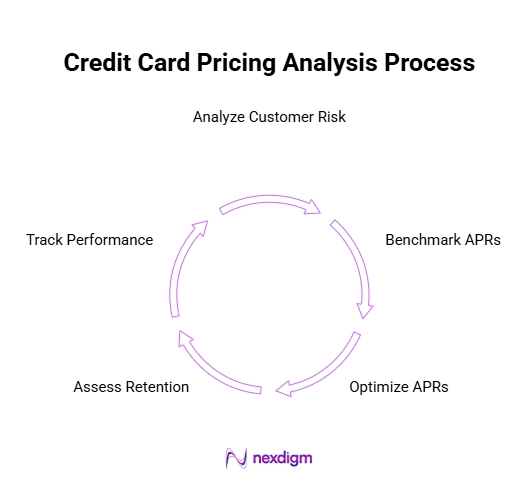
Step 1: Analyze Customer Risk Profiles
Evaluate credit scores, repayment history, income stability, spending patterns, and utilization levels to segment cardholders and establish risk-adjusted APR strategies.
Step 2: Benchmark APRs and Competitor Offers
Compare interest rates, promotional APRs, annual fees, balance transfer offers, and reward programs across issuers to identify pricing opportunities and competitive advantages.
Step 3: Optimize APRs for Customer Value
Balance funding costs, expected losses, revolving balances, and customer affordability to develop pricing structures that maximize profitability without discouraging card usage.
Step 4: Assess Retention and Spending Behavior
Monitor repayment patterns, transaction frequency, reward redemption, account activity, and customer engagement to refine pricing strategies that encourage loyalty and reduce attrition.
Step 5: Track Portfolio Performance and Refine Pricing
Measure portfolio yields, delinquency rates, customer lifetime value, competitive movements, and profitability metrics to continuously optimize APRs and strengthen long-term portfolio performance.
Nexdigm’s Role in Optimizing Card APRs and Customer Retention
Nexdigm’s Pricing Analysis Services help credit card issuers optimize APR strategies while balancing customer risk, retention, and portfolio profitability. Leveraging credit card pricing analysis, credit card interest rate benchmarking, risk-based pricing, competitive pricing intelligence, APR optimization, and portfolio profitability analysis, Nexdigm evaluates customer behavior, repayment trends, competitor offerings, and market dynamics to refine pricing decisions, improve cardholder retention, strengthen margins, and support sustainable portfolio growth.
Nexdigm’s Credit Card APR and Customer Retention Blueprint
Nexdigm’s blueprint combines customer risk, APR benchmarking, repayment behavior, portfolio economics, and retention analytics to optimize card pricing, protect margins, strengthen loyalty, and support sustainable portfolio growth. Data Driven steps followed by Nexdigm’s experts are:
Step 1: Segment Cardholders by Risk and Value
Classify cardholders by credit quality, income, repayment history, utilization, and lifetime value to establish relevant APR bands and retention priorities.
Step 2: Benchmark APRs and Market Offers
Compare standard, promotional, balance-transfer, and penalty APRs alongside fees and rewards to identify pricing gaps and strengthen competitive market positioning.
Step 3: Design Risk-Aligned APR Structures
Set differentiated APRs using default probability, revolving balances, funding costs, and affordability to balance customer value, portfolio risk, and profitability.
Step 4: Develop Targeted Retention Offers
Use fee waivers, APR reductions, balance-transfer incentives, and personalized rewards to retain valuable cardholders and reduce switching or account closure risks.
Step 5: Monitor Outcomes and Refine Pricing
Track attrition, repayment trends, utilization, portfolio yields, delinquencies, and competitor movements to continuously refine APR strategies and strengthen long-term retention.
Nexdigm’s Case
Nexdigm helped a leading card issuer optimize APR strategies and customer retention. The initiative improved cardholder retention by 16%, increased portfolio profitability by 12%, and reduced pricing decision cycles by 21%, enabling stronger competitive positioning and sustainable portfolio growth.
To take the next step, simply visit our Request a Consultation page and share your requirements with us.
Harsh Mittal
+91-8422857704