

Credit card pricing competitiveness analysis helps banks compare annual fees, interest rates, rewards, waivers, eligibility criteria, and customer benefits across leading institutions. Integrated with comprehensive pricing analysis, it reveals market gaps, strengthens product positioning, and supports balanced decisions across premium, rewards, cashback, travel, and mass-market portfolios.
Banks can use these insights to refine card propositions, improve pricing transparency, protect margins, and align offers with customer expectations. This evidence-based approach also supports stronger acquisition, retention, portfolio governance, and sustainable growth across increasingly competitive credit card markets worldwide today and beyond globally.
Federal Reserve data show 82% of U.S. adults held a credit card in 2025, while 8.0 million cards were originated in October 2025. This scale supports credit card pricing competitiveness analysis for sharper positioning, customer value, and profitable portfolio decisions.
Strategic Credit Card Pricing Analysis for Competitive Banking Markets
Strategic credit card pricing helps issuers balance fees, interest rates, rewards, customer value, and portfolio returns through evidence-based strategies tailored to changing banking markets and competitive consumer expectations worldwide. Major strategies used during analytical process are:
- Co-Branded Partnership Pricing Strategy: Evaluate partner-funded benefits, merchant economics, rewards contributions, and customer overlap to create sustainable co-branded card pricing with differentiated benefits and stronger acquisition potential.
- Risk-Based Pricing Strategy: Use credit quality, repayment behavior, utilization, and loss expectations to set appropriate rates and fees while balancing customer affordability, portfolio risk, and profitability objectives.
- Card Reactivation Strategy: Use targeted fee waivers, rewards accelerators, and personalized offers to reactivate dormant cardholders, increase transaction activity, and improve portfolio productivity without high acquisition spending.
- Credit Limit Optimization Strategy: Align credit limits with customer risk, spending behavior, income, and portfolio value to support responsible growth, higher utilization, improved engagement, and stronger risk-adjusted profitability.
Nexdigm’s Tailored Pricing Analysis Expertise for Credit Card Issuers
Nexdigm delivers tailored credit card pricing analysis through competitive benchmarking, customer segmentation, portfolio analytics, and market intelligence. With data-driven approach, it helps issuers optimize annual fees, interest rates, rewards, waivers, and promotional offers. These insights strengthen credit card pricing competitiveness, improve customer value, support portfolio profitability, enhance retention, and enable sustainable growth across premium, rewards, cashback, travel, and mass-market card segments.
Nexdigm’s Pricing Analysis Framework Model for Credit Card Issuers
Nexdigm’s credit card pricing framework guides issuers through proposition diagnostics, value architecture, behavioral testing, commercial calibration, and governance to strengthen competitiveness, profitability, customer relevance, and portfolio resilience across markets worldwide. Key framework steps followed are:
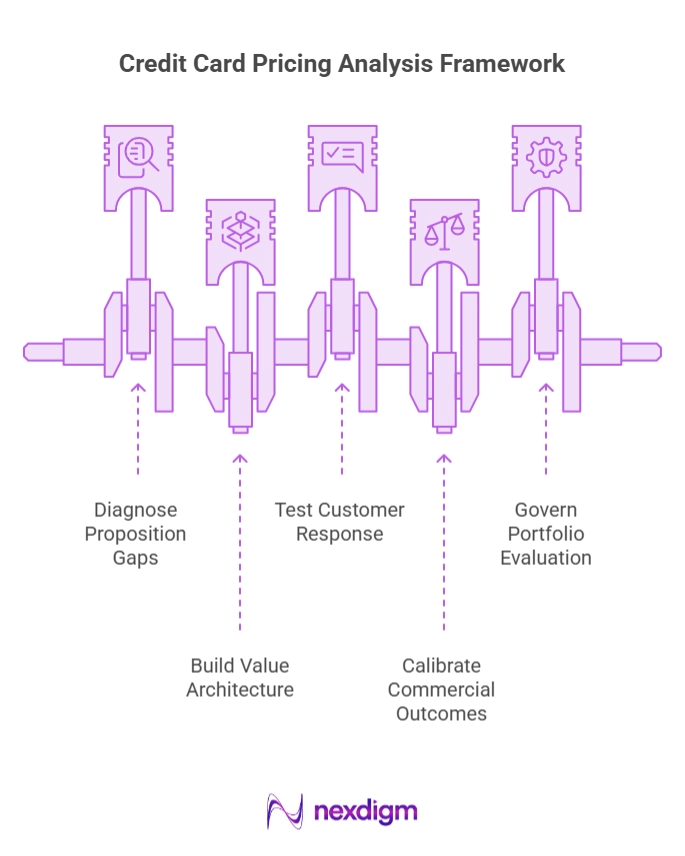
- Diagnose Proposition Gaps: Nexdigm reviews card features, fees, rewards, credit terms, and customer journeys to identify weak value propositions, duplicated offerings, and unmet market needs across portfolios effectively.
- Build Value Architecture: Benefits, rewards, service privileges, and pricing are structured into clear value tiers, helping issuers create distinct premium, rewards, cashback, travel, and mass-market propositions clearly today.
- Test Customer Response: Concept testing, behavioral analysis, and willingness-to-pay assessment reveal how target customers respond to alternative fees, rewards, rates, waivers, and benefit combinations before market launch confidently.
- Calibrate Commercial Outcomes: Revenue, cost, risk, utilization, and retention impacts are evaluated together to determine pricing structures that support sustainable economics without weakening competitiveness or customer appeal effectively.
- Govern Portfolio Evaluation: Nexdigm establishes review triggers, performance metrics, decision rights, and refresh cycles so issuers can adapt pricing as competitors, regulations, costs, and customer expectations evolve continuously.
Nexdigm’s Case
Nexdigm supported a credit card service provider in diagnosing proposition gaps, testing customer willingness to pay, and calibrating fees, rewards, rates, and benefits across portfolio tiers. The engagement informed targeted pricing changes. The results included a 13% rise in card activation, 10% higher retention, and a 12% improvement in portfolio revenue within nine months.
To take the next step, simply visit our Request a Consultation page and share your requirements with us.
Harsh Mittal
+91-8422857704