

Credit card markets are increasingly shaped by changing consumer preferences, interest rates, annual fees, and reward programs, making pricing strategies a critical area of investigation. This credit card pricing elasticity research explores how customers respond to variations in pricing components and how financial institutions optimize profitability through data-driven decisions.
Using pricing analysis techniques, the study evaluates the elasticity of demand across different customer segments and product categories. It further examines the relationship between pricing structures, customer retention, and competitive positioning in an evolving financial services landscape.
Recent industry reports show that credit cards account for more than 30% of retail transactions in many developed economies. Studies suggest that enhanced reward structures can increase card usage by 15–20%, while optimized pricing models improve customer retention and long-term profitability.
Pricing Analysis of Consumer Behavior in Credit Card Markets
Pricing analysis of consumer behavior in credit card markets examines how interest rates, fees, rewards, credit limits, and repayment terms influence customer choices, usage patterns, loyalty, and overall profitability outcomes. Core elements in focus are:
- Repayment Behavior: Examine how minimum payment requirements, grace periods, penalty rates, and installment options affect payment frequency, revolving balances, delinquency, and customer financial decisions.
- Competitor Pricing Comparison: Compare card pricing across financial institutions to identify market gaps, competitive advantages, customer switching triggers, and opportunities for stronger product positioning.
- Perceived Value of Credit Cards: Analyze how consumers balance costs against rewards, convenience, security, credit access, and service quality when evaluating the overall value of a card.
- Customer Retention and Pricing: Investigate how pricing changes influence card cancellations, inactivity, loyalty, product upgrades, and the likelihood of customers maintaining long-term banking relationships.
How Nexdigm Supports Strategic Pricing Analysis in Credit Card Markets
Nexdigm supports credit card issuers through strategic pricing analysis, market benchmarking, customer segmentation, and price elasticity assessment. Its advisory expertise helps evaluate interest rates, annual fees, rewards, and consumer behavior to strengthen pricing decisions. By applying data-driven pricing strategies, competitive pricing analysis, and profitability optimization, Nexdigm enables financial institutions to improve customer value, market positioning, revenue performance, and long-term growth.
Nexdigm’s End-to-End Framework Model for Credit Card Pricing Analysis
Nexdigm’s framework guides credit card issuers through structured pricing analysis, customer segmentation, market benchmarking, strategy design, implementation, and performance monitoring to improve competitiveness, profitability, and consumer value sustainably. Key framework steps are:
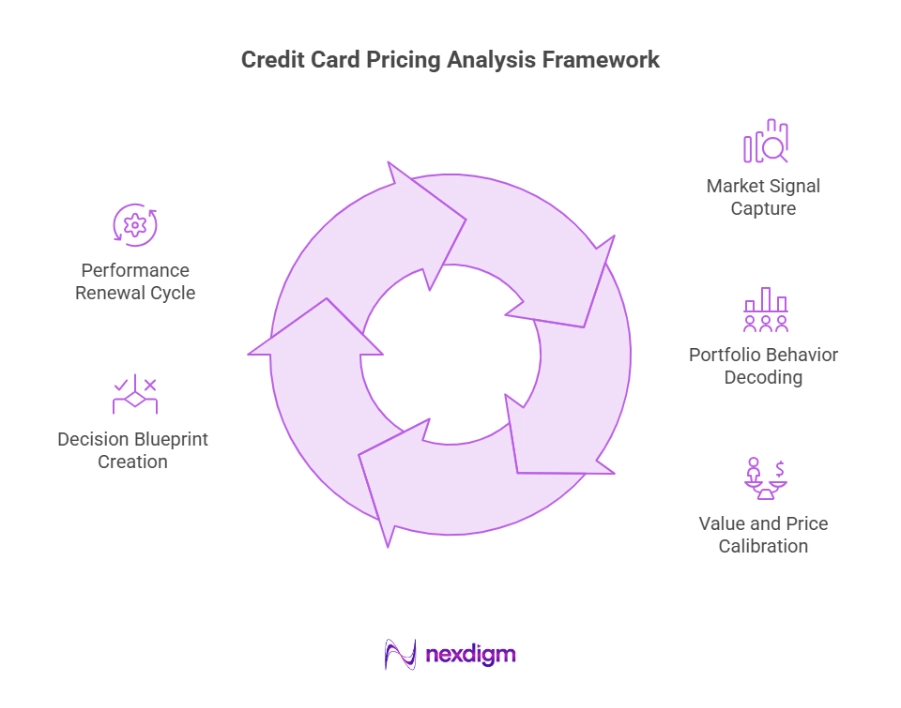
- Market Signal Capture: Gather competitor pricing, interest-rate trends, fee structures, reward benchmarks, regulatory developments, and consumer expectations to establish a reliable market intelligence foundation.
- Portfolio Behavior Decoding: Analyze transaction activity, revolving balances, repayment habits, attrition patterns, credit quality, and product engagement to uncover profitable and underserved customer segments.
- Value and Price Calibration: Determine appropriate rates, fees, rewards, and benefits by balancing customer willingness to pay, expected usage, credit risk, service costs, and profitability.
- Decision Blueprint Creation: Translate analytical findings into segment-specific pricing rules, product propositions, governance standards, approval mechanisms, and implementation priorities for consistent decision-making.
- Performance Renewal Cycle: Monitor acquisition, utilization, retention, revenue, reward costs, and risk outcomes, then refine pricing decisions through periodic testing and continuous portfolio optimization.
Nexdigm’s Case
In a recent engagement, Nexdigm supported a credit card issuer in redesigning rates, fees, and rewards using customer segmentation and pricing elasticity analysis. The resulting strategy improved card activation by 14%, increased transaction value by 11%, reduced attrition, and strengthened portfolio profitability within twelve months of implementation.
To take the next step, simply visit our Request a Consultation page and share your requirements with us.
Harsh Mittal
+91-8422857704