

Credit card pricing feasibility analysis helps financial institutions determine sustainable pricing structures across rewards, premium, and mass-market card segments. Through specialized Pricing Analysis Services, issuers can evaluate annual fees, interest rates, reward costs, interchange revenue, customer acquisition expenses, credit risk, and servicing costs. The analysis also supports competitor benchmarking, customer segmentation, willingness-to-pay assessment, price elasticity modeling, demand forecasting, and profitability analysis.
By testing alternative fee structures, reward propositions, promotional offers, and benefit packages, issuers can improve product affordability, strengthen market positioning, protect margins, increase card adoption, enhance customer retention, and support profitable portfolio growth across targeted consumer segments.
Nexdigm applied Pricing Analysis Services to optimize credit card fees, rewards, and interest structures, contributing to 17% higher projected card adoption, 14% stronger revenue potential, 12% improved margins, and 15% better customer retention across segments.
Pricing Analysis Strategies for Profitable Credit Card Portfolio Segmentation
Pricing Analysis Services help issuers segment cardholders, optimize fees and rewards, evaluate risk, improve customer value, protect margins, and build profitable credit card portfolios across diverse consumer markets and segments.
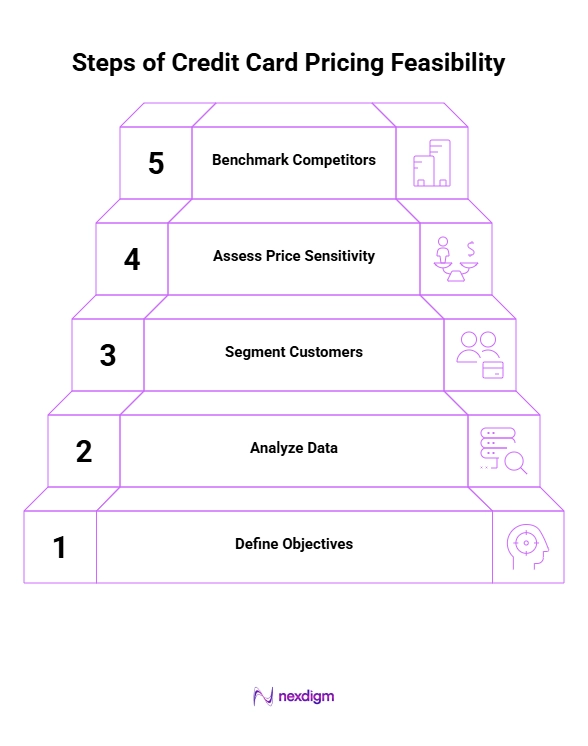
Steps for Profitable Credit Card Portfolio Segmentation
- Define Portfolio Pricing Objectives: Establish clear objectives for customer acquisition, card usage, fee income, interest revenue, reward costs, retention, risk management, and profitability across each credit card segment.
- Analyze Cardholder Data: Evaluate transaction patterns, spending levels, repayment behavior, credit utilization, income profiles, digital engagement, and product preferences to develop meaningful and commercially relevant customer segments.
- Segment Customers by Value: Group cardholders according to revenue potential, spending frequency, credit quality, reward preferences, fee sensitivity, and relationship value to support differentiated pricing decisions.
- Assess Price Sensitivity: Measure customer responses to annual fees, interest rates, late-payment charges, foreign transaction fees, and reward changes through price elasticity and willingness-to-pay analysis.
- Benchmark Competitor Card Pricing: Compare competitor annual fees, interest rates, rewards, introductory offers, eligibility requirements, and benefits to identify pricing gaps and strengthen portfolio positioning across segments.
Nexdigm’s Role in Optimizing Credit Card Pricing and Profitability
Nexdigm delivers Pricing Analysis Services that help issuers optimize credit card fees, interest rates, rewards, benefits, and promotional offers. Its approach combines credit card pricing analysis, competitor benchmarking, customer segmentation, willingness-to-pay assessment, price elasticity modeling, portfolio profitability analysis, demand forecasting, risk evaluation, and scenario modeling to strengthen product positioning, improve customer acquisition, protect margins, enhance retention, and support sustainable growth.
Nexdigm’s Strategic Framework for Credit Card Pricing and Portfolio Profitability
Nexdigm’s framework applies Pricing Analysis Services to evaluate customer value, fees, rewards, risk, competition, and profitability, enabling issuers to design differentiated credit card pricing across targeted portfolio segments effectively.
Types of Pricing Analysis Within Nexdigm’s Framework
- Competitor Pricing Analysis: Compares annual fees, interest rates, rewards, benefits, promotional offers, and eligibility criteria to identify market gaps and strengthen card positioning.
- Customer Segmentation Analysis: Groups cardholders by spending behavior, income, credit profile, reward preferences, fee sensitivity, and relationship value to support differentiated pricing structures.
- Willingness-to-Pay Analysis: Measures acceptable fee levels, interest charges, and benefit trade-offs to determine pricing thresholds across mass-market, rewards, and premium customer segments.
- Price Elasticity Analysis: Evaluates how changes in fees, interest rates, rewards, and benefits influence card applications, usage, balances, retention, and customer switching behavior.
- Value-Based Pricing Analysis: Aligns card pricing with perceived customer value, including rewards, travel privileges, insurance coverage, lifestyle benefits, convenience, and service quality.
Nexdigm’s Case
Nexdigm applied Pricing Analysis Services to refine credit card fees, rewards, and segment positioning, contributing to 18% higher card adoption, 15% revenue growth, 12% margin improvement, and 14% stronger retention across priority customer portfolio segments.
To take the next step, simply visit our Request a Consultation page and share your requirements with us.
Harsh Mittal
+91-8422857704