

Credit pricing optimization analysis helps lenders improve portfolio profitability without suppressing customer demand by aligning rates, fees, risk, affordability, and market competitiveness. Through advanced Pricing Analysis Services, financial institutions can evaluate borrower segments, credit quality, funding costs, expected losses, price elasticity, competitor offers, and conversion behavior.
These insights identify profitable rate corridors, demand thresholds, margin leakage, and risk-adjusted growth opportunities across lending products. Effective credit pricing optimization supports customer segmentation, interest rate benchmarking, scenario modelling, portfolio yield management, and acquisition planning, enabling lenders to strengthen approvals, protect margins, maintain accessible pricing, improve retention, and achieve sustainable portfolio performance across changing market conditions.
An illustrative 12% improvement in credit pricing accuracy can increase portfolio profitability without weakening demand. Pricing Analysis Services assess borrower risk, funding costs, elasticity, competitor rates, and conversion behavior, helping lenders protect margins, sustain approvals, optimize yields, and support growth.
Pricing Analysis for Credit Portfolio Profitability and Demand Stability
Credit pricing analysis aligns borrower risk, funding costs, demand sensitivity, competitive rates, and portfolio objectives to improve profitability, sustain loan volumes, protect margins, and support stable lending growth across markets. Some core benefits of it are:
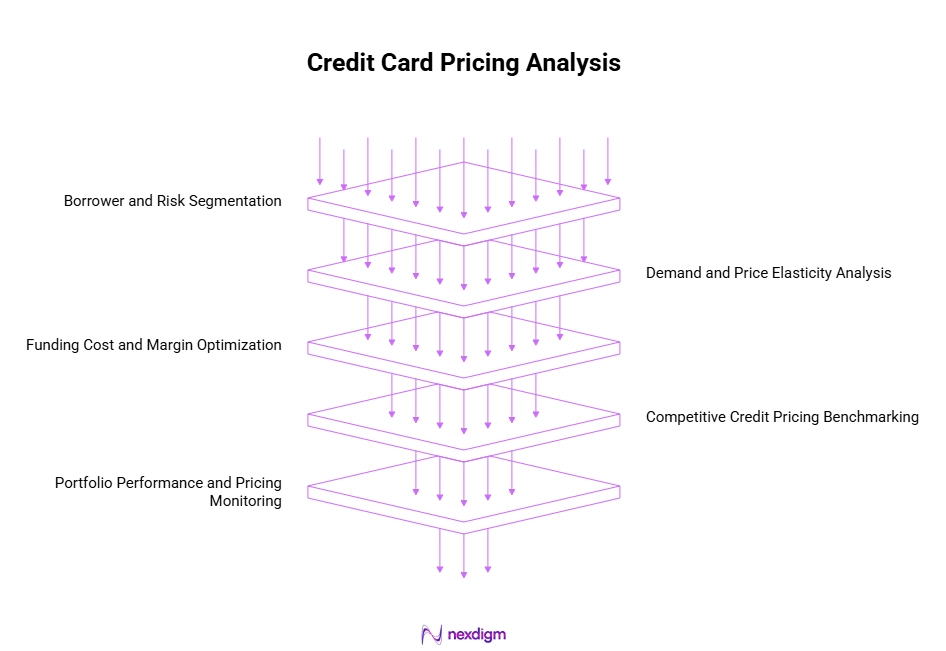
- Borrower and Risk Segmentation: Evaluate credit scores, repayment capacity, default probability, income stability, and loan purpose. Benefits include precise risk premiums, better targeting, controlled losses, and stronger portfolio quality.
- Demand and Price Elasticity Analysis: Measure how application, approval, and conversion volumes respond to changing rates, fees, and terms. Benefits include stable demand, optimized pricing corridors, and reduced customer resistance.
- Funding Cost and Margin Optimization: Assess funding rates, capital requirements, operating expenses, expected losses, and servicing costs. Benefits include sustainable price floors, protected margins, improved yields, and stronger profitability.
- Competitive Credit Pricing Benchmarking: Compare competitor rates, fees, loan terms, approval criteria, and promotional offers. Benefits include stronger market positioning, faster pricing responses, improved acquisition, and reduced borrower attrition.
- Portfolio Performance and Pricing Monitoring: Track approvals, disbursements, delinquencies, prepayments, yields, and customer behavior. Benefits include timely pricing refinements, demand stability, stronger retention, and sustainable portfolio profitability.
Nexdigm’s Pricing Analysis Services for Credit Portfolio Performance
Nexdigm’s Pricing Analysis Services help financial institutions enhance credit portfolio performance through credit pricing optimization analysis, competitive pricing intelligence, risk-based pricing, portfolio profitability analysis, interest rate benchmarking, and loan pricing strategy. By evaluating borrower behavior, funding costs, market demand, competitor pricing, credit risk, and portfolio performance, Nexdigm enables lenders to optimize pricing decisions, strengthen portfolio yields, maintain demand stability, improve customer acquisition, and achieve sustainable lending profitability.
Nexdigm’s Demand-Sensitive Credit Pricing Optimization Model
Nexdigm’s demand-sensitive model combines borrower behavior, price elasticity, credit risk, funding costs, and competitive benchmarks to optimize lending rates, preserve demand, protect margins, and strengthen portfolio profitability sustainably. Data Driven types followed by Nexdigm’s experts are:
Type 1: Price Elasticity-Based Pricing
Rates and fees reflect borrower responses to pricing changes, helping lenders identify demand thresholds, maintain application volumes, and improve conversion performance.
Type 2: Risk-Adjusted Segment Pricing
Borrowers are grouped by credit quality, repayment capacity, income stability, and default probability to establish differentiated rates supporting balanced risk-adjusted returns.
Type 3: Competitive Benchmark Pricing
Competitor interest rates, fees, terms, approval criteria, and promotions are compared to strengthen market positioning and reduce customer switching across segments.
Type 4: Cost and Margin-Based Pricing
Funding costs, expected losses, operating expenses, capital charges, and servicing costs determine sustainable price floors that protect profitability and portfolio yields.
Type 5: Dynamic Demand-Responsive Pricing
Pricing adjusts using application trends, conversion rates, borrower behavior, market demand, and portfolio performance to maintain competitiveness and sustainable lending growth.
Nexdigm’s Case
Nexdigm helped a financial institution optimize demand-sensitive credit pricing. The initiative increased portfolio profitability by 13%, improved loan conversion rates by 10%, and reduced pricing decision time by 18%, enabling stronger margins while maintaining stable customer demand.
To take the next step, simply visit our Request a Consultation page and share your requirements with us.
Harsh Mittal
+91-8422857704