

Credit assessment is moving beyond the traditional bureau score. Credit bureaus remain fundamental to lending decisions, particularly for prime borrowers with established financial histories, but their predictive value can weaken when borrowers are thin-file, new-to-credit (NTC), self-employed, or operating outside formal payroll and accounting systems.
Lenders are therefore building broader underwriting stacks that combine bureau information with transaction histories, consent-based bank account data, tax records, payment activity, enterprise ledgers, and other behavioral signals. These models can assess current cash-flow stability and identify changes in repayment capacity earlier.
This shift creates opportunities for scoring platforms, but adoption depends on more than model accuracy. The commercial opportunity varies by lender, borrower segment, data availability, regulatory environment, and integration requirements.
Banks, Fintechs, and Alternative Lenders Solve Different Problems
Large banks typically prioritize governance, security, explainability, and integration reliability. Alternative scoring capabilities may initially operate as overlays to established scorecards rather than replacing them.
Digital lenders place greater emphasis on low-latency APIs, automated decisions, and straight-through processing. For alternative NBFCs, the priority is often identifying reliable signals for borrowers whose financial capacity is poorly represented by conventional credit files.
Commercial banks may depend on bureau records, internal deposits, and payroll information. Fintech lenders can draw on open-banking, e-commerce, and digital activity data, while alternative lenders may use merchant payment flows, invoice records, and supply-chain information. The technology requirements therefore differ materially by lender archetype.
The Real Opportunity Lies in Underserved Borrower Segments
The strongest opportunity for alternative scoring infrastructure lies where conventional documentation provides an incomplete picture of repayment capacity.
- Micro-retail merchants: QR payment inflows and distributor reorder patterns can reveal cash-flow stability.
- Gig and platform workers: Platform tenure, activity continuity, and payment patterns can supplement inconsistent income documentation.
- Tier-2 and Tier-3 MSMEs: GST filings, e-way bills, and vendor settlement cycles can provide visibility into working-capital velocity and supply-chain resilience.
Nexdigm’s Credit Scoring Platform Market Assessment Framework
A Credit scoring platform market assessment should determine where scoring technology can translate into commercially viable demand rather than treating all lenders and borrowers as a single addressable market.
Nexdigm evaluates opportunities across seven dimensions:
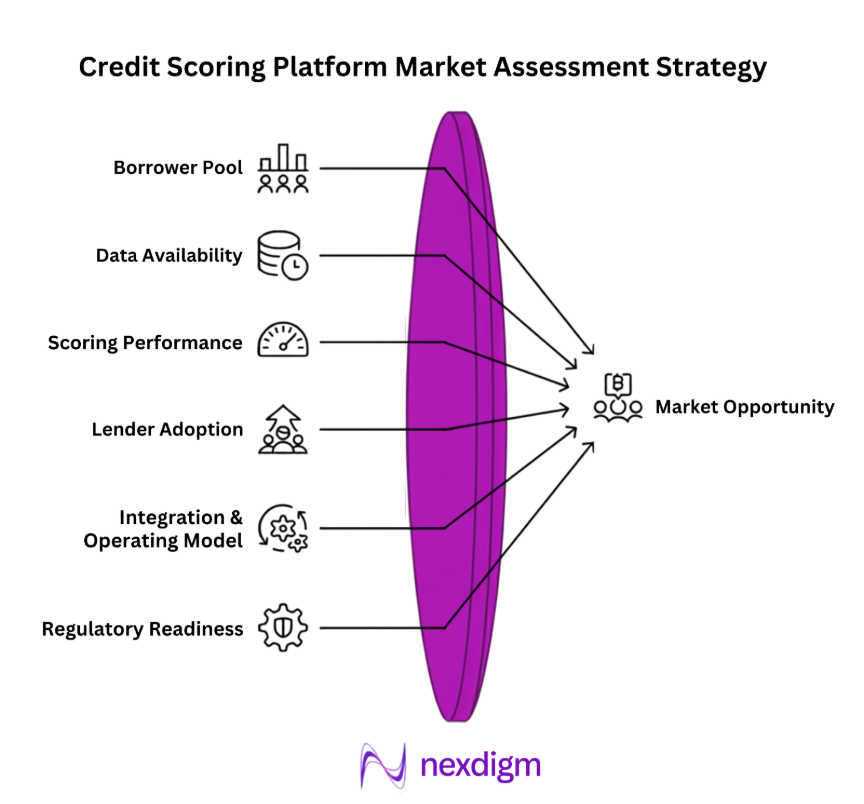
- Borrower Pool: Size prime, thin-file, NTC, MSME, and informal-income segments and determine their borrowing potential.
- Data Availability: Assess the maturity of open-banking infrastructure, tax networks, corporate registries, identity systems, and other alternative-data sources.
- Scoring Performance: Measure predictive lift over conventional bureau models and test score stability across different economic conditions.
- Lender Adoption Dynamics: Compare digital maturity, procurement cycles, risk appetite, and technology investment across banks, fintechs, NBFCs, and specialized lenders.
- Integration & Operating Model: Evaluate LOS/LMS compatibility, API performance, deployment requirements, and implementation complexity.
- Regulatory Readiness: Assess model governance, explainability, fair-lending requirements, data protection, and cross-border data restrictions.
- Commercial Opportunity: Estimate annual loan originations, platform pricing potential, customer lifetime value, and viable monetization models.
These factors can help lenders identify viable lending opportunities despite limited traditional credit histories or collateral. In India, the MSME credit shortfall is estimated at approximately ₹30 lakh crore, illustrating the scale of unmet financing demand.
Accuracy Is Only One Part of Platform Adoption
A scoring model may demonstrate strong AUC-ROC, Gini, or KS performance and still struggle to win enterprise adoption. Risk committees and technology teams also evaluate the operational conditions surrounding the model.
Integration is often decisive. Banks and established financial institutions operate complex Loan Origination Systems (LOS), Loan Management Systems (LMS), and core banking environments. Platforms requiring extensive customization can face lengthy procurement and implementation cycles.
Adoption also depends on API reliability, data freshness, consent integrity, model explainability, deployment requirements, and pricing. Fintechs may favor usage-based models that support rapid experimentation, while larger banks may prefer enterprise licensing with predictable costs.
How Nexdigm Prioritizes Credit Scoring Opportunities
A multi-regional financial technology vendor evaluated expansion opportunities across six lender archetypes, 18 borrower categories, and 12 regulatory environments. The analysis identified five commercial lending segments representing approximately ₹38 billion ($455 million) in annual originations across Tier-2 and Tier-3 commercial clusters.
Priority use cases included invoice-backed working-capital lending for FMCG distributors, recurring micro-lines for logistics workers, and cash-flow assessment for healthcare providers using insurance settlement receivables.The resulting strategy focused on segments where alternative data, lender demand, and platform economics were closely aligned.
To take the next step, simply visit our Request a Consultation page and share your requirements with us.
Harsh Mittal
+91-8422857704
[email protected]