

CRM is a large and mature software category, but maturity has not eliminated room for new products. Gartner estimates the CRM market reached $128 billion in 2024, growing 13.4% in current-dollar terms. Within CRM sales software specifically, the market reached $25.7 billion in 2024 after 12.2% growth. Gartner expects CRM sales software to continue expanding, with GenAI, AI sales agents, broader functionality, and increasing adoption supporting a 12.8% CAGR through 2029.
The difficulty for a new CRM vendor is therefore not proving that companies buy CRM. It is identifying which customers have an unresolved problem that existing platforms do not address efficiently enough to justify switching.
Incumbency Creates a High Switching Barrier
Large CRM platforms have accumulated more than customer records. They sit inside sales processes, reporting structures, marketing workflows, service operations, partner ecosystems, and enterprise integration architectures.
Salesforce, for example, reported a 20.0% global CRM market share for 2025 based on IDC’s latest ranking. Its AppExchange marketplace has more than 7,000 apps and certified consulting organizations, while Salesforce says 91% of its customers use AppExchange applications.
This ecosystem becomes part of the competitive barrier. A new CRM can have a cleaner interface or lower license price and still struggle if customers must rebuild integrations, migrate historical records, retrain sales teams, and recreate established workflows.
The entry question must therefore move beyond feature comparison.
The Opening Is Usually More Specific
The strongest opportunities for a new CRM product are likely to emerge where generic platforms require extensive configuration or fail to reflect industry-specific workflows.
A commercial insurance broker, for example, may need underwriting-specific data structures and compliance workflows. A wealth-management firm may prioritize household relationships, regulatory documentation, and investment activity. A healthcare sales organization may require account structures and approval processes that differ substantially from conventional B2B selling.
Vertical specialization can reduce the amount of customization required before the product becomes operational.
AI creates another opening. Gartner’s 2026 research indicates that CRM sales-platform vendors are increasingly incorporating generative and agentic AI into their offerings. Gartner also forecasts that spending on CRM software with agentic AI capabilities will surpass spending on CRM software without agentic AI in 2028, reaching $216 billion by 2029.
For challengers, however, adding an AI assistant is unlikely to be enough. The commercial question is whether AI removes a meaningful amount of sales administration, improves data capture, accelerates pipeline movement, or enables a workflow that incumbent systems handle poorly.
Price Alone Does Not Establish Product-Market Fit
CRM pricing needs to be evaluated alongside implementation requirements, integration costs, user adoption, and switching friction.
A lower subscription price can become irrelevant if customers need extensive systems-integration work. Conversely, a higher-priced platform can remain commercially attractive when it eliminates manual processes or reduces the need for additional applications.
New entrants therefore need to model the customer’s total economic burden rather than compare monthly seat prices alone.
This is particularly important as CRM pricing models evolve toward usage, automation, AI credits, and outcome-linked structures. The product has to remain economically predictable for both procurement teams and end users.
Five Variables Determine Commercial Feasibility
A CRM entrant can be tested against five variables:
- Unmet workflows need: Identify specific sales or customer-management processes that incumbent platforms address poorly or require excessive customization to support.
- Target-user concentration: Determine whether the addressable segment is sufficiently concentrated to support efficient customer acquisition and focused product development.
- Integration burden: Measure the effort required to connect email, telephony, ERP, billing, marketing automation, data warehouses, and existing CRM systems.
- Adoption economics: Compare implementation time, training requirements, user engagement, retention, and measurable productivity gains.
- Monetization durability: Test seat-based, usage-based, AI-enabled, and outcome-linked pricing against willingness to pay and customer acquisition costs.
Nexdigm CRM Software Market Feasibility Framework
Nexdigm can assess a CRM proposition through a market-entry lens covering:
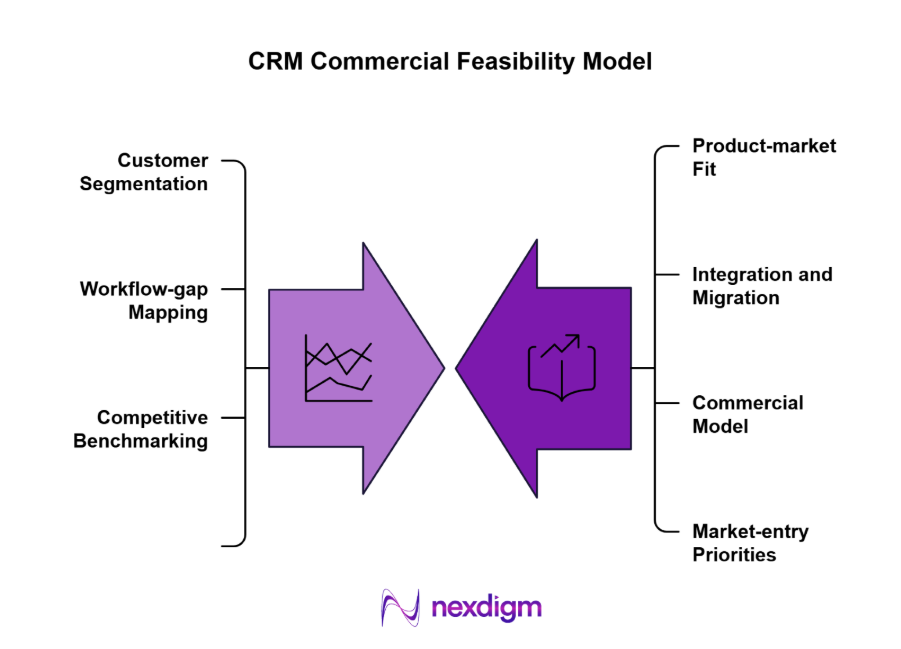
- Customer segmentation: Identify high-value industries, company sizes, buyer roles, and underserved user groups.
- Workflow-gap mapping: Compare incumbent capabilities with specific operational pain points and vertical requirements.
- Competitive benchmarking: Assess functionality, positioning, pricing, integrations, AI capabilities, implementation models, and ecosystem strength.
- Product-market fit: Test willingness to pay, adoption barriers, switching triggers, and the minimum feature set required for initial deployment.
- Integration and migration: Evaluate coexistence models that allow a challenger to enter alongside an incumbent before becoming a larger system of record.
- Commercial model: Build scenarios for subscription, usage, AI-agent, and outcome-linked revenue while testing CAC, retention, and payback.
- Market-entry priorities: Identify the segments and use cases where differentiation is sufficiently strong to support focused expansion.
Nexdigm Case: AI Solution Commercialization and Buyer Validation
Nexdigm supported an AI solution provider with buyer-persona validation, priority use-case assessment, proof-of-value metrics, and go-to-market planning. The engagement validated 9 enterprise buyer personas and 14 priority use cases, improving lead-qualification accuracy by 26% and reducing go-to-market planning time by 30%.
To take the next step, simply visit our Request a Consultation page and share your requirements with us.
Harsh Mittal
+91-8422857704