

Customer relationship management platforms have evolved from contact databases into systems that support sales execution, marketing coordination, customer service and revenue operations. They help businesses organise customer information, track interactions, manage sales pipelines and understand how prospects move through the buying journey.
However, CRM platforms differ considerably in their approach to customer data, workflow automation, analytics, integration and commercial models. Some are designed for complex enterprise sales environments, while others focus on smaller teams or specific customer engagement requirements.
For organisations evaluating the market, a CRM software vendor comparison analysis helps determine which platforms can support customer acquisition, improve engagement and provide the operational visibility needed to manage revenue growth.
CRM Adoption Is Increasing, but Platform Requirements Differ
CRM software has become an important part of enterprise application procurement. Eurostat reported that 27.9% of EU enterprises using paid cloud services purchased cloud-based CRM applications in 2025. Ireland’s Central Statistics Office reported that 28.4% of enterprises used CRM software that year, with adoption reaching 66.0% among large enterprises.
These figures indicate that CRM adoption is particularly relevant to larger organisations, where customer data and sales processes may span multiple teams, business units and markets.
But adoption alone does not determine which platform is appropriate. A business with a small sales team may need straightforward contact management and pipeline tracking. A multinational organisation may require advanced territory management, complex approval workflows, integration with ERP systems and consolidated customer reporting.
What Should a CRM Platform Actually Improve?
A CRM investment should be linked to measurable business processes rather than a general objective of improving customer relationships.
For customer acquisition, the platform should help teams capture leads, organise prospect information, assign opportunities and track conversion activity. Marketing integration can support campaign management, lead scoring and the transfer of qualified prospects to sales teams.
For customer engagement, CRM capabilities may include interaction histories, communication preferences, service requests and customer segmentation. These features help employees understand previous interactions and coordinate responses across departments.
For revenue management, pipeline reporting, forecasting, opportunity tracking and performance dashboards can improve visibility into sales activity. Managers should be able to identify stalled opportunities, monitor conversion rates and understand the factors influencing revenue performance.
The platform should connect these functions rather than treating sales, marketing and service as unrelated activities.
Comparing CRM Vendors Across Core Capabilities
The first comparison area is sales functionality. Procurement teams should examine lead management, opportunity tracking, pipeline customisation, forecasting, territory management and sales activity reporting.
Marketing capabilities require a separate assessment. Relevant features include campaign automation, audience segmentation, lead scoring, email integration and campaign attribution. Businesses should establish whether these capabilities are native to the CRM or require additional products.
Customer service functionality may include case management, service-level tracking, knowledge bases, customer communication histories and escalation workflows.
Data and analytics capabilities are equally important. A CRM should allow organisations to consolidate customer information, generate meaningful reports and integrate with other business systems. Buyers should examine data quality controls, duplicate management, APIs and reporting flexibility.
User Adoption Can Determine Whether the Investment Pays Off
A CRM platform can have extensive functionality and still deliver limited value if employees find it difficult to use.
The interface should support everyday tasks without requiring unnecessary navigation or manual data entry. Sales representatives should be able to update opportunities, record interactions and review customer information efficiently.
Procurement teams should also examine mobile accessibility, training requirements, role-based dashboards and workflow configuration.
During vendor demonstrations, evaluation teams should test realistic scenarios. For example, they can follow a lead from initial capture through qualification, opportunity creation, proposal development and closure. A separate exercise can examine how customer service teams handle an issue and access previous interactions.
This provides a more meaningful comparison than reviewing feature lists in isolation.
CRM Pricing and the Cost of Expansion
CRM vendors may price their products according to user tiers, feature editions, automation limits, data storage, marketing contacts or usage volumes.
The base subscription may not include all the functionality required by the organisation. Advanced analytics, marketing automation, integration tools and customer service modules may require additional licences.
A total cost assessment should account for:
- Subscription fees and user licences.
- Additional modules and premium features.
- Implementation and data migration.
- Integration with ERP, marketing and support systems.
- Training, configuration and ongoing administration.
- Renewal increases, expansion costs and data extraction at exit.
The organisation should also evaluate whether existing software already provides overlapping CRM functionality. Paying for duplicate capabilities across multiple platforms can reduce the commercial value of the investment.
Choosing a Platform That Can Grow With the Business
CRM requirements change as organisations expand their customer base, enter new markets and introduce additional sales channels.
A platform should be assessed for its ability to accommodate more users, business units, customer records and workflow complexity. It should also support appropriate data governance and integration as the technology environment evolves.
For some businesses, a specialised CRM may provide the strongest functional fit. Others may benefit from a broader customer platform that connects sales, marketing and service operations.
The decision should reflect business strategy, process maturity, internal resources and the level of customisation required.
CRM Software Vendor Comparison Framework
A CRM sourcing exercise should move through six stages:
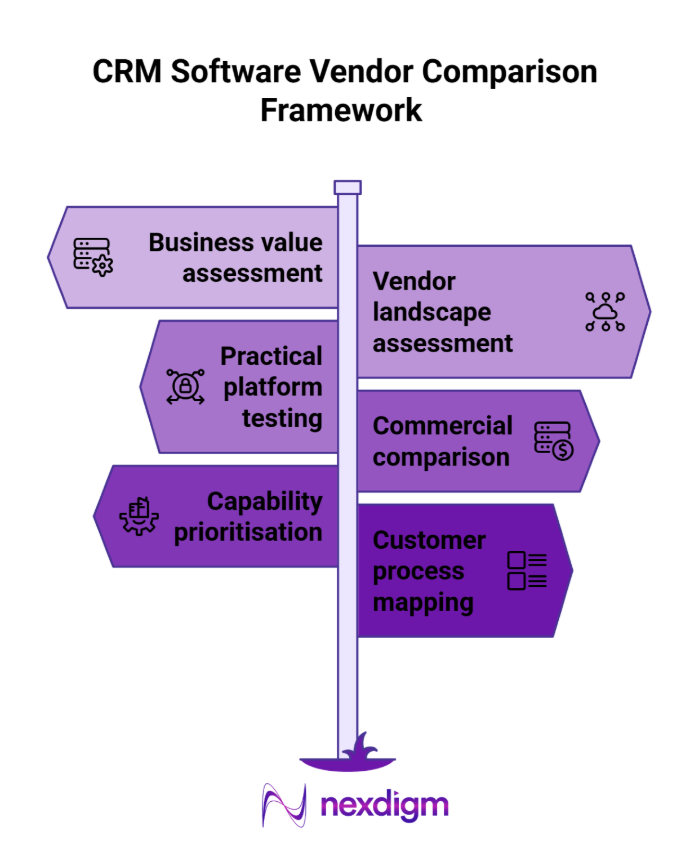
- Customer process mapping: Document lead generation, sales management, customer engagement and service workflows.
- Capability prioritisation: Define essential requirements for sales, marketing, customer service, reporting and automation.
- Vendor landscape assessment: Identify CRM providers according to enterprise size, industry focus, product breadth and deployment model.
- Practical platform testing: Evaluate usability, workflow configuration, integration and reporting through realistic scenarios.
- Commercial comparison: Model subscriptions, modules, implementation, training, expansion and exit costs.
- Business value assessment: Compare shortlisted vendors against adoption potential, process improvements, scalability and revenue management requirements.
Nexdigm can support organisations through CRM market research, supplier benchmarking, platform capability assessment and commercial analysis. These services help businesses compare CRM providers, understand competitive positioning and identify solutions aligned with customer acquisition, engagement and revenue objectives.
Nexdigm’s Case Study: Evaluating CRM Platforms for Enterprise Growth
Nexdigm assessed 12 CRM providers across 5 functional areas, comparing sales automation, customer engagement, analytics, integration and pricing. The study identified a 16% variation in comparable subscription costs, shortlisted 4 platforms and established 8 selection benchmarks.
To take the next step, simply visit our Request a Consultation page and share your requirements with us.
Harsh Mittal
+91-8422857704