

A crop input demand pricing study helps agribusinesses understand how price changes influence farmer demand for fertilizers, seeds, and crop protection products. Through structured Pricing Analysis Services, companies can evaluate affordability, product value, seasonal purchasing patterns, competitor prices, crop economics, and regional demand differences.
These insights reveal price sensitivity, substitution risks, adoption thresholds, and revenue opportunities across agricultural input categories. Effective pricing analysis supports demand forecasting, portfolio positioning, promotional planning, and margin protection. By aligning prices with farmer purchasing capacity and expected productivity benefits, businesses can improve market adoption, strengthen competitiveness, optimize revenue, and support sustainable agricultural growth.
An illustrative 6% improvement in crop input pricing accuracy can strengthen demand planning. Pricing Analysis Services evaluate farmer affordability, seasonal purchasing, competitor prices, and substitution risks, helping agribusinesses improve adoption, optimize volumes, protect margins, and sustain revenue growth across categories.
Pricing Analysis for Demand Across Seeds, Fertilizers, and Crop Protection
Pricing analysis helps agribusinesses understand how pricing influences farmer purchasing decisions across essential crop inputs, enabling stronger demand forecasting, market competitiveness, profitability, and sustainable portfolio growth. Core steps of pricing analysis are:
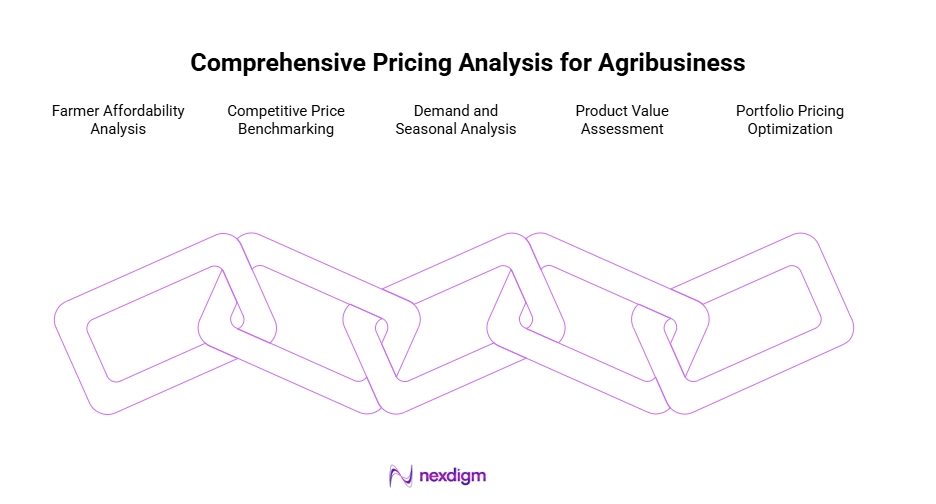
- Farmer Affordability Analysis: Assess farm income, crop profitability, seasonal cash flow, and purchasing power. Elements in focus: affordability thresholds, payment capacity, adoption potential, and regional demand differences.
- Competitive Price Benchmarking: Compare prices, discounts, pack sizes, promotional offers, and channel margins across competing products. Elements in focus: pricing gaps, market positioning, substitution risks, and competitive advantage.
- Demand and Seasonal Analysis: Evaluate crop cycles, weather patterns, planting seasons, and regional purchasing behavior. Elements in focus: seasonal demand fluctuations, inventory planning, localized pricing, and sales optimization.
- Product Value Assessment: Measure farmer perceptions of product quality, yield improvement, effectiveness, and return on investment. Elements in focus: value perception, premium acceptance, purchase intent, and brand differentiation.
- Portfolio Pricing Optimization: Align prices across seeds, fertilizers, and crop protection products using market intelligence. Elements in focus: portfolio balance, revenue growth, margin protection, cross-selling opportunities, and long-term competitiveness.
Nexdigm’s Role in Optimizing Agricultural Input Prices and Demand
Nexdigm’s Pricing Analysis Services help agribusinesses optimize pricing across seeds, fertilizers, and crop protection products through crop input demand pricing study, competitive pricing analysis, market price benchmarking, pricing intelligence, demand forecasting, and value-based pricing. By evaluating farmer affordability, regional demand, seasonal trends, and competitor pricing, Nexdigm enables organizations to improve demand planning, optimize product pricing, strengthen market competitiveness, protect margins, and drive sustainable revenue growth across agricultural input portfolios.
Nexdigm’s Agricultural Input Pricing Intelligence Blueprint
Nexdigm’s agricultural input pricing intelligence blueprint combines farmer demand, affordability, competitive benchmarks, seasonal patterns, and portfolio economics to optimize prices, strengthen adoption, protect margins, and support sustainable market growth strategically. Data Driven steps followed by Nexdigm’s experts are:
Step 1: Market and Farmer Segmentation
Nexdigm segments markets by crop, geography, farm size, purchasing power, and channel behavior to identify differentiated demand patterns and pricing opportunities.
Step 2: Competitive Price Benchmarking
Prices, pack sizes, discounts, product claims, dealer margins, and promotional offers are compared to reveal positioning gaps and competitive pricing priorities.
Step 3: Affordability and Demand Assessment
Farmer income, crop returns, seasonal cash flow, credit access, and price sensitivity are evaluated to determine practical adoption thresholds across input categories.
Step 4: Portfolio Pricing Design
Nexdigm develops differentiated pricing for seeds, fertilizers, and crop protection products using value, demand, competition, cost structures, and portfolio relationships.
Step 5: Performance Monitoring and Refinement
Sales volumes, margins, market share, channel feedback, seasonal demand, and competitor actions are monitored to refine prices and sustain profitable growth.
Nexdigm’s Case
In an illustrative engagement, Nexdigm helped an agricultural input manufacturer optimize pricing across seeds, fertilizers, and crop protection products. The initiative improved demand forecasting accuracy by 14%, increased price realization by 9%, and strengthened operating margins by 8%, driving profitable portfolio growth.
To take the next step, simply visit our Request a Consultation page and share your requirements with us.
Harsh Mittal
+91-8422857704