

A crop market price comparison study helps agribusinesses understand how crop prices vary across domestic and international agricultural markets due to supply, demand, quality, seasonality, exchange rates, trade policies, and logistics costs. By combining pricing analysis, regional market research, and export-import price assessment, companies can identify price gaps and improve market positioning.
These insights support sourcing, procurement, export planning, contract negotiations, and product portfolio decisions while helping businesses manage volatility, protect margins, and capture profitable opportunities across diverse crop categories and geographies.
Pricing Analysis Services converts cross-market price insights into measurable commercial improvements. A recent study, related to agricultural engagements observed, structured benchmarking supported margin gains of 8–12%, reduced sourcing costs by 10%, improved price forecasting accuracy, and accelerated market decisions by 30%, highlighting importance of Pricing Analysis.
Crop Pricing Analysis for Smarter Sourcing and Export Decisions
Crop pricing analysis evaluates domestic and international market conditions, enabling agribusinesses to optimise sourcing, identify export opportunities, manage volatility, protect margins, and make informed trading decisions across agricultural commodities. Some major elements in focus are:
- Domestic and International Price Benchmarks: Comparing crop prices across local mandis, wholesale markets, commodity exchanges, and export destinations to identify sourcing advantages, market gaps, and profitable trade opportunities.
- Quality and Grade Differentials: Assessing how crop variety, grade, moisture, certification, processing quality, and traceability influence prices, enabling accurate comparisons and stronger positioning in premium export markets.
- Logistics and Landed Cost Analysis: Calculating transportation, storage, handling, insurance, duties, and port charges to determine true landed costs and select sourcing or export markets with better margins.
- Currency and Trade Conditions: Monitoring exchange rates, tariffs, export restrictions, quotas, subsidies, and trade agreements to understand their pricing impact and reduce cross-border commercial and financial risks.
Nexdigm’s Strategic Support for Cross-Market Crop Pricing Analysis
Nexdigm delivers cross-market crop pricing analysis by integrating crop market price comparison studies, pricing analysis services, commodity price benchmarking, agricultural market intelligence, and export pricing analysis. With data-driven approach evaluates domestic and international price movements, trade dynamics, logistics costs, and market demand, this enabling agribusinesses to optimize sourcing, strengthen export competitiveness, improve price realization, and make informed commercial decisions across global agricultural markets.
Nexdigm’s Global Agricultural Pricing Analysis Strategy for Market Expansion
Nexdigm’s global agricultural pricing strategy combines pricing intelligence, market research, and commercial analytics to optimise sourcing, strengthen export competitiveness, improve margins, and support sustainable expansion across domestic and international markets. Major strategies referred by Nexdigm’s experts are:
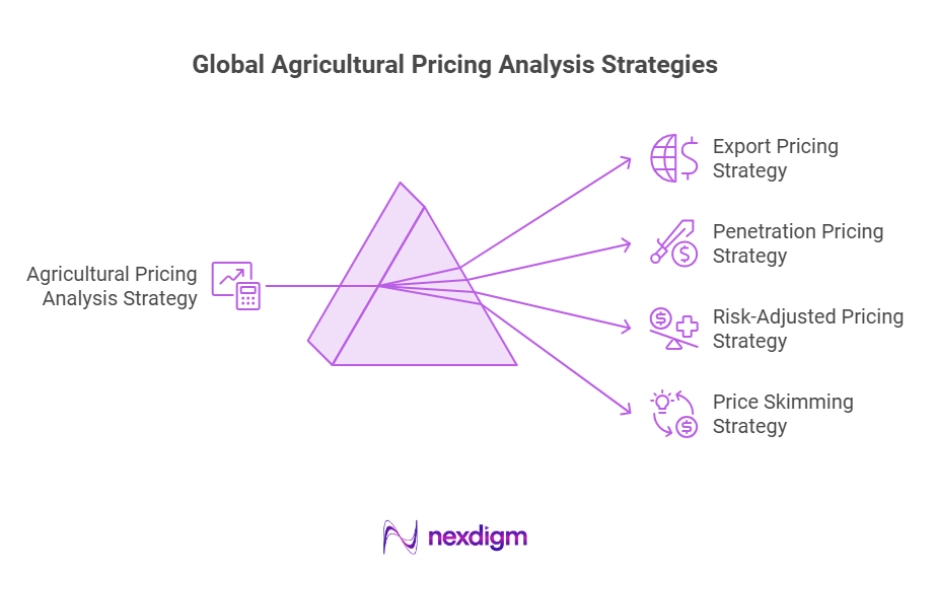
- Export Pricing Strategy: Establish competitive export prices by evaluating landed costs, tariffs, exchange rates, logistics expenses, competitor prices, and destination market demand to maximize international sales and profitability.
- Penetration Pricing Strategy: Introduce competitive prices in new markets to encourage trial, accelerate buyer adoption, build distribution confidence, and establish market presence before implementing gradual price increases.
- Risk-Adjusted Pricing Strategy: Factor supply disruptions, policy changes, commodity volatility, credit risk, and logistics uncertainty into prices to protect profitability and improve resilience across global agricultural markets.
- Price Skimming Strategy: Launch differentiated agricultural products at premium prices, then gradually reduce them as competition increases, helping recover innovation costs and maximize early-market value.
Nexdigm’s Case
Nexdigm supported an agribusiness in refining cross-market crop pricing and export strategy. The engagement improved forecast accuracy by 21%, reduced procurement variance by 13%, increased export win rates by 17%, and shortened sourcing decisions by 26%, strengthening resilience and profitability.
To take the next step, simply visit our Request a Consultation page and share your requirements with us.
Harsh Mittal
+91-8422857704