

Crop protection procurement involves more than comparing the prices of insecticides, fungicides and herbicides. Buyers need products that are appropriate for specific crops and pest pressures, supported by reliable efficacy information and supplied through compliant distribution channels. They must also consider product registration, formulation quality, storage conditions and the technical support available to farmers and distributors.
These requirements make supplier selection particularly important for agribusinesses, agricultural input distributors and organisations managing large-scale crop production. A structured comparison helps establish whether suppliers can meet product, quality, regulatory and commercial expectations.
Understand the Crop Protection Portfolio
Crop protection suppliers operate across several product categories. Their portfolios may include conventional chemical pesticides, biological products, seed treatments, herbicides, fungicides, insecticides and integrated pest management solutions.
The relevance of a portfolio depends on the crops and markets being served. A supplier with a strong herbicide range may be well positioned in large-scale cereal cultivation, while another may specialise in fungicides for horticulture or insecticides for cotton and other commercial crops.
Buyers should map products by active ingredient, formulation, target pest or disease, crop application and registration status. This helps identify genuine portfolio coverage rather than relying on broad category claims.
Efficacy Must Be Evaluated in the Intended Application
A product’s commercial value depends on whether it performs effectively under the conditions in which it will be used. Efficacy can vary with crop type, pest pressure, application timing, weather conditions, dosage and resistance patterns.
Supplier claims should therefore be assessed against relevant evidence. Procurement teams may examine approved product information, field trial results, technical documentation and recommendations from recognised agricultural research institutions.
The evaluation should also consider application requirements and compatibility with relevant farming practices. A product that requires specialised equipment or technical handling may not be suitable for every distribution market.
Importantly, efficacy should not be inferred solely from a product’s active ingredient or marketing material. The assessment must consider the registered use, crop, target organism and prescribed application conditions.
Conducting crop protection chemical supplier benchmarking Across Product and Market Categories
A crop protection chemical supplier benchmarking compares suppliers across four areas: product capability, regulatory standing, quality assurance and distribution performance.
Product capability includes the breadth of active ingredients, formulations, crop coverage and availability of relevant alternatives. Regulatory standing requires verification of product registrations, approved uses, manufacturing licences and applicable compliance documentation. Quality assurance covers formulation consistency, batch testing, packaging and traceability. Distribution performance examines stock availability, dealer coverage, technical service and seasonal fulfilment.
India’s regulatory environment makes this assessment particularly important. Under the Insecticides Act, 1968 and associated rules, the Central Insecticides Board and Registration Committee evaluates pesticides for safety, efficacy and quality. A December 2025 government response reported 368 registered technical-grade products and 1,139 registered pesticide formulations for use in India. This indicates the breadth of the regulated product landscape, but individual products still need to be assessed for their approved uses and suitability.
Compliance and Product Stewardship
Crop protection suppliers must demonstrate more than the ability to provide regulatory documents. Their products should be sourced, manufactured, stored, labelled and distributed in accordance with applicable requirements.
Procurement teams should verify:
- Product registration and approved crop or pest applications.
- Manufacturing and distribution licences, where applicable.
- Batch identification and quality testing documentation.
- Packaging, labelling and storage requirements.
- Safety information and handling instructions.
- Procedures for complaints, recalls and non-conforming products.
Product stewardship should also form part of supplier evaluation. Technical guidance, safe handling information, responsible use education and support for distributors can influence the quality of the overall supply relationship.
Distribution Capability and Regional Availability
Crop protection demand is influenced by crop calendars, pest outbreaks, weather conditions and regional cultivation patterns. Suppliers need distribution networks capable of responding to these fluctuations.
A national distribution presence does not necessarily guarantee product availability in every agricultural cluster. Buyers should examine regional warehouses, active dealers, inventory levels, replenishment lead times and the supplier’s ability to respond to seasonal demand.
Technical service is another important consideration. Dealers and farmers may need guidance on approved product uses, application timing, resistance management and safe handling. Suppliers with established field support and complaint resolution processes may offer greater operational value than those focused primarily on product sales.
Comparing Commercial Value
Commercial benchmarking should examine the full cost of procurement, including product price, packaging, transport, distributor margins, payment conditions and replacement arrangements.
Buyers should avoid treating the lowest quoted price as the most competitive option. A supplier may offer lower prices but have limited availability or inconsistent batch documentation. Another may justify a price premium through stronger quality assurance, regulatory support and distribution reliability.
Where several suppliers offer products with similar intended uses, procurement teams should assess the evidence and contractual terms before determining whether the products are commercially comparable.
How Nexdigm Supports Crop Protection Supplier Research
Nexdigm supports agribusinesses through market research, supplier intelligence, competitive benchmarking and commercial analysis. Its work can help clients map crop protection providers, compare product portfolios, assess regulatory positioning and evaluate regional distribution capabilities across relevant markets.
Crop Protection Supplier Benchmarking Framework
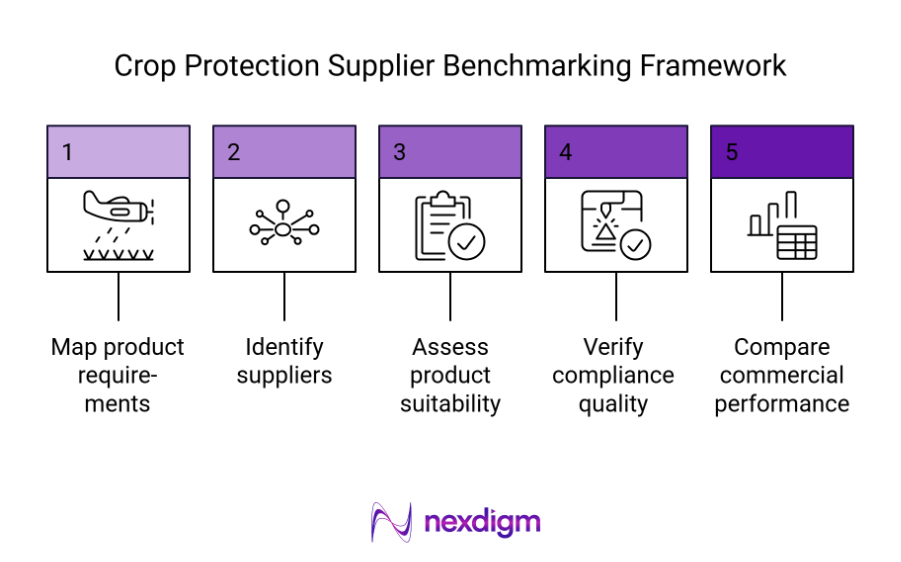
- Map product requirements: Define crops, target pest categories, formulations and intended markets.
- Identify suppliers: Profile manufacturers, importers, distributors and specialist crop protection providers.
- Assess product suitability: Review approved uses, efficacy evidence, product range and technical specifications.
- Verify compliance and quality: Examine registration, licences, batch testing, labelling and product stewardship.
- Compare commercial and distribution performance: Evaluate pricing, inventory, dealer coverage, technical support and fulfilment.
Nexdigm’s Case Study: Benchmarking Crop Protection Suppliers
Nexdigm assessed 12 crop protection suppliers across five product categories, reviewed 30 product and compliance indicators and mapped distribution capabilities across 8 agricultural markets. The research shortlisted 4 suppliers for further evaluation.
To take the next step, simply visit our Request a Consultation page and share your requirements with us.
Harsh Mittal
+91-8422857704