

Manufacturers that depend on agricultural commodities rarely face a simple purchasing decision. The same raw material can differ considerably in quality, availability and price depending on its origin, harvest period, processing history and route to market. For food processors, ingredient manufacturers, textile businesses and bio-based product companies, these variations can affect production yields, product consistency and procurement budgets.
A sourcing strategy built around familiar suppliers may work during stable market conditions. It becomes far less dependable when weather disrupts production, regional demand increases or competing buyers enter the market. Understanding the origin markets behind agricultural materials is essential to managing these risks.
Regional Concentration Makes Procurement Vulnerable
Many agricultural raw materials are produced in specific geographic clusters. Manufacturers sourcing cotton, maize, soybean, sugarcane, spices, oilseeds or fruit-based ingredients may depend heavily on a limited number of producing states or districts.
This concentration creates exposure to local disruptions. Unfavourable weather, pest outbreaks, changes in crop acreage or restrictions on movement can affect the availability of raw materials across an entire procurement region. Even where national production remains stable, a manufacturer may experience shortages if its preferred sourcing area underperforms.
Regional concentration also affects bargaining power. Where several buyers compete for the same crop, suppliers and aggregators may have greater control over pricing and allocation. Manufacturers without alternative sourcing arrangements can be forced to accept higher costs or less favourable delivery terms.
Harvest Cycles Create a Gap Between Availability and Consumption
Agricultural production is seasonal, but industrial consumption often continues throughout the year. Manufacturers must therefore manage the period between harvest and use through inventory planning, storage, processing arrangements and supplier contracts.
This creates financial pressure. Buying during the harvest window may improve access to volume and price, but it can increase storage costs and working capital requirements. Delaying procurement may reduce inventory exposure but leave manufacturers vulnerable to price increases or reduced availability.
The challenge is particularly significant for perishable or quality-sensitive materials. Improper storage can change moisture, colour, flavour, nutritional composition or processing performance. The cost of securing raw material cannot be separated from the cost of preserving its usability.
Quality Variation Complicates Supplier Comparisons
Agricultural raw materials are not always standardised at the point of origin. Differences in crop variety, cultivation practices, soil conditions, harvesting methods and post-harvest handling can create variation within the same commodity category.
A buyer purchasing maize, for instance, may need to account for moisture, broken grains, foreign matter and aflatoxin risk. A processor sourcing oilseed may focus on oil content, impurities and processing yield. For spices or botanical ingredients, active compound levels, colour, aroma and contamination can determine commercial suitability.
Without consistent specifications and testing, procurement teams may compare suppliers on quoted price while overlooking differences in usable material and processing outcomes.
Limited Origin Visibility Can Hide Supply Chain Dependencies
A supplier may claim to source from multiple regions while depending on the same aggregator, processor or trading network. This can create the appearance of diversification without reducing actual supply risk.
Origin information is also important for traceability and compliance. Manufacturers serving export markets or customers with sustainability requirements may need evidence of where raw materials were grown, collected, processed and stored. Weak documentation can complicate audits and increase the risk of rejected shipments.
What Buyers Should Do to Improve Crop-Based Raw Material Procurement
A structured crop raw material procurement intelligence programme should connect market-level research with the manufacturer’s consumption requirements. It should identify major production regions, harvest calendars, supplier networks, market prices, quality variations and transportation routes.
The analysis should compare origins on a consistent basis. Buyers need to understand not only where material is available, but whether the quality, volume and landed cost make each origin commercially viable. Supplier relationships should be traced far enough upstream to identify shared dependencies and potential concentration risks.
Procurement teams should also use flexible sourcing arrangements. This may involve qualifying suppliers across multiple production clusters, defining quality-linked pricing, planning seasonal inventory and establishing alternative logistics routes. Nexdigm supports these decisions through agricultural market research, supplier intelligence, origin mapping and commercial benchmarking.
Crop-Based Raw Material Procurement Framework
A practical procurement assessment should include six connected workstreams:
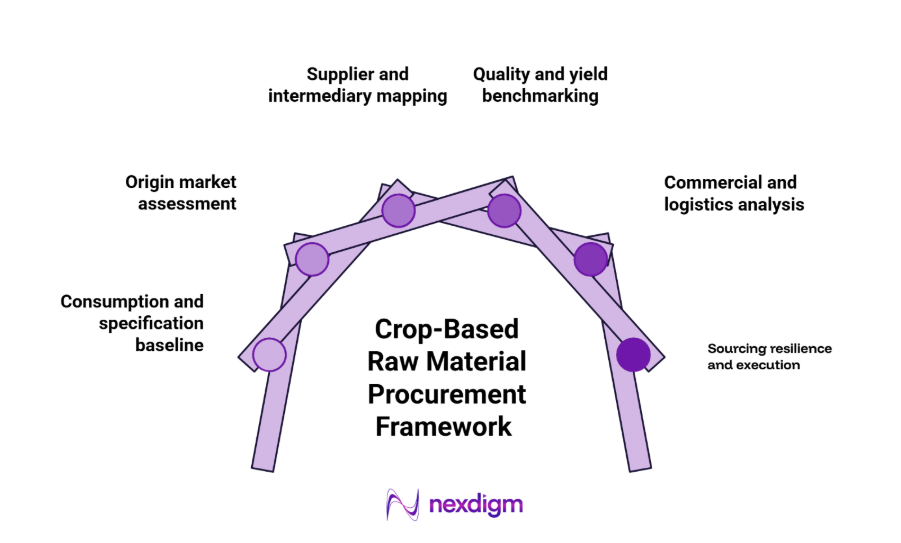
- Consumption and specification baseline: Establish annual and monthly material requirements, production schedules, acceptable quality ranges and critical processing parameters. Separate essential specifications from negotiable preferences.
- Origin market assessment: Identify major producing states, districts and agricultural clusters. Review crop acreage, production trends, harvest calendars, market arrivals and competing demand to understand the depth of supply.
- Supplier and intermediary mapping: Identify farmers’ organisations, aggregators, traders, processors, exporters and organised suppliers. Trace important upstream relationships to determine whether apparently separate vendors depend on common sources.
- Quality and yield benchmarking: Compare material specifications, testing practices, rejection rates, storage conditions and processing yields. Evaluate the cost of usable material rather than relying only on quoted commodity prices.
- Commercial and logistics analysis: Assess seasonal price movements, procurement terms, freight, handling, storage, insurance and working capital. Calculate delivered cost across alternative origin markets.
- Sourcing resilience and execution: Qualify secondary origins, establish supplier performance measures, define inventory buffers and create contingency arrangements for weather, logistics or market disruptions.
Nexdigm’s Case Study: Evaluating Agricultural Raw Material Origins
Nexdigm assessed 7 origin markets across 5 crop-based raw material categories, comparing production trends, supplier networks, seasonal pricing and logistics costs. The research identified 11 qualified sourcing options and 3 opportunities to reduce regional supply concentration.
To take the next step, simply visit our Request a Consultation page and share your requirements with us.
Harsh Mittal
+91-8422857704