
Crop productivity is increasingly diverging across regions as farmers experience different access to improved seeds, irrigation, fertilizers, mechanization, technology, extension services, and climate-resilient practices. Understanding these differences is important for agribusinesses, input companies, investors, governments, and agricultural organizations seeking opportunities to improve productivity and expand market reach.
Recent statistics highlight the scale of productivity gains. FAO estimates that global cereal production reached approximately 3.1 billion tonnes in 2024, with maize, wheat, and rice accounting for major shares of output. FAO also reports that global agricultural productivity has increased substantially over recent decades, although growth rates vary considerably between regions.
These trends create opportunities to identify regions where yield improvements can be supported through better inputs, precision agriculture, irrigation, soil management, mechanization, and farmer advisory services. A structured crop-yield assessment helps organizations distinguish productivity constraints from scalable growth opportunities.
Understanding Regional Differences in Crop Productivity
Crop yields are influenced by a combination of agronomic, economic, and environmental factors. While some regions benefit from improved seeds, mechanization, irrigation, and advanced farming technologies, others continue to face constraints related to resource availability, infrastructure, and climate variability.
These differences are reflected in global productivity trends. According to the USDA Economic Research Service, global agricultural output grew by an average of 1.63% annually during 2021-23, but productivity growth varied significantly across countries, highlighting substantial regional disparities in agricultural performance.
Understanding these variations is essential for identifying yield gaps, addressing productivity constraints, and uncovering scalable opportunities to enhance agricultural performance through targeted investments and interventions
From Productivity Trends to Yield Assessment
The widening gap in crop productivity underscores the need for a structured evaluation of the factors influencing regional agricultural performance. While natural conditions remain important, sustained yield growth is increasingly shaped by access to improved inputs, irrigation, technology, mechanization, and farmer support systems.
To help stakeholders identify productivity constraints and scalable growth opportunities, Nexdigm applies a data-driven assessment approach that examines the key drivers and latest trends behind regional yield performance and long-term agricultural competitiveness.
Nexdigm’s Approach to Crop Yield Trend Analysis
At Nexdigm, Crop Yield Trend Analysis goes beyond measuring production outcomes to examine the factors influencing productivity across regions and farming systems. The strategic approach assesses trends in input adoption, irrigation, agronomic practices, technology usage, infrastructure, and farmer support ecosystems.
By combining yield data with market and operational insights, Nexdigm helps stakeholders identify productivity gaps, evaluate growth drivers, and uncover opportunities for sustainable agricultural development.
Nexdigm’s Crop Yield Assessment Framework
To support effective Crop Yield Trend Analysis, Nexdigm evaluates regional productivity performance through a structured framework that identifies both yield constraints and growth enablers across agricultural systems. The framework assess the following areas:
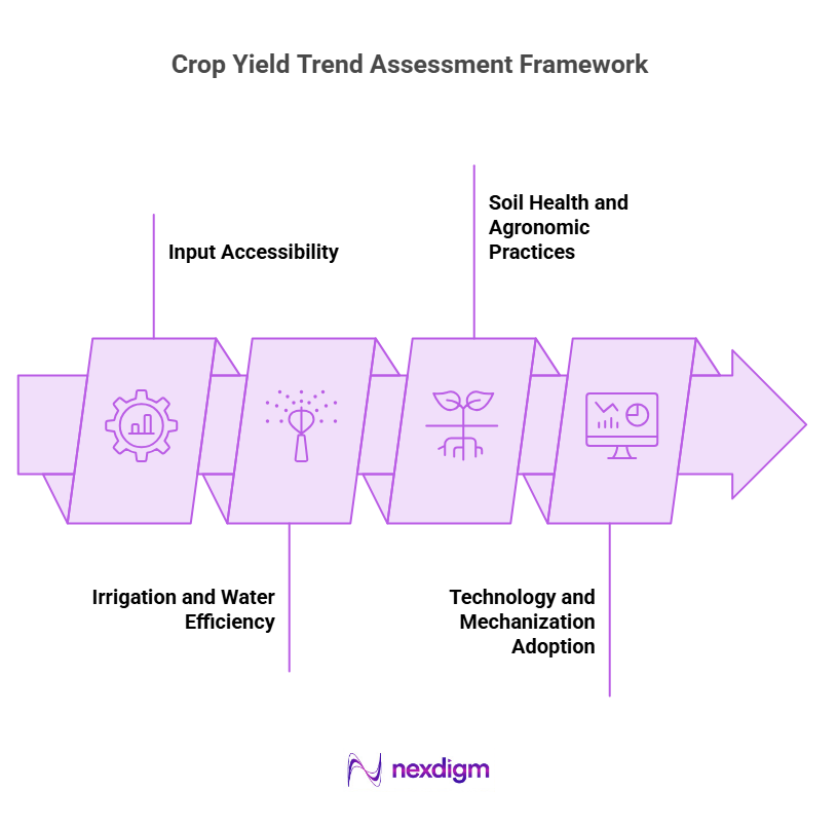
- Input Accessibility: Assess the availability and adoption of improved seeds, fertilizers, crop protection products, and other critical inputs that directly influence crop productivity and yield outcomes.
- Irrigation and Water Efficiency: Evaluate irrigation coverage, water-management practices, and resource efficiency to understand their impact on production stability and resilience.
- Technology and Mechanization Adoption: Analyze the use of precision agriculture, farm mechanization, digital tools, and modern technologies that enable operational efficiency and productivity improvements.
- Soil Health and Agronomic Practices: Examine soil fertility, nutrient management, crop management techniques, and sustainable farming practices that contribute to long-term yield growth.
This framework provides a comprehensive view of regional productivity trends. This approach helps stakeholders prioritize investments, address yield constraints, and unlock scalable opportunities for long-term agricultural growth.
Nexdigm’s Crop Yield Assessment: Identifying Agricultural Growth Opportunities
Beyond identifying productivity trends, Nexdigm’s framework helps stakeholders translate assessment insights into strategies that drive sustainable agricultural growth. By evaluating the following areas, Nexdigm helps organizations with:
- Target High-Potential Regions: Identifying geographies where productivity constraints can be addressed through improved inputs, irrigation, mechanization, and agronomic support.
- Prioritize Investment Opportunities: Focusing on resources on solutions that demonstrate strong potential to improve yields, enhance resource efficiency, and deliver measurable economic returns.
- Accelerate Technology Adoption: Supporting the deployment of precision agriculture, digital advisory platforms, and modern farming technologies that enable productivity improvements at scale.
- Strengthen Farmer Ecosystems: Enhancing access to training, extension services, financing, and market linkages to improve adoption rates and long-term productivity outcomes.
This enables stakeholders to move from understanding yield trends to implementing targeted growth strategies. By identifying scalable opportunities and addressing key productivity constraints, organizations can unlock sustainable agricultural growth and strengthen long-term competitiveness.
Nexdigm’s Crop Yield Assessment: Enabling Sustainable Agricultural Growth
Nexdigm’s assessment extends beyond identifying yield trends to uncover opportunities for sustainable agricultural growth. By evaluating productivity drivers, technology adoption, resource efficiency, and farmer support systems, stakeholders can address regional constraints while strengthening resilience and profitability. This approach supports long-term productivity improvements, enhances value-chain performance, and enables agricultural systems that are both economically viable and environmentally sustainable.
Nexdigm’s Case
An agribusiness client engaged Nexdigm to assess regional crop-yield differences across seed quality, irrigation, fertilizer use, mechanization, and farmer practices. The study evaluated 60+ productivity indicators and improved regional investment prioritization by 29%, supporting targeted input strategies, resource allocation, farmer programs, and productivity-focused expansion.
To take the next step, simply visit our Request a Consultation page and share your requirements with us.
Harsh Mittal
+91-8422857704