

A cross-border expansion strategy helps companies enter new international markets while managing regulatory, cultural, and competitive complexity. Expanding across borders requires more than identifying demand; businesses must understand local laws, compliance requirements, consumer behavior, pricing expectations, distribution channels, and competitor activity.
Cross-border expansion strategy enables companies to assess risks, adapt operations, and build a practical roadmap for sustainable growth. It supports informed decision-making, reduces entry barriers, and helps businesses position their products or services effectively in unfamiliar markets while improving acceptance, operational readiness, and long-term competitiveness.
Recent global expansion data shows why a structured cross-border expansion strategy is important. In 2026, companies plan to increase international expansion by 36%, with 42% targeting two or more new markets. However, 36% have delayed or reduced market entry due to localization challenges, while poor localization can cost businesses around 20% of potential revenue annually.
Understanding Cultural Differences That Influence Market Acceptance
Understanding cultural differences helps companies adapt products, messaging, pricing, and customer experience to local expectations, improving trust, relevance, acceptance, and overall market entry success:
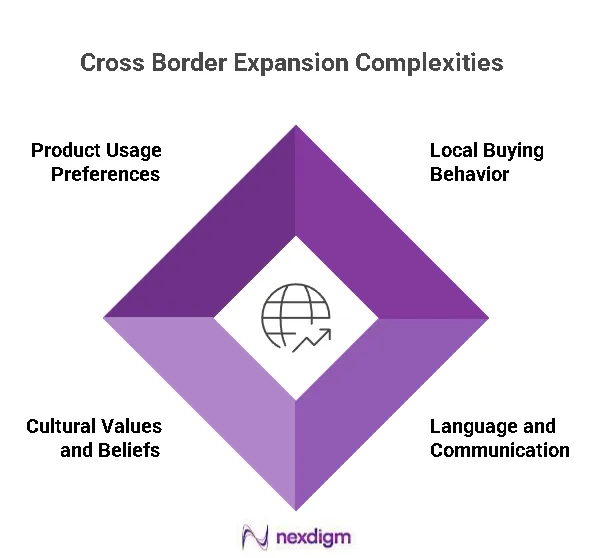
- Local Buying Behavior: Understand how customers research, compare, negotiate, and purchase products to shape an effective market entry approach.
- Language and Communication Style: Adapt wording, tone, visuals, and brand messages to avoid confusion and connect naturally with local audiences.
- Cultural Values and Beliefs: Study traditions, priorities, and social norms that influence product acceptance, trust, and purchase decisions.
- Product Usage Preferences: Identify how customers use similar products locally to adjust features, packaging, service, or delivery models.
Nexdigm’s Market Feasibility Assessment for Global Expansion Decisions
Nexdigm’s market feasibility assessment helps companies evaluate whether a target international market is commercially viable before expansion. It includes analyzing market size, demand potential, customer behavior, competition, regulations, pricing, distribution channels, and entry barriers. These insights help businesses make informed global expansion decisions, reduce cross-border risks, and build a practical market entry strategy for sustainable growth.
Nexdigm’s Regulatory and Compliance Assessment for Cross-Border Expansion
Nexdigm’s regulatory and compliance assessment helps companies understand local laws, approvals, tax requirements, import rules, and operating obligations, reducing risks during cross-border expansion and market entry.
- Reviewing Local Regulatory Requirements: Identify sector-specific laws, licenses, approvals, and operating rules required before entering or expanding in a new market.
- Assessing Tax and Duty Implications: Evaluate corporate taxes, customs duties, transfer pricing, and indirect tax obligations that may affect expansion costs.
- Understanding Import and Export Rules: Review trade regulations, documentation, tariffs, and product clearance requirements to support smoother cross-border movement.
- Checking Product Compliance Standards: Ensure products meet local safety, quality, labeling, certification, and packaging requirements before market launch.
- Evaluating Entity Setup Requirements: Analyze business registration, ownership rules, legal structures, and local presence requirements for compliant market entry.
Nexdigm’s case:
Nexdigm helped a European manufacturing company assess regulatory and compliance requirements before entering India. Nexdigm reviewed 35+ applicable regulations, mapped 12 licensing and approval steps, assessed import duties across 8 product categories, and created a compliance roadmap covering tax, entity setup, product certification, and reporting obligations. This helped the company reduce expected approval delays by 30%, lower compliance risk, and build a more confident cross-border expansion plan.
To take the next step, simply visit our Request a Consultation page and share your requirements with us.
Harsh Mittal
+91-8422857704