

Cross-border freight is becoming increasingly complex as global trade networks expand and supply chains grow more interconnected. Cross-border freight intelligence provides businesses with critical insights into trade flows, regional demand patterns, and emerging logistical challenges. By leveraging competitive intelligence, companies can monitor competitor strategies, anticipate market shifts, and identify new opportunities for efficiency and cost optimization.
Integrating these insights into logistics planning allows organizations to make informed, data-driven decisions, mitigate risks, and maintain a strategic advantage. Effective use of cross-border freight intelligence is essential for navigating today’s dynamic and competitive international trade environment.
Global trade continues to expand, with total trade flows expected to exceed USD 35 trillion, driven by growth in goods and services across major regions. Maritime transport carries over 80 % of traded goods by volume, highlighting the scale of cross‑border freight activity. In North America alone, transborder freight moved more than USD 1.6 trillion in 2025, with notable increases in truck and air freight segments. These figures illustrate the scale and importance of cross‑border freight in global commerce.
Using Competitive Intelligence to Navigate Cross-Border Logistics Challenges
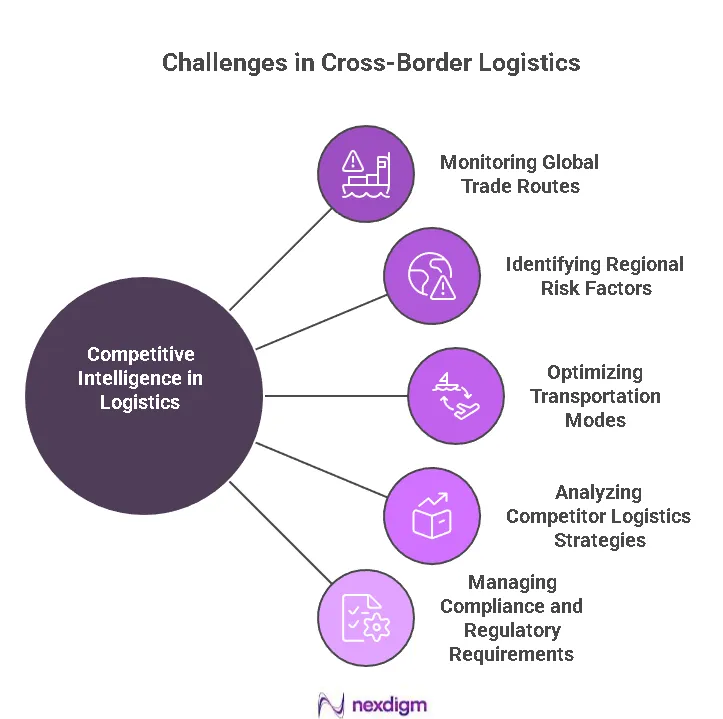
Using competitive intelligence in cross-border logistics helps businesses monitor trade patterns, anticipate disruptions, optimize routes, manage costs, and make data-driven decisions, ensuring efficient operations and a strategic advantage globally:
-
Monitoring Global Trade Routes
Competitive intelligence tracks key shipping lanes, port activity, and trade flows to optimize cross-border route planning and efficiency.
-
Identifying Regional Risk Factors
Analyzing geopolitical, regulatory, and economic factors allows businesses to anticipate disruptions and mitigate cross-border logistics risks effectively.
-
Optimizing Transportation Modes
Intelligence insights guide selection of shipping, air, or land modes based on cost, speed, and regional constraints.
-
Analyzing Competitor Logistics Strategies
Monitoring competitor supply chain operations helps businesses refine their own strategies, maintain competitiveness, and identify market opportunities.
-
Managing Compliance and Regulatory Requirements
Cross-border intelligence ensures adherence to customs, tariffs, and international regulations, reducing delays and penalties.
Cost and Risk Management Solutions in Cross Border Freight by Nexdigm
Nexdigm’s Cost and Risk Management Solutions for cross-border freight help businesses identify and mitigate financial and operational risks. By analyzing tariffs, regulatory requirements, fuel fluctuations, and geopolitical factors, Nexdigm enables proactive planning, cost optimization, and route efficiency. Leveraging competitive intelligence and data-driven insights, companies can reduce delays, avoid penalties, and maintain resilient, cost-effective international logistics operations.
How Nexdigm Enhances Cross-Border Freight Intelligence for Global Trade?
Nexdigm enhances cross-border freight intelligence by analyzing trade flows, monitoring competitor strategies, and leveraging data-driven insights, enabling businesses to optimize logistics, manage risks, reduce costs, and gain strategic advantage.
-
Monitoring Global Trade Flows
Nexdigm tracks international shipping lanes, port activity, and trade volumes to optimize cross-border logistics and identify emerging opportunities.
-
Analyzing Competitor Strategies
Competitive intelligence helps businesses anticipate competitor moves, pricing strategies, and route optimization, maintaining a strategic edge in global freight.
-
Identifying Regional Market Trends
Nexdigm evaluates regional trade patterns, demand fluctuations, and economic shifts to guide strategic decisions in cross-border freight operations.
-
Risk and Compliance Management
By monitoring tariffs, regulations, and geopolitical factors, Nexdigm ensures compliance while mitigating operational and financial risks.
-
Leveraging Data Analytics and AI
AI-driven insights and predictive analytics allow proactive decision-making, cost optimization, and efficient management of freight demand cycles.
Nexdigm’s case:
Nexdigm helped a rapid‑growth diagnostics manufacturer optimize its distribution network, achieving 16 % cost savings through improved demand planning and warehouse utilization. By restructuring transportation lanes and negotiating better logistics arrangements, service levels increased by 7 %, and the addition of new strategic warehouse locations delivered an extra 27 % reduction in overall supply chain costs. These improvements enhanced operational efficiency and competitiveness
To take the next step, simply visit our Request a Consultation page and share your requirements with us.
Harsh Mittal
+91-8422857704