

Cross-border freight is being reshaped by shifting trade routes, nearshoring, e-commerce, manufacturing expansion, and changing supply-chain strategies. UNCTAD reported that global trade reached a record $35 trillion in 2025, with merchandise trade contributing strongly to the increase.
However, growing trade does not mean every corridor offers the same opportunity. Freight volumes can be constrained by border delays, limited capacity, customs complexity, fuel costs, infrastructure gaps, and geopolitical disruption.
For logistics companies, freight operators, ports, infrastructure investors, manufacturers, technology providers, and financial institutions, understanding these differences is critical.
A Cross border freight market assessment helps evaluate corridor volumes, capacity, freight costs, border friction, infrastructure, trade flows, competition, and future growth.
Nexdigm connects trade and logistics intelligence to identify the corridors, markets, and freight segments with the strongest commercial potential.
How Nexdigm Tracks Trade Movement
Nexdigm begins by studying how goods move between markets. Trade volumes are analyzed alongside commodity categories, origin-destination patterns, manufacturing activity, e-commerce shipments, and seasonal changes.
This shows whether freight growth is temporary or supported by deeper changes such as new production facilities, regional trade agreements, supplier relocation, or growing consumer markets.
Nexdigm can then compare rising trade demand with existing transportation and storage capacity.
Nexdigm in Measuring Corridor Strength
A growing corridor needs more than high shipment volumes. It also requires reliable connectivity and sufficient infrastructure.
Nexdigm assesses corridor performance through freight growth, road and rail connections, port access, available capacity, transit reliability, and competitive intensity.
This analysis helps identify corridors where additional logistics services or infrastructure could capture expanding demand.
Nexdigm in Finding Capacity Pressure
Freight growth can expose bottlenecks across the logistics network. Nexdigm helps stakeholders assess whether existing infrastructure can sustainably support future freight demand and economic growth. Nexdigm evaluates:
- Trucking availability: Assesses fleet size, driver availability, and road network efficiency to determine freight movement capacity and potential constraints.
- Rail capacity: Evaluates rail infrastructure, cargo handling capability, and network utilization to identify congestion risks and expansion needs.
- Port throughput: Analyzes cargo volumes, berth utilization, and operational efficiency to measure ports’ ability to handle growing demand.
- Warehouses: Reviews storage capacity, occupancy rates, and distribution capabilities to ensure efficient inventory management and logistics support.
The analysis compares current capacity with projected demand. This helps logistics operators identify expansion opportunities while helping investors avoid markets where additional infrastructure could remain underutilized.
Nexdigm in Connecting Transport Modes
Road, rail, sea, and air each serve different freight requirements. Nexdigm evaluates the combination of transportation modes available across major corridors.
Road can provide flexibility for regional movement, rail can support high-volume land transportation, sea remains important for large international cargo flows, and air serves time-sensitive or high-value goods.
Nexdigm identifies where combining these modes can improve transit times, reliability, capacity utilization, or overall transportation economics.
How Nexdigm Finds Market Gaps
Competition across freight corridors varies considerably. Nexdigm compares global logistics companies, regional carriers, freight forwarders, digital freight platforms, customs specialists, warehouse operators, and cold-chain providers.
The analysis highlights underserved customer groups, service gaps, pricing opportunities, and areas where logistics companies can differentiate.
Nexdigm also evaluates digital opportunities such as shipment tracking, freight booking, route optimization, electronic documentation, customs platforms, and supply-chain visibility.
Nexdigm’s Cross Border Freight Market Analysis
Nexdigm’s Cross Border Freight Market Assessment provides a structured framework to evaluate the attractiveness of freight corridors and trade routes. By examining the following factors, the analysis helps businesses and investors identify growth opportunities, operational risks, and infrastructure requirements across cross-border logistics networks.
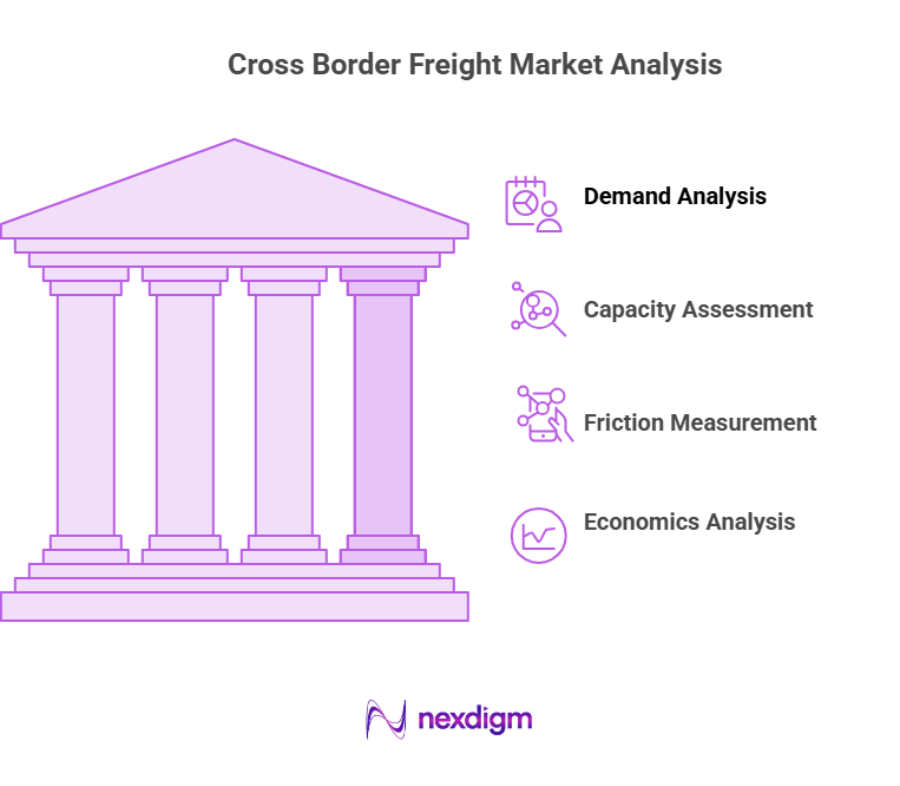
- Demand shows where trade, manufacturing, e-commerce, and freight volumes are expanding.
- Capacity shows whether transportation and storage infrastructure can handle additional demand.
- Friction explains how customs, congestion, regulations, and border processes affect movement.
- Economics determines whether freight rates, operating costs, competition, and investment requirements support attractive commercial opportunities.
These factors provide a practical view of which corridors have strong growth potential and which constraints must be addressed first.
Turning Analysis Into Strategy with Nexdigm
Nexdigm uses corridor intelligence to support decisions around market entry, capacity expansion, network optimization, technology investment, partnerships, and infrastructure development.
The objective is to identify where to grow, where to invest, what constraints to remove, and which services can capture emerging freight demand.
This gives logistics and investment leaders a clearer connection between trade trends and operational strategy.
Building Cross-Border Growth With Nexdigm
Cross-border freight is increasingly influenced by changing trade patterns, nearshoring, e-commerce, infrastructure investment, and supply-chain resilience.
Through Cross border freight market assessment, Nexdigm helps logistics companies, manufacturers, freight operators, ports, investors, and technology providers evaluate trade flows, corridor capacity, freight economics, border friction, competition, and infrastructure.
By connecting trade demand with logistics performance and commercial economics, Nexdigm provides a practical foundation for identifying high-potential corridors, prioritizing infrastructure, improving freight efficiency, and building sustainable cross-border logistics growth.
Nexdigm’s Case
A logistics provider used Nexdigm’s Cross border freight market assessment to identify high-growth corridors and reduce operational bottlenecks. Within 10 months, shipment volumes increased 27%, average transit time fell 22%, corridor utilization improved 31%, and operating costs declined 15%, strengthening service reliability and commercial performance.
To take the next step, simply visit our Request a Consultation page and share your requirements with us.
Harsh Mittal
+91-8422857704