

Cross-border logistics is becoming more important as businesses expand internationally, e-commerce grows, supply chains diversify, and consumers expect faster delivery across markets. Yet border procedures, documentation, customs requirements, infrastructure gaps, and inconsistent regulations can create delays and additional costs.
The World Trade Organization reported that world merchandise trade volume grew 4.6% in 2025, while global commercial services trade increased by 5.3%. These flows continue to create demand for more efficient international logistics networks.
For logistics providers, freight forwarders, e-commerce companies, manufacturers, retailers, importers, exporters and investors, the opportunity lies in logistics solutions which can improve international trade flows.
A Cross border logistics market opportunity study helps evaluate trade corridors, customs processes, transportation networks, service demand, competitive supply, and future growth to identify where cross-border logistics can create such opportunities.
Key Sources of Friction in Cross-Border Logistics
Cross-border shipments can face multiple points of friction throughout the transportation process. Documentation errors, customs inspections, duties, regulatory requirements, port congestion, limited infrastructure, and inconsistent border procedures can increase transit times and logistics costs.
For businesses operating across multiple countries, even relatively small delays can affect inventory availability, customer service levels, working capital efficiency, and overall supply chain performance. Understanding these challenges is essential for identifying opportunities to improve international logistics networks.
The Growing Connectivity of Global Trade
Global commerce is becoming increasingly interconnected as businesses source products, components, and raw materials from multiple countries while serving customers across wider geographic markets.
This trend is driving demand for reliable international transportation, customs management, warehousing, fulfillment, and distribution services. At the same time, the continued growth of e-commerce is increasing the volume of smaller international shipments, creating additional requirements for parcel networks, fulfillment centers, customs technology solutions, and last-mile delivery capabilities.
How Nexdigm Helps Identifies Cross-Border Logistics Opportunity
As international trade networks expand, organizations must determine which trade corridors, customer segments, and logistics services offer the strongest growth potential. Nexdigm’s Cross-Border Logistics Market Opportunity Study provides organizations with a data-driven assessment of international logistics markets.
The study evaluates key factors influencing growth and profitability, helping stakeholders prioritize the most attractive opportunities. The assessment typically includes Trade corridor analysis, Import-export trends and market growth evaluation.
To identify and prioritize such promising opportunities, Nexdigm applies a structured assessment framework that evaluates trade flows, market demand, regulatory requirements, infrastructure, and competitive dynamics.
Nexdigm’s Cross-Border Logistics Framework
Nexdigm’s experts use a framework model which combines Cross border logistics market opportunity study to evaluate important dimensions. These dimensions help organizations understand where cross-border logistics networks face constraints and where new services or infrastructure can create value. And they are:
- Trade Flows: Nexdigm maps import and export volumes, commodities, origins, destinations, and growth patterns to identify major cross-border corridors and emerging trade opportunities.
- Border Processes: The assessment evaluates customs procedures, documentation, inspections, tariffs, clearance times, and regulatory requirements to identify sources of friction affecting cross-border movement.
- Transportation: Nexdigm assesses road, rail, air, sea, and multimodal connections to compare transit times, costs, reliability, and corridor competitiveness across international routes.
- Logistics Infrastructure: The framework evaluates warehouses, distribution centers, border terminals, ports, airports, and logistics hubs to identify capacity gaps and infrastructure requirements.
- Market Opportunity: Nexdigm considers customer demand, competition, e-commerce, industrial activity, investment, and trade forecasts to identify markets with stronger cross-border logistics potential.
The framework analyzes these dimensions, helping organizations identify practical opportunities to make cross-border logistics faster, more reliable, and commercially sustainable.
Applications of Nexdigm’s Assessment Framework
Nexdigm’s Cross-Border Logistics Opportunity Assessment Framework can be applied across a range of business decisions, helping organizations evaluate opportunities, reduce market-entry risks, and prioritize growth initiatives through:
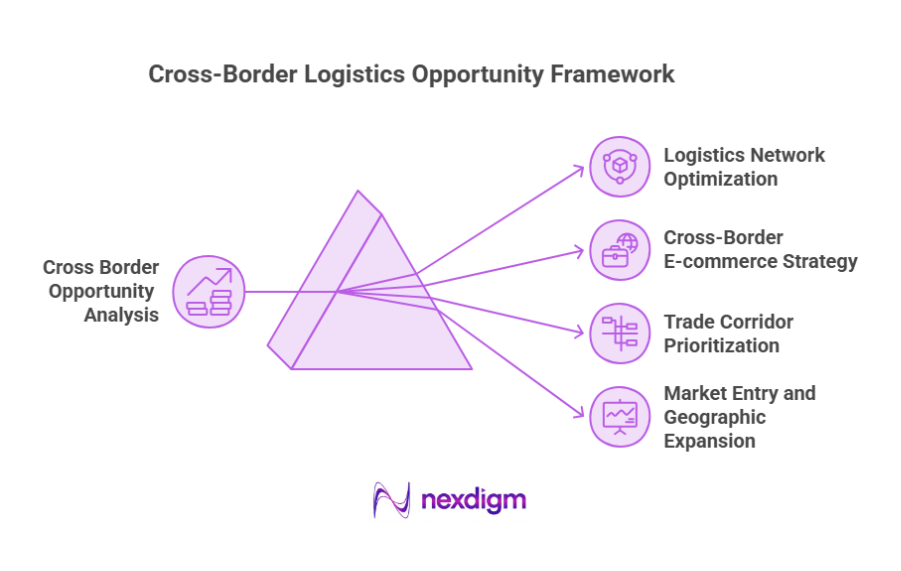
- Market Entry and Geographic Expansion: Identifying attractive countries, regions, and trade corridors for expansion by assessing trade volumes, growth potential, competitive intensity, and regulatory requirements.
- Trade Corridor Prioritization: Evaluating and compare cross-border trade routes to determine where logistics demand, infrastructure readiness, and market attractiveness are strongest.
- Cross-Border E-commerce Strategy: Assessing opportunities arising from growing international e-commerce activity, including fulfillment requirements, customs processes, parcel logistics, and last-mile delivery capabilities.
- Logistics Network Optimization: Supporting decisions related to warehousing, distribution centers, transportation networks, and multimodal logistics infrastructure to improve operational efficiency and service levels.
By applying this framework, organizations can move beyond identifying opportunities to making informed strategic decisions that support sustainable growth and stronger competitive positioning in cross-border logistics markets.
Key Outcomes and Strategic Benefits of Nexdigm’s Expertise
Leveraging Nexdigm’s expertise and structured assessment framework, organizations can identify high-potential trade corridors, evaluate market attractiveness, understand customer demand, and assess competitive dynamics across cross-border logistics markets.
These insights support better investment decisions, market-entry strategies, network optimization initiatives, and service expansion plans, enabling businesses to enhance operational efficiency, strengthen competitive positioning, and achieve sustainable growth.
Nexdigm’s Case
A logistics provider engaged with Nexdigm to assess customs processes, border corridors, warehousing, and transportation networks. The assessment reduced average clearance times by 26%, lowered cross-border logistics costs by 15%, and improved delivery reliability by 20%. The impact enabled faster shipments, stronger customer service, and more efficient international expansion.
To take the next step, simply visit our Request a Consultation page and share your requirements with us.
Harsh Mittal
+91-8422857704