

Cross-border BFSI expansion is rarely a matter of transferring a successful domestic model into another country. Financial institutions operate within different regulatory systems, payment infrastructures, tax regimes, customer behaviours, and data requirements. These differences can change the economics of an otherwise successful business model.
A credible expansion strategy therefore needs to determine which elements of the domestic model can travel, which must be localized, and whether the resulting economics justify the investment.
The Entry Structure Comes First
The regulatory framework determines how a foreign institution can operate and how much control it can exercise. Depending on the market and activity, an entrant may consider a direct branch, wholly owned subsidiary, joint venture, partnership, or acquisition.
Each structure creates different trade-offs:
- Wholly owned subsidiary: Greater operational control and flexibility, but requires dedicated local capital and governance.
- Foreign bank branch: Direct access to the parent institution’s capabilities, but potentially narrower operating flexibility and regulatory permissions.
- Joint venture: Provides access to local infrastructure and relationships, while introducing shared governance.
- Strategic partnership: Faster and more asset-light, but with less control over customer relationships and economics.
- Acquisition: Provides immediate market presence and customers, but introduces balance-sheet and integration risks.
The choice should follow the intended business model rather than precede it.
Regulation Can Redesign the Business Model
Cross-border entry requires more than determining whether foreign ownership is permitted. The assessment needs to establish the full regulatory perimeter covering licensing, capital, governance, permitted activities, distribution, data, and reporting.
Capital requirements can also change the economics significantly. Funds may need to be ring-fenced locally, while restrictions on dividends or capital repatriation can affect the parent’s ability to extract returns.
Tax treatment adds another layer. Withholding taxes, transfer pricing, double-taxation arrangements, and the treatment of management or technology fees can materially alter the returns generated by the same operating business.
Local Customers Behave Differently
Products and underwriting models do not automatically transfer across borders.
Credit assessment may need to incorporate different bureau systems, tax records, transaction histories, and informal income patterns. Insurance products can face different claims behaviours and risk perceptions. Wealth customers may have distinct preferences around liquidity, investment products, and trusted intermediaries.
Brand recognition also matters. Customers may be reluctant to place deposits, purchase long-term protection, or transfer investment assets to an unfamiliar foreign institution.
Local partnerships, language capabilities, physical presence, and established distributors can therefore become strategic assets rather than simply distribution expenses.
Localization Changes the Cost Base
The more extensively a business needs to localize, the further its economics can diverge from the parent company’s domestic model.
Localization may involve:
- Local-language customer journeys
- Domestic identity and verification systems
- Local payment infrastructure
- Country-specific underwriting models
- Local compliance and reporting
- Data-storage and processing requirements
- Country-specific product pricing and disclosures
These investments increase upfront costs but can be essential to achieving regulatory compliance and customer adoption.
For this reason, market-entry modelling should calculate returns after localization costs rather than applying the parent company’s existing margins to projected local revenue.
Trust and Distribution Can Determine the Winning Model
A foreign institution may possess strong products and technology but still struggle to acquire customers without local credibility.
The appropriate distribution model depends on the target segment. Institutional and corporate customers may require relationship-led distribution, while mass-market financial products can increasingly use digital and embedded channels. Wealth products may depend on local private banks, IFAs, or established advisory networks.
The strategic question is therefore whether the entrant should build local distribution, acquire it, or access it through partnerships.
Nexdigm’s Cross-Border BFSI Market Entry Framework
Nexdigm’s cross-border market entry bfsi consulting approach evaluates international expansion through five interconnected workstreams:
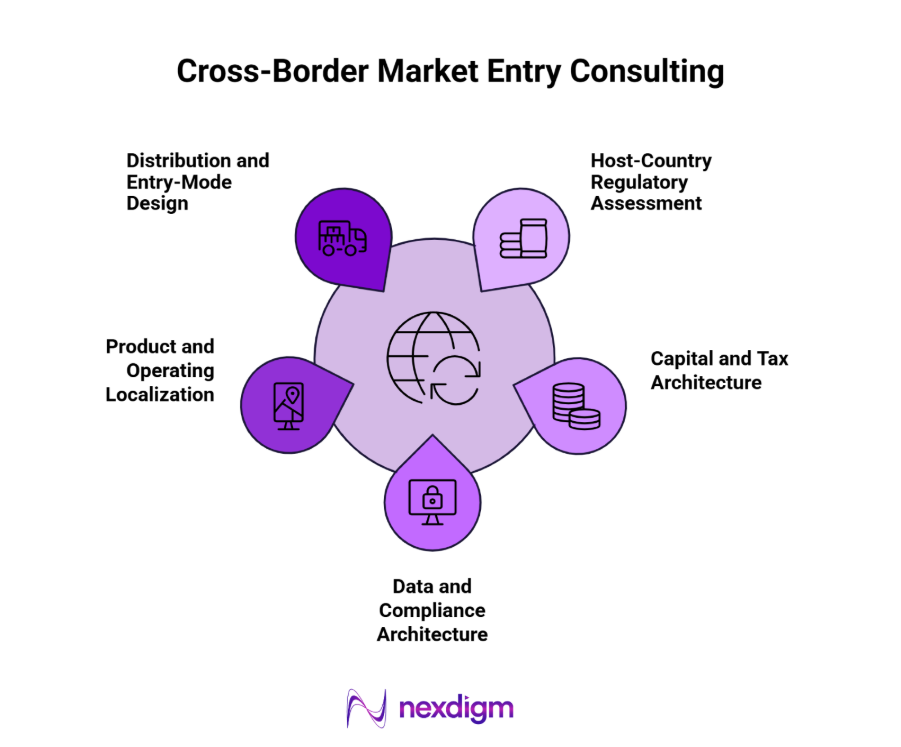
- Host-Country Regulatory Assessment: Map licensing, ownership, permitted activities, capital requirements, regulatory timelines, and supervisory obligations.
- Capital and Tax Architecture: Model local capital requirements, ring-fencing, repatriation, withholding taxes, transfer pricing, and the tax implications of alternative structures.
- Data and Compliance Architecture: Assess data-residency, privacy, cybersecurity, reporting, and technology requirements and determine how local systems should connect with the parent infrastructure.
- Product and Operating Localization: Adapt products, pricing, underwriting, customer journeys, and operating processes to local market conditions.
- Distribution and Entry-Mode Design: Compare branches, subsidiaries, partnerships, joint ventures, and acquisitions based on control, capital intensity, market access, execution risk, and expected returns.
The output is a market-specific entry architecture covering structure, capital, products, distribution, operating requirements, and implementation sequence.
How Nexdigm Tests Cross-Border Expansion Readiness
A Singapore-headquartered financial institution assessing India compared an offshore advisory desk, foreign-bank branch, and locally incorporated NBFC with PMS capabilities. Nexdigm found the offshore model constrained by product and regulatory restrictions, while a bank branch created excessive capital and lending obligations. A localized non-bank model required $350 million over five years and projected 17.6% ROIC by Year 4, supporting board approval.
To take the next step, simply visit our Request a Consultation page and share your requirements with us.
Harsh Mittal
+91-8422857704