

Cross-border payments benchmarking is important for understanding how global payment providers compete in a market valued in annual flows. It compares international payment systems across transfer speed, transaction cost, FX margins, settlement efficiency, transparency, compliance handling, and network reach.
From a competitive intelligence perspective, Cross border payments benchmarking helps businesses identify leading providers, assess competitor strengths, uncover inefficiencies, and find opportunities to improve pricing, reliability, customer experience, and global payment performance.
Cross-border payments are projected to grow from nearly USD 150 trillion in 2017 to over USD 250 trillion by 2027, reflecting rising global trade, mobility, and digital commerce. However, these payments remain slower, costlier, and less transparent than domestic payments. This makes Cross border payments benchmarking essential for improving speed, cost, transparency, and provider competitiveness.
Cross Border Payments Benchmarking and Market Efficiency Analysis
Cross Border Payments Benchmarking and Market Efficiency Analysis compares international payment providers on speed, cost, FX margins, transparency, compliance, and reliability to identify inefficiencies and improve global payment performance.
-
Transfer Speed Benchmarking
Compares payment processing and settlement timelines to identify providers offering faster, more reliable cross-border transactions.
-
Transaction Cost Analysis
Evaluates fees, service charges, and hidden costs to assess affordability and efficiency across cross-border payment providers.
-
FX Margin Comparison
Analyzes exchange rate markups to understand pricing transparency and cost competitiveness in international money transfers.
-
Payment Transparency Review
Assesses tracking features, status visibility, and fee disclosure to improve customer trust and payment experience.
-
Compliance and Risk Control Assessment
Reviews AML, KYC, sanctions screening, and fraud controls to evaluate operational readiness and regulatory strength.
Nexdigm Technology Research on Payment Tracking and Cross Border Settlement Capabilities
Nexdigm Technology Research on Payment Tracking and Settlement Capabilities helps businesses assess how cross-border payment providers use technology to improve transaction visibility, speed, and reliability. It reviews tracking tools, settlement timelines, API connectivity, reconciliation systems, compliance integration, and customer notifications.
These insights support benchmarking, vendor evaluation, operational improvement, and stronger decision-making in global payment ecosystems.
Nexdigm Customer Experience Research for International Payment Journeys
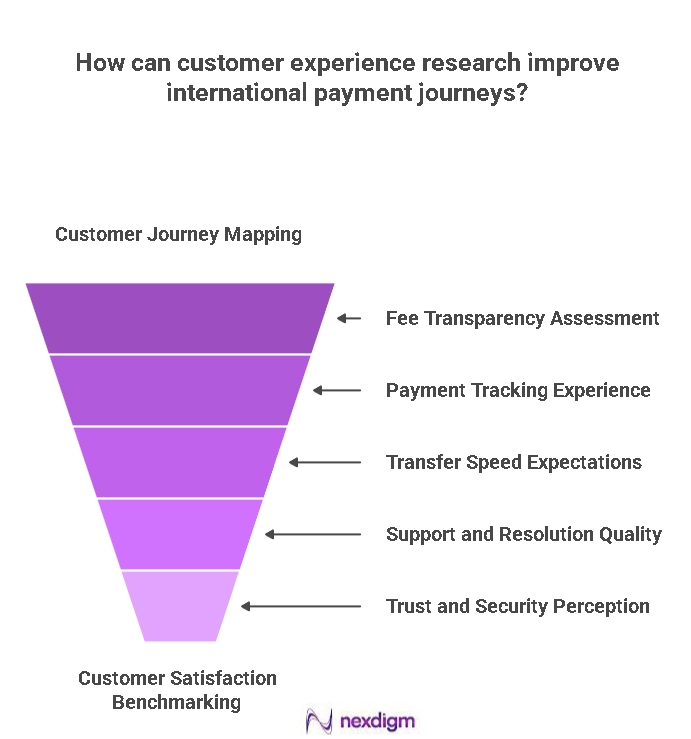
Nexdigm Customer Experience Research for International Payment Journeys analyzes user expectations, transfer pain points, fee transparency, tracking visibility, support quality, and satisfaction levels to improve cross-border payment experiences:
-
Customer Journey Mapping
Tracks each step of international payment journeys, from initiation to settlement, identifying friction points and improvement areas.
-
Fee Transparency Assessment
Evaluates how clearly providers disclose transfer fees, FX margins, deductions, and final recipient amounts.
-
Payment Tracking Experience
Assesses transaction visibility, status updates, notifications, and tracking tools across international payment providers.
-
Transfer Speed Expectations
Studies customer expectations around delivery timelines and compares them with actual processing and settlement performance.
-
Support and Resolution Quality
Reviews customer support channels, response time, dispute handling, and issue resolution during failed or delayed transfers.
-
Trust and Security Perception
Analyzes customer confidence in fraud controls, data protection, authentication, and regulatory compliance.
-
Customer Satisfaction Benchmarking
Measures user feedback, complaints, repeat usage, and loyalty indicators to benchmark international payment experience.
Nexdigm’s case:
Nexdigm assisted an international payment journey opportunities through its UAE e-commerce market research, where cross-border trade and digital checkout behavior were key themes. The study found B2C accounted for 68% of the market, supported by smartphone-led purchasing and digital payment adoption.
To take the next step, simply visit our Request a Consultation page and share your requirements with us.
Harsh Mittal
+91-8422857704