

Cross-border payments are booming across trade, remittances, and digital commerce, but the landscape remains deeply fragmented. Because regulations, currencies, settlement rails, and user preferences vary drastically across borders, where money moves matters just as much as how much moves. Corridor geography defines the opportunity.
The question worth asking is which corridors offer enough demand, manageable friction, and sustainable commercial potential to justify expansion.
A Global Payment Market Made Up of Local Corridors
Cross-border payment activity falls into several distinct demand pools, each with different characteristics.
B2B payments drive the highest volume through trade and business services, while remittances deliver consistent, high-frequency consumer flows. Concurrently, cross-border e-commerce and marketplace payouts are expanding rapidly across merchants, freelancers, and digital creators.
These flows cannot be evaluated using the same criteria. A corporate treasury payment may prioritize reliability and settlement visibility, while a consumer sending money home may be more sensitive to fees and exchange rates.
That distinction makes corridor-level analysis essential.
The Largest Corridor May Not Be the Best Opportunity
While major-currency routes face saturated competition and margin pressure, emerging corridors like US–Mexico and Gulf–South Asia offer higher margins and resilient demand by combining steady remittances with growing B2B and SME trade.
The commercial opportunity therefore depends on the quality of the payment flow, not just its size. Providers need to consider:
- The direction and consistency of transaction flows
- Customer and business segments driving demand
- Existing payment-provider competition
- Currency liquidity
- Pricing and foreign-exchange conditions
- Potential for repeat transactions
- Ease of reaching customers
A corridor with moderate volumes and clear customer pain points can be more attractive than a much larger but heavily commoditized market.
Fees Still Create Room for Switching
Cost remains one of the most visible pain points in international payments. Customers can face transaction charges, foreign-exchange markups, and deductions from intermediary institutions, making the amount ultimately received difficult to predict.
The World Bank’s Remittance Prices Worldwide data has consistently shown global remittance costs above the United Nations Sustainable Development Goal target of 3%. This gap indicates continued room for providers that can offer greater transparency and competitive pricing.
For SMEs, the issue extends beyond the headline fee. Businesses making regular international payments also care about exchange-rate visibility, reconciliation, settlement certainty, and how easily payments can be tracked.
A provider that reduces uncertainty across these areas can compete on the overall payment experience rather than price alone.
Faster Settlement Is Changing Customer Expectations
Domestic payment systems have become increasingly immediate, raising expectations for international transfers. Customers are less willing to accept long and uncertain settlement periods when faster alternatives are becoming available.
Payment infrastructure is responding through direct connections between faster-payment systems. India’s UPI and Singapore’s PayNow, for example, demonstrate how domestic instant-payment networks can be connected across borders.
The implications extend beyond consumer remittances. Faster settlement can help SMEs manage working capital, allow marketplaces to pay international sellers more efficiently, and reduce the operational burden associated with delayed reconciliation.
The opportunity is particularly relevant in corridors where existing payment processes remain slow despite strong transaction demand.
Regulation Can Change the Investment Case
Every corridor also has a regulatory dimension. Providers may need to navigate licensing, customer identification, anti-money-laundering requirements, foreign-exchange controls, reporting obligations, and rules governing how funds can enter or leave a market.
These requirements can significantly influence the cost and complexity of entering a corridor.
The challenge is particularly pronounced in emerging markets where currency controls, documentation requirements, or differences between local and international payment regulations can restrict how providers operate.
At the same time, regulatory modernization is creating new opportunities. Greater interoperability between payment systems and the emergence of regulated digital settlement infrastructure could gradually reduce some of the friction associated with traditional correspondent banking.
Nexdigm’s Cross-Border Corridor Assessment
A Cross-border payments market assessment should determine whether a corridor is commercially attractive after considering both its demand and its operating environment.
Nexdigm can assess each route across five areas:
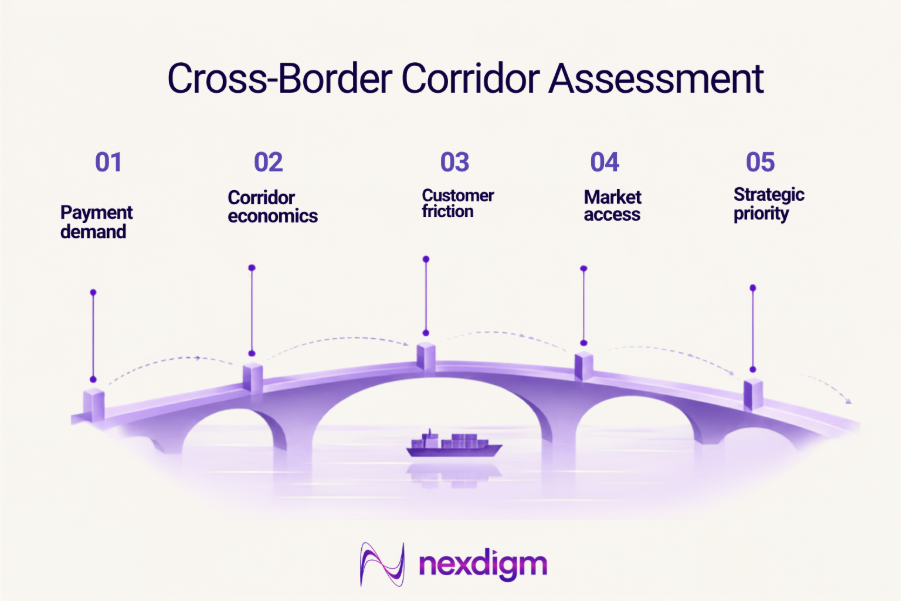
- Payment demand: Identify the major transaction flows and the consumer, SME, enterprise, and digital-commerce segments generating them.
- Corridor economics: Examine pricing, foreign-exchange conditions, transaction characteristics, and the competitive environment.
- Customer friction: Assess where customers experience high costs, slow settlement, limited transparency, or inadequate payment options.
- Market access: Evaluate licensing, compliance requirements, local infrastructure, and potential banking or technology partners.
- Strategic priority: Compare corridors according to demand potential, commercial viability, accessibility, and execution risk.
This creates a practical basis for deciding whether a provider should build its own presence, enter through a local partner, or defer the opportunity.
How Nexdigm Ranks Corridors for Payment Expansion
A payment provider evaluating international expansion screened multiple corridors across remittances, SME payments, and digital commerce.
Nexdigm’s evaluation prioritized 4 high-yield corridors across GCC–South Asia and the Americas, unlocking access to over $120B in addressable remittance and B2B flows.
By targeting routes with 15–25% annual growth, the provider optimized compliance costs and accelerated cross-border market entry.
For payment providers and investors, the opportunity lies in understanding these differences before committing capital. The strongest corridor is the one where customer demand, payment friction, infrastructure, regulation, and commercial economics align.
To take the next step, simply visit our Request a Consultation page and share your requirements with us.
Harsh Mittal
+91-8422857704
[email protected]