

Cross-industry benchmarking helps companies look beyond traditional competitor sets to identify new ways of improving efficiency, reducing costs, and strengthening performance. Instead of comparing only with direct rivals, businesses study best practices from other industries such as manufacturing, retail, logistics, healthcare, and technology to uncover smarter operating models. Cross-industry benchmarking supports competitive intelligence by revealing proven process improvements, digital tools, automation practices, cost structures, and productivity benchmarks from wider markets.
Recent benchmarking studies show that companies can unlock meaningful performance gains by looking beyond direct competitors. Cross-industry benchmarking helps organizations compare cost, cycle time, productivity, and process efficiency against wider best-practice standards. These insights help companies challenge internal assumptions, spot hidden efficiency gaps, and identify opportunities for achieving up to 20% efficiency gains through practical, transferable ideas.
Identifying Cost Optimization Opportunities Through Cross-Industry Benchmarking
Identifying cost optimization opportunities through cross-industry benchmarking helps companies compare processes, cost structures, automation levels, and productivity practices across sectors to uncover savings beyond traditional competitor insights.
- Process Cost Comparison: Compare workflows across industries to identify cost-heavy activities, duplication, delays, and opportunities for leaner operations.
- Automation Benchmarking: Study automation practices in advanced sectors to reduce manual work, improve accuracy, and lower operational costs.
- Productivity Gap Analysis: Benchmark output per employee, cycle times, and resource use to identify areas where efficiency can improve.
- Shared Service Models: Review shared service practices across industries to centralize functions, reduce overheads, and improve process consistency.
- Supply Chain Cost Review: Compare sourcing, logistics, inventory, and vendor management practices to identify cost-saving opportunities.
Nexdigm’s Competitive Intelligence to Compare Best Practices Across Industries
Nexdigm’s competitive intelligence helps businesses compare best practices across industries by analyzing operating models, cost structures, productivity benchmarks, automation adoption, workflow efficiency, and process maturity. By looking beyond direct competitors, Nexdigm enables companies to identify transferable practices, uncover performance gaps, reduce inefficiencies, and apply proven approaches from high-performing sectors to improve business outcomes.
Nexdigm’s Insights for Turning External Benchmarks into Efficiency Gains
Nexdigm’s insights turn external benchmarks into efficiency gains by comparing industry best practices, identifying process gaps, prioritizing improvement areas, and converting market intelligence into practical cost and productivity actions:
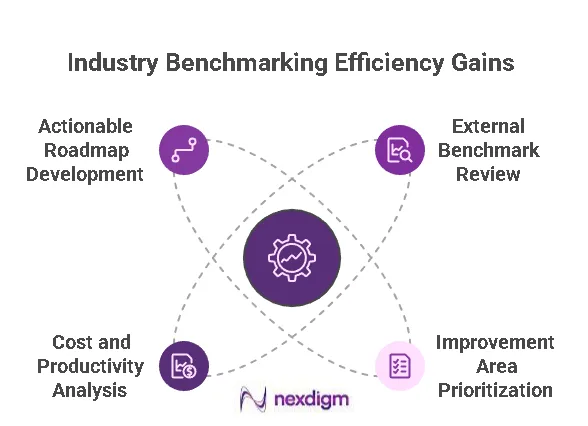
- External Benchmark Review: Nexdigm compares performance standards across industries to identify practices that can improve efficiency and reduce operational gaps.
- Improvement Area Prioritization: Nexdigm helps rank efficiency opportunities based on cost impact, feasibility, implementation effort, and expected performance gains.
- Cost and Productivity Analysis: Nexdigm evaluates cost structures, cycle times, resource utilization, and productivity metrics to identify measurable improvement potential.
- Actionable Roadmap Development: Nexdigm supports structured efficiency roadmaps that guide implementation, performance tracking, and sustainable operational improvement.
Nexdigm’s case:
A mid-sized enterprise services company was facing rising operating costs, repeated process delays, and limited visibility into how other industries were improving productivity. Nexdigm helped the company’s workflows against benchmarks from technology, logistics, and shared services sectors. It uncovered automation gaps, duplicated tasks, and inefficient handoffs.
After applying Nexdigm’s recommendations, the company improved process efficiency by 20%, reduced operating costs by 15%, added USD 4.8 million in revenue, and increased operating profit by USD 1.1 million.
To take the next step, simply visit our Request a Consultation page and share your requirements with us.
Harsh Mittal
+91-8422857704