

The automotive market is seeing a clear shift in consumer preferences, with crossovers becoming one of the fastest-growing vehicle segments. As customer expectations evolve, many consumers are moving away from sedans in favor of vehicles that offer greater versatility without sacrificing comfort or affordability. This trend is influencing how manufacturers develop products, position brands, and compete across key vehicle categories.
A detailed Crossover vehicle market analysis shows that the growing popularity of crossovers is being driven by changing lifestyles, rising demand for feature-rich vehicles, and the increasing preference for models that balance utility, performance, and value. To understand where crossovers are gaining ground, it is important to understand the rise of segment, demand trends,, pricing dynamics, and competitive forces shaping this market.
The Rise of the Crossover Segment
Crossovers have successfully positioned themselves between traditional sedans and full-sized SUVs. Consumers are increasingly attracted to crossover vehicles because they offer:
- Higher driving positions
- Improved interior space
- Greater versatility
- Better fuel efficiency than larger SUVs
- Urban-friendly dimensions
- Enhanced safety perception
As a result, many markets are experiencing steady migration from sedan and hatchback segments toward compact and mid-sized crossovers. Emerging economies are also witnessing growing crossover adoption as disposable incomes rise, and lifestyle preferences evolve.
The Four Dimensions of Crossover Vehicle Market Assessment
The growth of crossover is being shaped by a combination of evolving consumer preferences, shifting vehicle demand, pricing dynamics, and competitive pressures. To understand where crossovers are gaining ground and where future opportunities exist, it is important to evaluate the market through four key dimensions:
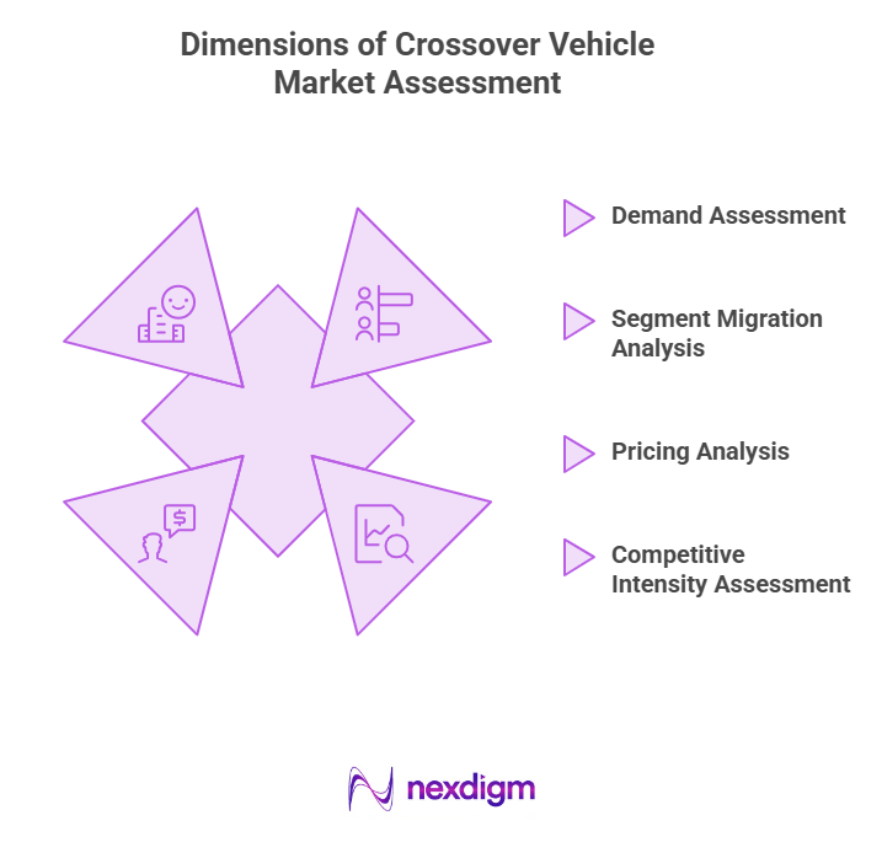
Dimension 1: Demand Assessment
Demand is the foundation of any market opportunity evaluation. Before investing in a segment, organizations must understand whether customer interest is growing, stable, or declining. It involves thorough assessment of:
- Vehicle ownership trends
- Consumer preferences
- Demographic patterns
- Urbanization rates
- Household income growth
- Financing accessibility
Organizations like Nexdigm provide detailed demand assessment that help businesses identify markets where crossover adoption has both current momentum and future growth potential.
Dimension 2: Segment Migration Analysis
One of the most revealing aspects of a Crossover vehicle market analysis is understanding which vehicle segments are losing share to crossovers. Key migration patterns include:
- Sedan to Compact Crossover: Consumers seeking enhanced space and elevated driving comfort.
- Hatchback to Entry-Level Crossover: Buyers upgrading their lifestyle and vehicle expectations.
- SUV Downsizing: Drivers moving from larger SUVs toward fuel-efficient crossover alternatives.
Nexdigm helps manufacturers understand these transitions, enabling product portfolios to align more closely with evolving consumer demand.
Dimension 3: Pricing Analysis
Pricing plays a critical role in determining the attractiveness and profitability of the crossover segment. Beyond vehicle affordability, organizations must assess how pricing influences customer preferences, segment positioning, and purchasing decisions. Nexdigm evaluates pricing dynamics by analyzing:
- price bands
- feature-to-value perceptions
- premiumization trends
- competitor pricing strategies
These factors help businesses identify opportunities for differentiation and sustainable growth.
Dimension 4: Competitive Intensity Assessment
Understanding the competitive landscape is essential for evaluating market attractiveness and long-term success. As more manufacturers expand their crossover portfolios, competition is increasing across price points and customer segments. Nexdigm assesses competitive intensity through:
- market share analysis
- product portfolio benchmarking
- brand positioning
- new model launches
- competitive strengths
These insights help organizations identify gaps, assess risks, and develop effective market entry or expansion strategies. However, it becomes increasingly important to identify where crossover adoption is accelerating, and which customer groups are driving demand. Evaluating these shifts provides valuable insight into where the strongest growth opportunities.
Where are Crossover Segments gaining ground?
The crossovers are gaining traction across multiple passenger vehicle segments as consumer preferences shift toward vehicles that offer greater versatility, comfort, and perceived value. Rather than competing solely with traditional SUVs, crossovers are increasingly attracting buyers who would have previously considered hatchbacks, sedans, or entry-level utility vehicles. The growth is particularly evident across:
- Urban Commuters: Seeking higher seating positions, improved visibility, and practical everyday usability.
- Family-Oriented Buyers: Looking for additional space, safety features, and flexible cabin configurations.
- First-Time SUV Buyers: Preferring crossover models that provide SUV-like appeal at a more accessible price point.
- Premium Vehicle Consumers: Demanding advanced technology, connectivity features, and enhanced driving experiences.
- Younger Buyers: Attracted by modern styling, lifestyle-oriented branding, and multifunctional vehicle capabilities.
The crossover segment presents significant opportunities across the automotive value chain, but realizing this importance requires informed decision-making and strategic planning. Nexdigm helps businesses identify such opportunities through its advisory support.
Nexdigm’s Strategic Support for Crossover Market Expansion
Nexdigm works with automotive businesses to transform market insights into actionable strategies. By combining market intelligence, competitive analysis, and growth-focused advisory capabilities, Nexdigm helps organizations identify high-potential opportunities and make informed expansion decisions in an increasingly dynamic automotive landscape. The major support areas include:
- Automotive market intelligence
- Consumer demand analysis
- Competitive landscape assessment
- Product portfolio evaluation
- Pricing and revenue optimization
- Market entry strategy development
- Distribution network planning
- Growth opportunity identification
By combining market research, commercial analysis, and strategic advisory expertise, Nexdigm helps organizations navigate rapidly evolving automotive markets with greater confidence.
Nexdigm’s Case
Recently, Nexdigm supported an automotive client in assessing crossover demand, segment migration, pricing, and competitive intensity. Real-time analysis improved segment forecasting by 34%, identified migration opportunities, optimized pricing potential by 22%, and strengthened competitive positioning.
Nexdigm’s market assessment approach enabled the client to identify high-growth crossover segments, refine pricing, and prioritize opportunities for profitable expansion.
To take the next step, simply visit our Request a Consultation page and share your requirements with us.
Harsh Mittal
+91-8422857704