

Crude oil trade is entering a period where supply availability, refinery demand, and trade-route resilience are becoming increasingly interconnected. OPEC’s latest outlook projects world oil demand at around 106 million barrels per day in 2026, while the U.S. Energy Information Administration expects U.S. crude production to remain close to 14 million barrels per day.
Meanwhile, the U.S. exported an average of approximately 4 million barrels per day of crude oil during 2025, demonstrating its growing role in international supply.
These movements make trade records increasingly valuable for understanding how sourcing relationships are changing. Crude oil import export analysis can connect import dependence, export availability, supplier concentration, pricing, and routes to reveal emerging supply-security risks and market opportunities.
Refinery Requirements Are Reshaping Import Demand
Crude import demand is closely linked to refinery utilization, domestic production, inventory requirements, and the type of crude refineries are configured to process. A rise in imports can therefore signal more than stronger consumption. It may indicate changing refinery economics, declining domestic supply, or a shift in preferred crude grades. Tracking these factors alongside import origins helps businesses understand where external supply requirements are becoming more important.
Export Availability Can Change Market Access
Export supply can change as producers adjust output, domestic consumption rises, or disruptions affect production and transportation. Changes in export volumes and destination markets can therefore reveal where supply is becoming more available or constrained. Examining exporter concentration, destination shifts, and alternative routes helps businesses understand the resilience of supply networks and identify potential sourcing options when established trade relationships become less reliable.
Nexdigm’s Role in Assessing Crude Trade Import-Export Markets
Crude trade movements can create both exposure and opportunity depending on where supply comes from, how concentrated sourcing is, and how easily markets can access alternative routes. Nexdigm interprets these movements through a broader commercial lens:
- Measure Supply Exposure: Assess supplier concentration, import dependence, production availability, and origin markets to identify where businesses may face sourcing vulnerability.
- Compare Market Options: Examine demand, pricing, supplier participation, infrastructure, and trade routes to distinguish attractive markets from less accessible ones.
- Translate Trade Signals: Connect import-export movements with refinery activity, competitive conditions, and market developments to determine their strategic implications.
This approach helps businesses understand not only how crude trade market is changing, but where those changes could affect sourcing security, market access, and growth.
What Nexdigm Examines Across Crude Trade Markets
Understanding crude trade requires looking beyond import and export volumes. Nexdigm examines the commercial factors surrounding each movement to determine:
- Import and Refinery Signals: Analyse import growth, refinery requirements, domestic production, consumption, and buyer activity to understand changing crude demand.
- Export and Supplier Signals: Assess exporter volumes, supplier concentration, origin markets, destination coverage, and production-linked availability to identify supply shifts.
- Pricing and Route Signals: Evaluate indicative pricing, ports, pipelines, shipping corridors, logistics, and alternative routes to assess sourcing economics and market access.
These areas create the basis for a structured crude oil import export analysis, connecting trade movements with the commercial conditions that influence supply security and market demand.
Nexdigm’s Crude Oil Import-Export Assessment Framework
Nexdigm can structure the assessment around four connected dimensions to understand how import demand, export supply, pricing, and trade routes influence supply security and market opportunity. These dimensions are:
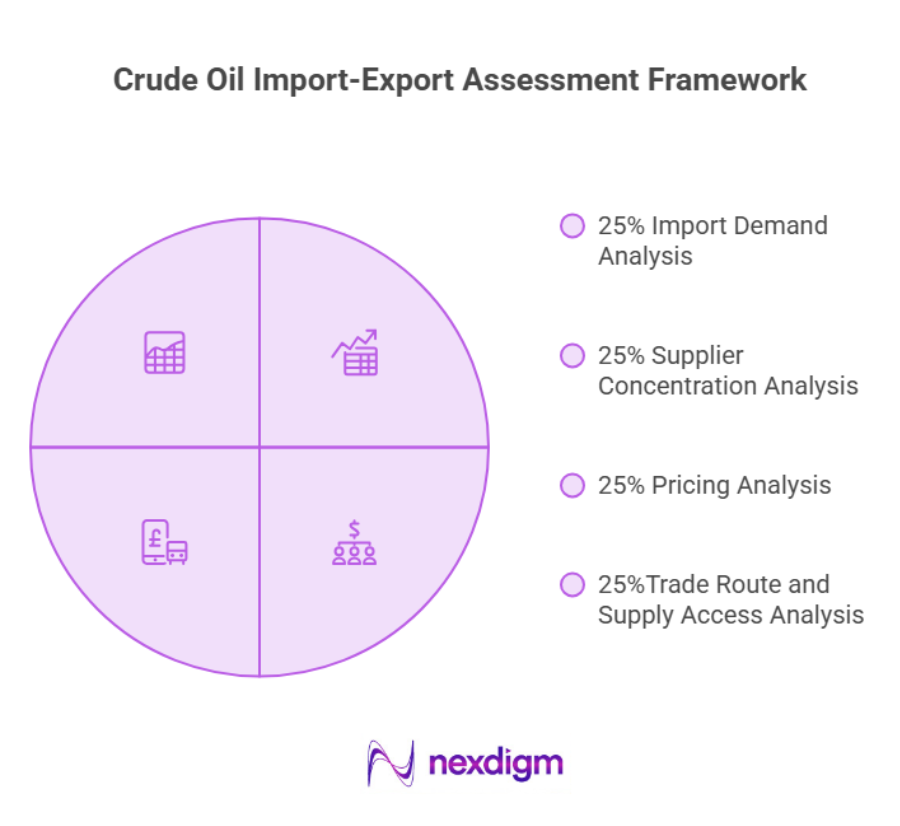
- Assess Import Demand and Market Dependence: Examine import volumes, growth trends, refinery requirements, domestic production, consumption, inventory conditions, and buyer activity to identify markets where dependence on imported crude is increasing.
- Map Export Supply and Supplier Concentration: Analyze export volumes, producing countries, supplier shares, origin markets, destination coverage, and production-linked availability to determine how diversified or concentrated crude supply is.
- Evaluate Pricing and Trade Economics: Compare indicative crude prices, trade values, transportation costs, supplier economics, and destination-market conditions to assess the relative attractiveness of different sourcing relationships.
- Analyze Trade Routes and Supply Access: Assess ports, pipelines, shipping corridors, storage, logistics networks, alternative routes, and infrastructure dependencies to determine how resilient and accessible crude supply is.
The framework brings these dimensions together to help businesses identify changing supply dependencies, emerging demand, sourcing alternatives, route exposure, and commercially attractive market opportunities.
Applications of Nexdigm’s Crude Oil Import Export Assessment
The framework can support decisions across sourcing, market expansion, supply security, and competitive positioning by connecting trade movements with the commercial conditions behind them in the following ways:
- Sourcing and Supplier Diversification: Compare exporters, origins, pricing, supply availability, and routes to identify alternative crude sources and reduce dependence on concentrated suppliers.
- Market Expansion: Identify destinations with growing import demand, refinery requirements, attractive pricing conditions, and accessible infrastructure for potential market-entry or export strategies.
- Supply Security Planning: Assess supplier concentration, import dependence, route exposure, and infrastructure constraints to identify vulnerabilities and develop alternative sourcing or transportation options.
These applications allow businesses to use trade intelligence not only to understand what is changing in crude markets, but where those changes can influence commercial strategy.
Nexdigm’s Case
Nexdigm supported an energy-sector client by analyzing 18,000+ crude trade records across 15 markets, covering 35+ suppliers, origin-destination combinations, and multiple pricing indicators. The assessment identified high-potential trade corridors and 16 supplier relationships for deeper evaluation, supporting more targeted sourcing and market-prioritization decisions.
To take the next step, simply visit our Request a Consultation page and share your requirements with us.
Harsh Mittal
+91-8422857704