

Crude oil trade is being shaped by production changes, refinery requirements, geopolitical disruptions, shipping constraints, and shifting import demand. The U.S. Energy Information Administration estimates global liquid-fuels consumption at 102.4 million barrels per day in 2026, while U.S. crude production is forecast at 13.9 million barrels per day.
Brent crude averaged $114 per barrel in September, up $23 from August, after disruptions affected Middle East oil infrastructure and shipping routes. EIA also estimates that global oil inventories declined by an average 1.9 million barrels per day in Q3 2026.
These developments show why crude oil trade analysis needs to connect import demand, export supply, pricing, and trade routes rather than examining each signal independently.
Import Demand Is Revealing Changing Market Requirements
Crude imports reflect more than consumption. Refinery capacity, domestic production, inventory levels, product demand, and sourcing economics can all influence how much crude a country purchases from overseas. Comparing import volumes across markets and periods can reveal where dependence on external supply is increasing, where buyers are diversifying origins, and where refinery requirements are creating new sourcing opportunities.
Export Supply and Routes Are Becoming More Strategic
Export availability can change quickly when production is disrupted or transportation routes become constrained. EIA estimates that Middle East crude-production shut-ins averaged 4.8 million barrels per day in September, while attacks on Saudi Arabia’s East-West pipeline temporarily affected a route that had been carrying more than 5 million barrels per day of exports. Such developments make origin and route analysis increasingly important for understanding supply exposure.
Nexdigm’s View of Changing Crude Trade
As crude flows shift between producing and consuming markets, businesses need to understand what these movements mean for supply access, sourcing economics, and market exposure. Nexdigm brings trade and energy-market perspectives together to provide this context.
Our Crude Oil Trade analysis connects import demand, export supply, pricing, refinery requirements, infrastructure, and trade routes, creating a clearer picture of the forces influencing crude-market movements.
This provides the foundation for a more focused assessment of where supply is changing, which markets are becoming important, and where businesses may need to adjust their strategy.
Nexdigm’s Crude Oil Trade Intelligence Approach
Crude oil markets can shift quickly as supply, refinery demand, pricing, and transportation conditions change. Nexdigm brings these signals together to understand:
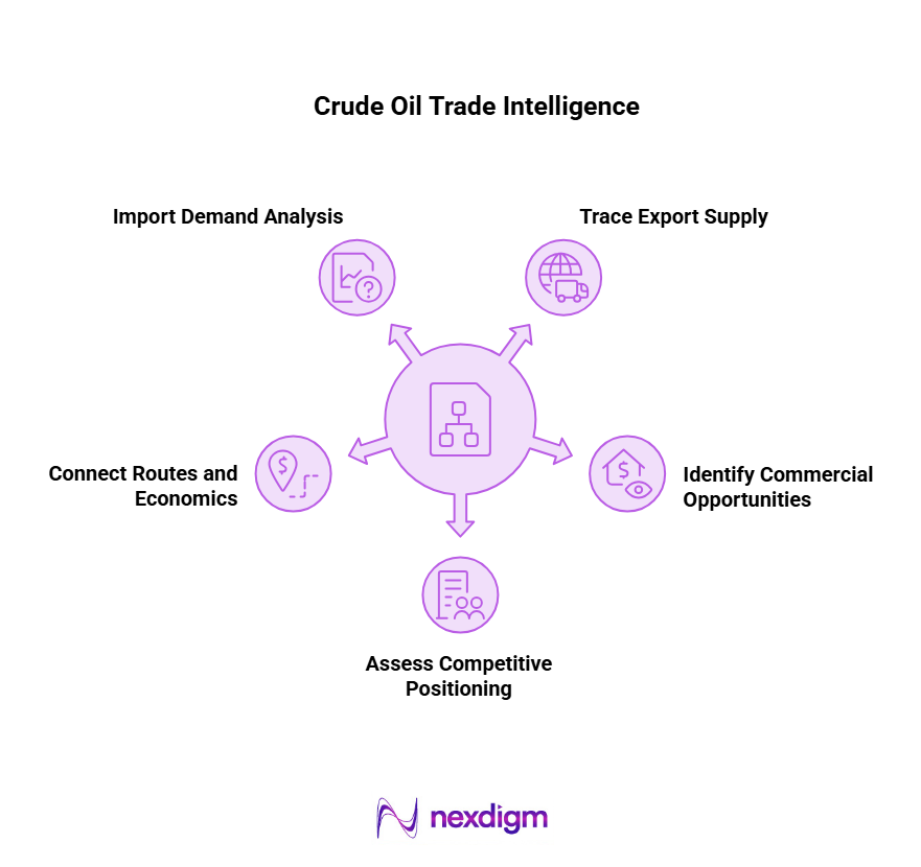
- Read Import Demand: Analyze import dependence, refinery requirements, buyer activity, and demand movements to identify markets where crude sourcing needs are changing.
- Trace Export Supply: Examine exporter participation, production-linked availability, shipment patterns, origins, and supplier concentration to identify changing sources and dependencies.
- Connect Routes and Economics: Assess pricing, ports, pipelines, shipping corridors, and logistics to understand how trade routes influence sourcing attractiveness and supply exposure.
- Assess Competitive Positioning: Compare supplier shares, buyer relationships, company participation, trade volumes, and origin-destination patterns to identify changing competitive dynamics across crude markets.
- Identify Commercial Opportunities: Evaluate demand growth, supply gaps, pricing conditions, alternative suppliers, and market access to identify attractive sourcing, market-entry, and expansion opportunities.
By connecting these perspectives, Nexdigm helps businesses move from tracking crude movements to identifying the market, sourcing, and supply-chain decisions behind them.
Why Businesses Partner with Nexdigm
Businesses partner with Nexdigm for an integrated view of crude markets that connects trade flows with energy research, pricing, competitive intelligence, supply-chain conditions, and market dynamics. This helps decision-makers interpret complex trade movements, evaluate sourcing alternatives, identify market opportunities, assess supplier and route risks, and translate detailed trade data into practical priorities for procurement, market entry, diversification, and growth.
Nexdigm’s Approach Turning Crude Trade Signals into Business Insight
Crude trade data becomes commercially valuable when individual movements are connected with the conditions influencing them. Nexdigm’s approach helps businesses to:
- Understand Market Dependence: Identify where import requirements are increasing, which suppliers dominate, and where buyers may need alternative sources.
- Evaluate Commercial Attractiveness: Compare pricing, demand, supply availability, infrastructure, and trade routes to identify markets and sourcing options with stronger potential.
- Anticipate Supply Exposure: Assess supplier concentration, route dependencies, production changes, and infrastructure constraints to identify vulnerabilities before they affect sourcing decisions.
This perspective moves the analysis from what is happening in crude trade to what businesses can do about it, creating a natural foundation for the detailed assessment.
Nexdigm’s Case
Nexdigm supported an energy-sector client by assessing crude-import markets and 28 potential suppliers, analyzing trade flows, pricing, refinery requirements, infrastructure, and demand indicators. The assessment shortlisted 12 priority markets and 11 viable sourcing options, helping the client strengthen supplier diversification and focus its international expansion strategy on commercially attractive opportunities.
To take the next step, simply visit our Request a Consultation page and share your requirements with us.
Harsh Mittal
+91-8422857704