

The strongest customer service vendor for a financial institution is one that can resolve customer issues accurately across channels while maintaining consistent service quality and manageable operating costs. High call volumes handled at a low price do not necessarily indicate good performance. Repeated customer contacts, unresolved complaints, poor escalation and inconsistent information can create additional costs and damage customer relationships.
Banks, insurers and financial service providers therefore need to assess customer service partners through the entire service journey. This includes how enquiries are received, how agents access customer information, how cases are resolved and how performance is measured across channels.
Omnichannel Capability Must Deliver Continuity
Customer service increasingly operates across telephone, email, chat, mobile applications, websites and social platforms. However, having several channels does not automatically create an integrated service model.
A customer who begins an enquiry through chat and later calls a contact centre should not have to repeat the entire issue. The vendor’s technology should support a consolidated view of customer interactions, case history and resolution status.
Supplier assessment should examine whether the provider can manage interactions across channels through a shared workflow. Important considerations include CRM integration, case routing, interaction history, language support, authentication processes and escalation management.
The institution should also understand which channels the vendor manages directly and which depend on separate technology partners. This helps identify gaps in accountability when a customer interaction moves between systems.
Productivity Should Be Measured Alongside Resolution Quality
Contact centre productivity is often measured through average handling time, calls answered per agent, occupancy and staffing utilisation. These indicators are useful, but they can create the wrong incentives when viewed independently.
An agent who resolves an issue quickly but provides incomplete information may generate repeat calls or complaints. A longer interaction may be appropriate when handling complex loan enquiries, insurance claims or disputes involving multiple records.
A more balanced assessment should consider first-contact resolution, repeat-contact rates, complaint escalation, abandonment, customer satisfaction and adherence to service-level commitments.
The relevance of each metric depends on the interaction type. Routine balance enquiries and password assistance can be assessed differently from loan servicing, policy disputes or claims-related communication.
Quality Assurance and Compliance Need Industry Context
Financial customer interactions involve sensitive information and regulated processes. Vendors must understand customer authentication, data confidentiality, communication standards and escalation requirements relevant to the institution’s services.
Quality assurance should examine call monitoring, interaction reviews, complaint classification, agent training and process documentation. Buyers should also understand how the provider handles sensitive customer information and restricts access to systems.
The institution should establish whether the vendor has experience with banking, lending, insurance or payments. General contact centre experience may not be sufficient for processes involving financial products, customer disclosures or complex service requests.
Cost Comparison Requires a Clear View of the Delivery Model
Customer service providers use different pricing structures. Common models include cost per agent, cost per productive hour, cost per interaction, dedicated team pricing and outcome-linked arrangements.
These structures are not directly comparable without understanding the assumptions behind them. A per-interaction price may exclude technology, training or quality assurance, while a dedicated team model may involve minimum staffing commitments regardless of actual demand.
Buyers should compare workforce costs, supervisory requirements, technology charges, training, transition expenses and additional language or after-hours support. They should also consider the cost of repeat contacts and unresolved cases.
The scale of India’s financial services customer base makes these operating differences significant. The RBI’s annual reporting on banking operations shows continued growth in banking activity alongside greater use of digital channels. As customer interactions become more distributed, vendors need to support both assisted service and digital case resolution.
How customer service supplier evaluation BFSI sector Research Supports Better Selection
A market assessment can help financial institutions understand the supplier landscape before issuing a request for proposal. Nexdigm’s research can identify providers by industry specialisation, delivery location, workforce scale, channel coverage and commercial model.
This is particularly useful when comparing providers that appear similar in size but serve different customer segments. A vendor focused on high-volume retail banking may have a different operating model from one specialising in insurance servicing or complex financial complaints.
Customer Service Vendor Evaluation Framework
A robust customer service supplier evaluation in the BFSI sector requires a structured, multi-dimensional assessment that balances channel integration, compliance, resolution quality, and true total cost of ownership.
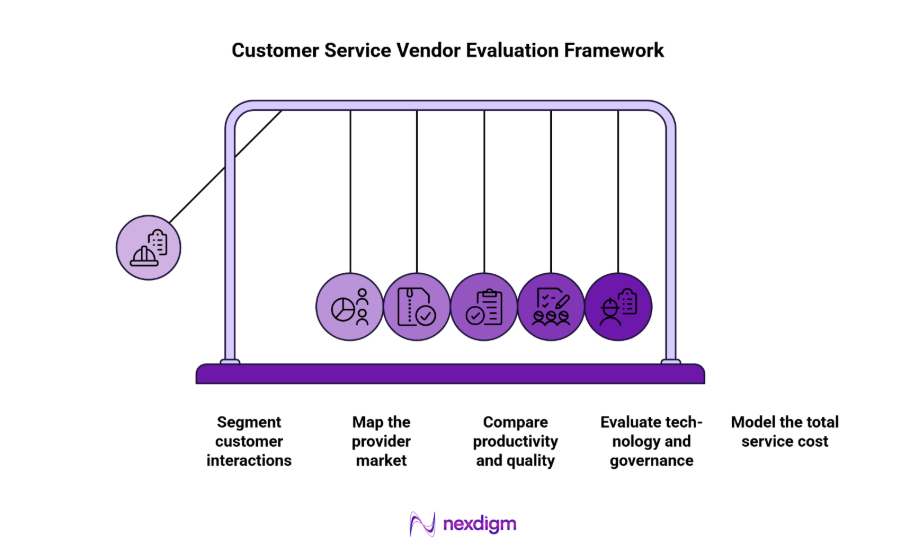
- Segment customer interactions: Separate routine enquiries, complaints, transaction support, claims communication and specialised servicing by complexity and channel.
- Map the provider market: Identify vendors by BFSI experience, workforce capacity, delivery locations and omnichannel capabilities.
- Compare productivity and quality: Assess first-contact resolution, repeat interactions, service levels, complaint handling and quality assurance.
- Evaluate technology and governance: Examine CRM integration, customer data access, authentication, monitoring, agent training and escalation processes.
- Model the total service cost: Compare pricing assumptions, staffing requirements, transition costs and the financial impact of unresolved interactions.
Nexdigm’s Case: Customer Service Provider Assessment
A banking group reviewing outsourced customer support compared 14 providers across voice, chat and email operations. The assessment examined language coverage, service locations, resolution metrics and pricing structures, identifying five suppliers for detailed evaluation across its retail banking and card services operations.
To take the next step, simply visit our Request a Consultation page and share your requirements with us.
Harsh Mittal
+91-8422857704