

A customized market entry strategy is essential when standard expansion playbooks fail across diverse markets. Every country or region has different customer expectations, regulatory requirements, competitive intensity, pricing dynamics, distribution channels, and cultural factors. A generic approach may overlook these differences and lead to delays, weak demand, compliance issues, or poor partner selection.
A strong market entry strategy should therefore be adapted to local market realities, business objectives, and execution risks. By using a customized market entry strategy, companies can make better entry decisions, reduce uncertainty, improve market acceptance, and build a more practical path for sustainable expansion.
The need for a customized market entry strategy is clear, as nearly 70% of cross-border expansions face execution challenges, while 36% of companies have delayed or pulled back from market entry due to localization challenges. Poor localization can cost businesses up to 20% of potential revenue annually, and 75% of companies struggle to adapt products and maintain brand consistency across markets. These figures show why standard expansion playbooks often fail in diverse markets.
Aligning Market Entry Strategy with Local Consumer Behavior and Market Conditions
Aligning Market Entry Strategy with Local Consumer Behavior and Market Conditions means adapting products, pricing, messaging, channels, and entry models to local demand, buying habits, competition, regulations, and cultural expectations.
-
Local Customer Preference Analysis
Study customer needs, cultural expectations, buying habits, and product preferences to shape a more relevant market entry strategy.
-
Pricing Sensitivity Assessment
Evaluate affordability, willingness to pay, competitor pricing, and value perception to design pricing suited to local market realities.
-
Channel and Distribution Review
Identify preferred sales channels, distributors, retailers, and digital platforms to improve reach and customer access.
-
Product Localization Planning
Adapt product features, packaging, service models, and communication style to match local usage patterns and expectations.
-
Competitive Positioning Review
Analyze competitor strengths, market gaps, and customer switching behavior to create a differentiated entry approach.
Nexdigm’s Local Market Assessment for Adapting Standard Expansion Playbooks
Nexdigm’s Local Market Assessment for Adapting Standard Expansion Playbooks helps companies evaluate customer behavior, demand patterns, competition, pricing, regulations, distribution channels, and cultural factors in each target market. These insights allow businesses to modify generic expansion plans into localized strategies, reducing execution risks, improving market fit, and supporting a more practical customized market entry strategy.
Nexdigm’s Risk Assessment Framework for Customized Market Entry Planning
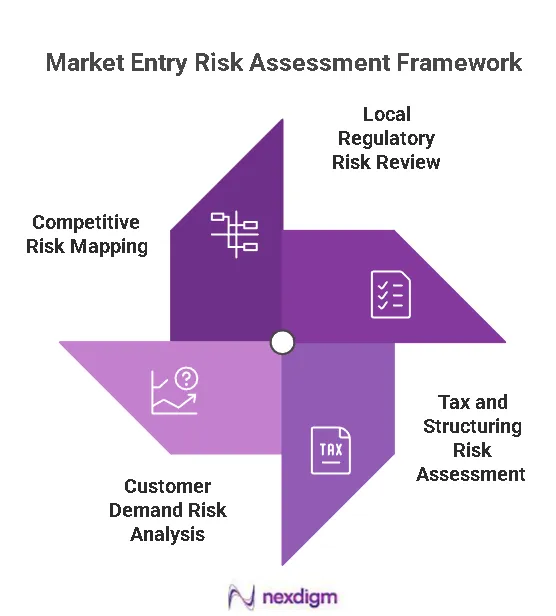
Nexdigm’s Risk Assessment Framework for Customized Market Entry Planning helps companies identify local regulatory, tax, operational, competitive, cultural, and demand-related risks to build a more practical and market-specific expansion strategy:
-
Local Regulatory Risk Review
Nexdigm assesses licenses, approvals, sector rules, and compliance requirements that may affect customized market entry planning.
-
Tax and Structuring Risk Assessment
Nexdigm reviews tax exposure, entity options, duties, and reporting obligations to support market-specific expansion decisions.
-
Customer Demand Risk Analysis
Nexdigm evaluates demand strength, buying behavior, affordability, and adoption barriers before companies commit expansion resources.
-
Competitive Risk Mapping
Nexdigm studies local competitors, pricing pressure, market gaps, and differentiation opportunities to refine entry positioning.
Nexdigm’s case:
A Japanese farm equipment manufacturer needed a customized market entry strategy for India’s tractor market. Nexdigm analyzed competitor performance, sales and distribution networks, manufacturing presence, production capacity, after-sales support, pricing, import-export trends, and state-level incentives across Maharashtra, Haryana, and Tamil Nadu. The team also conducted 20+ industry associate interviews.
Broader Nexdigm market insights show India’s tractor market is expected to cross 1 million annual units by 2035, with farm mechanization exceeding 60%, reinforcing the need for localized entry planning.
To take the next step, simply visit our Request a Consultation page and share your requirements with us.
Harsh Mittal
+91-8422857704