

Cyber defense technologies are gaining strong traction as organizations increase security spending to protect critical systems, sensitive data, and digital operations from evolving threats. Rising attack complexity, stricter compliance expectations, and greater reliance on cloud, remote access, and connected infrastructure are pushing enterprises to invest in advanced defense capabilities.
This creates opportunities for technology providers to build a focused market entry strategy that addresses risk reduction, resilience, threat detection, and response readiness. A successful Cyber defense technology launch strategy should align product features with enterprise security priorities, regulatory needs, and measurable protection outcomes to support adoption in competitive cybersecurity markets.
Rising security budgets show strong demand for cyber defense technologies. The global cybersecurity market is projected to grow from USD 248.28 billion in 2026 to USD 699.39 billion by 2034, at a CAGR of 13.8%. Another estimate places the market at USD 302.0 billion in 2026, reaching USD 663.2 billion by 2033.
Cyber Defense Technology Launch Strategy for Risk-Focused Enterprises
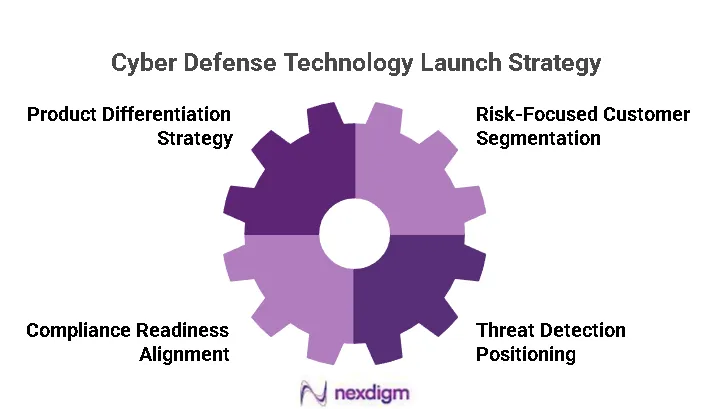
Cyber Defense Technology Launch Strategy for Risk-Focused Enterprises focuses on entering security-driven markets by aligning solutions with threat detection, response readiness, compliance needs, resilience goals, and measurable enterprise risk reduction:
-
Risk-Focused Customer Segmentation
Identify enterprises with high cyber exposure, compliance pressure, sensitive data, and strong demand for advanced defense technologies.
-
Threat Detection Positioning
Position solutions around real-time threat visibility, faster detection, automated alerts, and improved response readiness.
-
Compliance Readiness Alignment
Align technology capabilities with cybersecurity standards, audit expectations, data protection rules, and enterprise governance needs.
-
Product Differentiation Strategy
Differentiate through automation, analytics, integration flexibility, scalability, threat intelligence, and measurable risk reduction outcomes.
Nexdigm’s Product Positioning Strategy for Risk Reduction and Resilience
Nexdigm’s Product Positioning Strategy for Risk Reduction and Resilience helps cyber defense technology providers define clear value propositions around threat detection, response readiness, compliance support, and operational continuity. It supports differentiation by aligning product capabilities with enterprise risk priorities, buyer expectations, measurable security outcomes, and long-term resilience goals.
Nexdigm’s Growth Strategy for Cyber Defense Technologies in Security-Spending Markets
Nexdigm’s Growth Strategy for Cyber Defense Technologies in Security-Spending Markets helps providers identify demand areas, prioritize enterprise segments, refine positioning, plan channels, and scale adoption across risk-focused markets.
-
Go-to-Market Channel Planning
Define direct sales, partner networks, advisory-led outreach, and digital channels to reach enterprise security decision-makers.
-
Pricing and Revenue Planning
Develop scalable pricing models based on deployment size, monitoring depth, response capability, and enterprise security maturity.
-
Proof-of-Value Development
Use pilots, demos, assessments, and performance metrics to validate security outcomes and support faster enterprise adoption.
-
Expansion Roadmap Design
Create phased growth plans covering priority markets, launch milestones, channel development, resource allocation, and performance tracking.
Nexdigm’s case:
Nexdigm helped a cyber defense technology provider build a growth strategy for security-spending markets. Through demand assessment, customer segmentation, competitive benchmarking, pricing review, and channel planning, Nexdigm helped the company identify four priority enterprise segments and refine its launch roadmap. The company improved qualified lead generation by 32%, reduced go-to-market planning time by 30%, and increased pilot conversion opportunities by 26% within the first year.
To take the next step, simply visit our Request a Consultation page and share your requirements with us.
Harsh Mittal
+91-8422857704