

Cyber threats are becoming harder to identify as attackers use legitimate tools, exploit vulnerabilities, and adapt their techniques to evade conventional security controls. Mandiant’s 2026 M-Trends report recorded a global median attacker dwell time of 14 days in 2025, up from 11 days in 2024. It also found that organizations detected malicious activity internally in 52% of investigated incidents, compared with 43% in the previous year.
Meanwhile, another 2026 Cyber Threat Intelligence Survey highlights the growing use of intelligence to detect unknown threats and prioritize security resources. Through cyber threat detection vendor intelligence, enterprises can assess how providers convert threat data into actionable insights, timely detection, and coordinated response capabilities.
From Threat Data to Actionable Security Intelligence
Cyber threat intelligence involves collecting, processing, and interpreting information about potential and active threats. Its value depends on the ability to connect indicators, attacker behavior, vulnerabilities, and threat context with enterprise security operations. Organizations increasingly need platforms that go beyond basic threat feeds to support continuous monitoring, behavioral analysis, investigation, and informed response across changing threat environments.
The Elements That Make Threat Intelligence Operationally Valuable
When evaluating threat intelligence solutions, enterprises should consider three interconnected capabilities:
- Threat Visibility: Assess coverage of threat actors, attack indicators, vulnerabilities, dark web activity, and emerging campaigns across relevant sources.
- Behavioral Analysis: Examine how platforms identify anomalous activity, correlate events, and recognize tactics, techniques, and procedures associated with adversaries.
- Automated Response: Evaluate alert prioritization, intelligence enrichment, workflow orchestration, and integration with security operations to accelerate investigation and containment.
Together, these capabilities help organizations determine whether intelligence platforms can support proactive detection and more effective security decisions.
Bridging the Intelligence-to-Action Gap Through Nexdigm’s Research
Collecting threat information is only valuable when it leads to relevant security decisions. Through cyber threat detection vendor intelligence, our experts can help enterprises examine how providers translate raw intelligence into operational insights. Our research can assess intelligence relevance, contextual accuracy, prioritization mechanisms, and integration with security workflows. This helps organizations distinguish information-heavy platforms from solutions that can support timely threat assessment, investigation, and response.
Nexdigm’s Role in Evaluating Vendor Readiness for Emerging Threat Intelligence Requirements
Cyber threats continue to evolve as attackers adopt new techniques, exploit emerging vulnerabilities, and modify their methods to bypass existing security controls. Our experts can help enterprises assess how prepared vendors are to respond to these developments through:
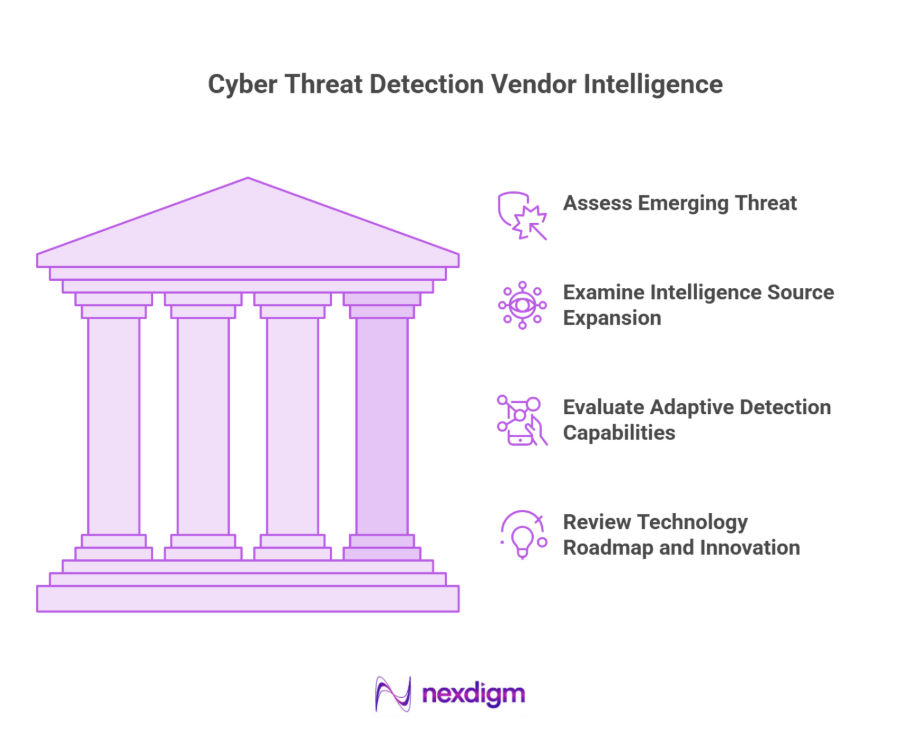
- Emerging Threat Monitoring: Assess how vendors track new threat actors, evolving attack campaigns, emerging vulnerabilities, and changes in adversary behaviour.
- Intelligence Source Expansion: Examine whether providers incorporate relevant sources such as external threat feeds, vulnerability databases, security telemetry, and dark web intelligence.
- Adaptive Detection Capabilities: Evaluate how vendors update detection models, behavioural analytics, and threat correlation methods to identify unfamiliar attack patterns.
- Technology Roadmap and Innovation: Review vendor investments in AI-assisted analysis, predictive intelligence, automation, and other developing capabilities that may strengthen future threat detection.
This assessment helps enterprises understand which vendors are adapting their capabilities to address changing threat conditions and which may have limitations in supporting future cybersecurity requirements.
Understanding the Business Impact of Nexdigm’s Threat Intelligence Investments
Investing in threat intelligence is not solely a cybersecurity decision; it can also influence business continuity, operational efficiency, and risk management. Our intelligence can help enterprises assess the broader business implications by focusing on:
- Risk Exposure and Business Continuity: Examine how vendor capabilities support early threat identification, reduce potential exposure, and help limit disruption to critical business operations.
- Security Operations Efficiency: Assess whether automation, intelligence enrichment, and alert prioritization can reduce manual investigation efforts and improve response workflows.
- Regulatory and Compliance Support: Evaluate how vendors support security monitoring, threat documentation, reporting, and compliance-related requirements.
- Investment and Cost Considerations: Compare pricing models, deployment requirements, integration costs, and scalability to understand the broader financial implications of adopting different solutions.
This analysis helps enterprises connect technical capabilities with business priorities, supporting more informed vendor selection and cybersecurity investment decisions.
Nexdigm’s Case
A multinational enterprise sought to strengthen its threat intelligence capabilities. Nexdigm assessed 20 vendors across monitoring, behavioural analytics, automation, and integration. The research found that 39% had limited emerging threat monitoring capabilities. Based on the assessment, 9 vendors were shortlisted for detailed evaluation.
To take the next step, simply visit our Request a Consultation page and share your requirements with us.
Harsh Mittal
+91-8422857704