

The cybersecurity market is becoming increasingly competitive as organizations accelerate investments in cloud security, endpoint protection, identity management, threat intelligence, and data protection. For cybersecurity providers, entering new markets requires more than technical capabilities; success depends on understanding customer priorities, competitive positioning, pricing models, compliance requirements, and evolving threat landscapes.
Recent market indicators highlight strong growth potential. According to Gartner, worldwide information security spending is projected to exceed $200 billion in 2025 as organizations increase investments in cybersecurity solutions and services.
As cybersecurity adoption expands, providers must identify underserved segments, develop differentiated offerings, build trust, and demonstrate measurable business value to compete effectively.
For cybersecurity vendors, managed security service providers (MSSPs), security software companies, investors and strategy teams, cybersecurity market entry feasibility reports help evaluate market demand, customer requirements, competitive intensity, pricing strategies, and expansion opportunities.
The Expanding Opportunity for Cybersecurity Providers
Rising cyber threats, increasing regulatory scrutiny, and growing investments in digital transformation are driving demand for advanced cybersecurity solutions. As organizations strengthen their security posture, providers have significant opportunities to expand into new markets, customer segments, and service areas.
Factors Driving Differentiation in the Cybersecurity Market
As competition intensifies, cybersecurity providers must demonstrate value beyond core security capabilities. Sustainable growth depends on understanding customer expectations, emerging security challenges, compliance requirements, and areas where providers can establish a distinct market position.
- Solution Differentiation: Identifying unique capabilities, specialized services, and innovation areas that address evolving security requirements.
- Customer Trust & Credibility: Evaluating certifications, industry expertise, service quality, and proof of outcomes that influence purchasing decisions.
- Compliance & Regulatory Alignment: Understanding regulatory requirements and industry standards that shape customer security investments and vendor selection.
Providers that successfully differentiate through expertise, innovation, trust, and customer value are better positioned to win market share, establish long-term client relationships, and achieve sustainable growth in competitive cybersecurity markets.
Nexdigm’s Role in Building Competitive Differentiation for Cybersecurity Providers
In an increasingly competitive cybersecurity landscape, Nexdigm helps providers identify opportunities to differentiate through market intelligence, customer insights, competitive benchmarking, and strategic analysis.
By evaluating customer expectations, compliance requirements, pricing dynamics, and evolving threat trends, Nexdigm enables organizations to strengthen their market position, build customer trust, and develop sustainable growth strategies.
Nexdigm helps cybersecurity providers create differentiated value propositions, target high-potential opportunities, reduce market entry risks, and establish a strong foundation for long-term market success.
Why Cybersecurity Market Entry Feasibility Matters
While market opportunities continue to expand, entering a cybersecurity market without a clear understanding of customer needs, competitive dynamics, compliance requirements, and commercial viability can increase expansion risks. A structured feasibility assessment helps providers validate opportunities, prioritize investments, and develop effective market entry strategies.
To support these decisions, Nexdigm’s cybersecurity market entry feasibility reports provide data-driven insights into market attractiveness, customer demand, competitive positioning, and growth potential, enabling providers to enter new markets with greater confidence.
Nexdigm’s Approach in Assessing Cybersecurity Market Potential
Through its cybersecurity market entry feasibility reports, Nexdigm evaluates the factors that influence market attractiveness, competitive differentiation, and long-term growth potential for cybersecurity providers:
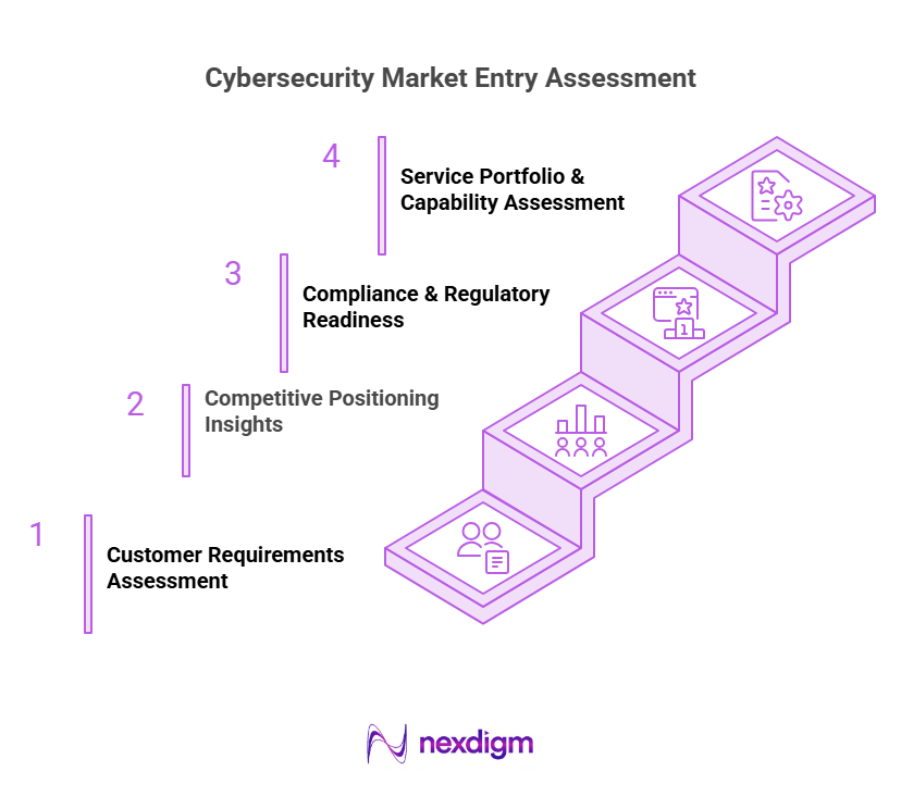
- Customer Requirements & Security Priorities: Assess security challenges, investment priorities, buying criteria, and technology adoption trends across target customer segments.
- Competitive Positioning & Differentiation: Benchmark competitors, service portfolios, pricing models, and market presence to identify differentiation opportunities.
- Compliance & Regulatory Readiness: Evaluate regulatory requirements, industry standards, and compliance expectations impacting market entry and customer adoption.
- Service Portfolio & Capability Assessment: Nexdigm analyzes solution capabilities, delivery models, and service gaps to strengthen market relevance and competitiveness.
With this, Nexdigm helps cybersecurity providers identify growth opportunities, strengthen differentiation, mitigate market entry risks, and develop strategies that support sustainable competitive advantage and long-term business growth.
Applications of Nexdigm’s Cybersecurity Market Assessment Approach
Nexdigm’s cybersecurity market entry assessment supports strategic decision-making across the various areas for growth and expansion. The following applications delivered by Nexdigm’s assessment are:
- New Geographic Market Entry: Assessing demand, competition, regulations, and customer requirements to evaluate expansion into new regions and countries.
- Customer Segment Prioritization: Identifying the most attractive industries, enterprise sizes, and buyer groups based on security needs and spending potential.
- Service Portfolio Expansion: Evaluating opportunities for new cybersecurity offerings, managed services, and specialized security solutions.
- Competitive Positioning Strategy: Benchmarking competitors and market dynamics to strengthen differentiation and value proposition development.
These applications enable cybersecurity providers to make informed market entry decisions, prioritize growth opportunities, strengthen competitive positioning, and build sustainable expansion strategies.
How Nexdigm Helps Build Cybersecurity Expansion Strategies
Building on insights from its cybersecurity market entry feasibility reports, Nexdigm helps providers translate market opportunities into actionable expansion plans. By supporting geographic expansion, customer segment prioritization, service portfolio growth, competitive positioning, partnership evaluation, and investment planning, Nexdigm enables organizations to focus resources on the most attractive opportunities and pursue sustainable, long-term growth.
Nexdigm’s Case
A global cybersecurity provider engaged with Nexdigm to evaluate market entry opportunities across cloud security, identity protection, threat intelligence, and managed security services. The assessment analyzed 50+ market factors and improved expansion strategy effectiveness by 24%, supporting positioning, pricing decisions, partnerships, and go-to-market planning.
To take the next step, simply visit our Request a Consultation page and share your requirements with us.
Harsh Mittal
+91-8422857704