

Cybersecurity vendors operate across increasingly complex portfolios spanning endpoint security, identity protection, cloud security, threat intelligence, network defense, and managed security solutions. Cybersecurity pricing benchmarking consulting helps providers compare licensing structures, subscription tiers, usage-based models, bundling strategies, and competitor positioning.
Through comprehensive Pricing Analysis, organizations get support to identify appropriate pricing gaps and points. These insights support stronger value communication, differentiated packaging, improved monetization, and commercially sustainable pricing decisions across enterprise cybersecurity products and services.
The commercial impact of disciplined pricing can be significant. Recent study reports that a 3% price increase can translate into an 8.7% rise in operating profit, assuming volumes remain unchanged, reinforcing how structured Pricing Analysis Services can strengthen profitability and revenue realization.
Pricing Analysis for Enterprise Cybersecurity Tools and Protection Solutions
Pricing analysis helps cybersecurity providers evaluate how market dynamics, solution capabilities, customer requirements, competition, and commercial models influence price positioning. An effective pricing depends on specific factors that shape willingness to pay and pricing potential. Key pricing drivers include:
- Deployment Model Requirements: Cloud-native, on-premise, and hybrid deployments create different infrastructure, implementation, integration, and maintenance requirements, directly influencing pricing structures and total customer cost considerations.
- Threat and Risk Criticality: Rising threat frequency, attack sophistication, and business exposure increase the perceived value of advanced protection, influencing willingness to pay for mission-critical cybersecurity capabilities.
- Regulatory Requirements: Industry regulations, data protection mandates, audit requirements, and security standards influence solution complexity and customer urgency, supporting differentiated pricing across regulated sectors.
- Feature Differentiation: Proprietary capabilities, AI-enabled detection, automation, analytics, and specialized security features strengthen differentiation and influence premium positioning relative to competing cybersecurity products.
How Nexdigm Supports Strategic Pricing Across Cybersecurity Solutions
Nexdigm supports cybersecurity providers with data-driven Pricing Analysis Services designed to strengthen commercial positioning and revenue potential. With deep expertise across cybersecurity pricing analysis, competitive pricing analysis, pricing benchmarking, price optimization, willingness-to-pay analysis, and pricing strategy consulting, Nexdigm helps businesses establish differentiated, scalable, and sustainable pricing strategies across cybersecurity solutions.
Nexdigm’s Data-Driven Cybersecurity Pricing Strategic Roadmap
Nexdigm’s cybersecurity pricing strategic roadmap follows a structured sequence from market assessment through pricing implementation and ongoing performance evaluation, helping businesses gain a competitive edge. Its key steps include:
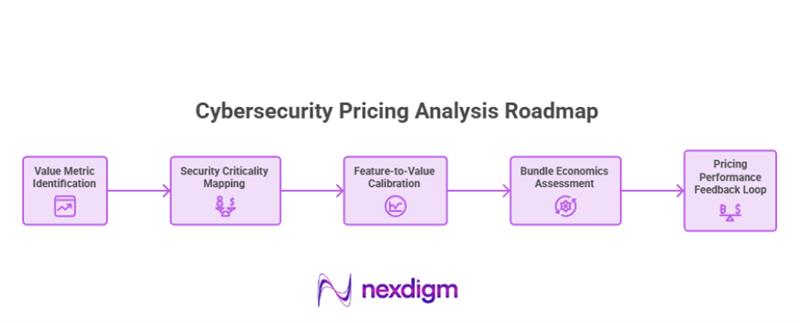
- Value Metric Identification: Identify whether users, endpoints, workloads, protected assets, or consumption levels best represent delivered value and provide a scalable foundation for cybersecurity pricing structures.
- Security Criticality Mapping: Assess threat exposure, operational importance, compliance requirements, and business risk to determine which cybersecurity capabilities justify differentiated pricing and stronger value-based positioning.
- Feature-to-Value Calibration: Map cybersecurity features against customer outcomes and perceived benefits to distinguish essential capabilities from premium functionality and establish clearer differentiation across pricing tiers.
- Bundle Economics Assessment: Evaluate standalone and bundled solution economics to identify combinations that strengthen customer value, encourage cross-selling, simplify purchasing, and improve overall revenue realization across portfolios.
- Pricing Performance Feedback Loop: Track realized prices, win rates, discounting, churn, renewals, and expansion revenue to continuously refine pricing decisions as customer expectations and cybersecurity market conditions evolve.
Nexdigm’s Case
Nexdigm supported a cybersecurity provider in refining pricing across enterprise solutions. Competitive benchmarking, value mapping, and packaging analysis identified monetization gaps, enabling a 16% improvement in realized pricing, 21% higher renewal value, and 18% growth in cross-sell opportunities.
To take the next step, simply visit our Request a Consultation page and share your requirements with us.
Harsh Mittal
+91-8422857704