

As cybersecurity threats intensify and regulatory obligations expand, providers must price solutions to reflect rising delivery costs, customer risk exposure, and evolving market expectations. Cybersecurity pricing strategy analysis consulting helps businesses evaluate service complexity, compliance requirements, threat exposure, competitive benchmarks, and cost-to-serve.
Through structured pricing analysis, providers can refine service tiers, differentiate premium capabilities, assess margin sustainability, and establish commercially viable pricing that balances affordability with the growing value of protection, resilience, compliance, security expertise, and evolving enterprise requirements.
Cybersecurity investment continues expanding as the studies show projected worldwide information-security spending at $213 billion in 2025 and $240 billion in 2026, representing 12.5% annual growth. This rising spend further strengthens the case for Pricing Analysis Services to support value-aligned, competitive pricing decisions.
Cybersecurity Pricing Analysis for Threat and Compliance Cost Management
Cybersecurity pricing analysis helps providers assess threat complexity, compliance obligations and service delivery costs to establish sustainable pricing that reflects security value and evolving market requirements. The analysis can be structured across key dimensions, they are:
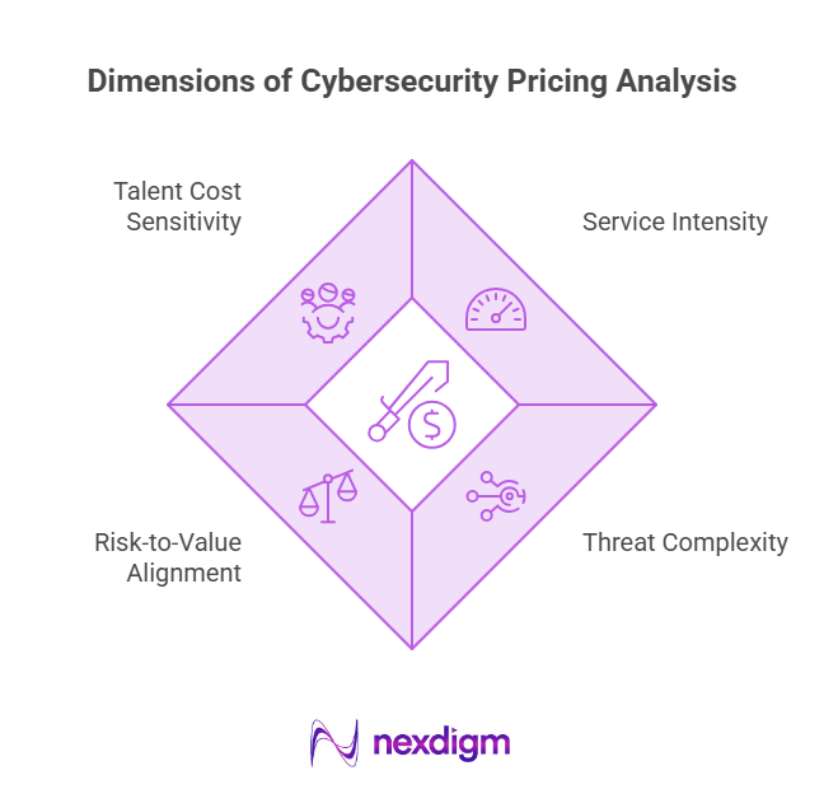
- Security Service Intensity: Measures monitoring coverage, incident response, threat intelligence, vulnerability management, and specialist involvement to align prices with the operational intensity of delivered cybersecurity services.
- Threat Complexity Economics: Evaluates attack sophistication, threat frequency, monitoring intensity, and response requirements to determine how changing cyber risks influence service costs and appropriate pricing levels.
- Risk-to-Value Alignment: Connects customer risk exposure, potential business disruption, asset criticality, and security outcomes with pricing to ensure fees reflect the value of protection and resilience.
- Cyber Talent Cost Sensitivity: Analyzes specialist salaries, certification premiums, scarce-skill requirements, and staffing models to understand how cybersecurity talent economics influence service pricing and sustainable margin levels.
Nexdigm’s Expertise in Pricing Cybersecurity Services for Sustainable Margins
Nexdigm supports cybersecurity providers in developing pricing strategies that account for threat complexity, compliance requirements, service delivery costs, and customer value. Through structured Pricing Analysis Services, Nexdigm helps assess cost drivers, competitive benchmarks, service tiers, and willingness to pay, enabling providers to strengthen price realization, protect margins, improve commercial positioning, and adapt pricing to evolving cybersecurity market dynamics and regulatory demands.
Nexdigm’s Cybersecurity Pricing Intelligence Framework for Sustainable Margins
Nexdigm’s Cybersecurity Pricing Intelligence Framework comprises of features integrated with pricing capabilities that connect risk exposure, delivery economics, regulatory requirements, and market value to help businesses strengthen cybersecurity pricing decisions. These features are as follows:
- Service Intensity Scoring: Measures monitoring coverage, specialist involvement, support frequency, tooling requirements, and response commitments to differentiate pricing according to the actual intensity of security delivery.
- Technology Cost Allocation: Maps licensing, monitoring platforms, threat intelligence, automation, cloud security, and specialist tooling costs to services, improving visibility into technology-driven pricing requirements and profitability.
- Cyber Cost Volatility Tracking: Monitors changes in technology, insurance, threat intelligence, specialist talent, and compliance expenses to identify emerging cost pressures requiring timely pricing adjustments and margin protection.
- Client Risk Economics: Evaluates potential financial loss, operational disruption, regulatory exposure, and reputational impact for customers to determine pricing that better reflects the economic significance of cybersecurity protection.
Nexdigm’s Case
Nexdigm supported a global digital trade finance platform in strengthening cyber resilience through security assessments, continuous monitoring, incident support, and technology optimization. The engagement achieved 70% annual cost savings while strengthening defenses, improving resource utilization, mitigating vulnerabilities, and maintaining robust security standards across operations.
To take the next step, simply visit our Request a Consultation page and share your requirements with us.
Harsh Mittal
+91-8422857704