

Cybersecurity expenditure can be difficult to consolidate because financial institutions procure protection across multiple technology layers. Identity management, endpoint security, network protection, cloud security, threat monitoring, and specialist services may each sit under separate contracts.
The result is a fragmented spending structure in which licence fees, infrastructure costs, implementation charges, and support services are recorded across different budgets. Procurement teams may understand what each product costs individually while lacking a clear view of the total expenditure required to protect the institution’s technology environment.
A meaningful cost analysis should map security spending to the risks and capabilities it supports. It should also account for differences in licensing models, deployment requirements, and service scope before comparing suppliers.
Security Spending Follows the Technology Environment
Financial institutions use a broad range of security products to protect employees, customers, applications, infrastructure, and sensitive data.
Identity and access management platforms control permissions and user authentication. Privileged access management solutions protect sensitive administrative accounts, while endpoint detection tools monitor devices for suspicious activity. Network security products protect traffic and infrastructure, and application security tools help identify vulnerabilities in software environments.
Cloud security introduces further requirements. Institutions may need workload protection, configuration monitoring, encryption, data loss prevention, and access controls across multiple cloud environments.
Each category has different cost drivers. Identity platforms may charge by user or managed account, endpoint products by device, and cloud security tools by workload or consumption. Comparing suppliers without accounting for these billing units can produce misleading conclusions.
Licensing Models Can Conceal Additional Expenditure
The quoted licence price rarely captures the full cost of a cybersecurity solution.
Some suppliers offer a base product with additional charges for advanced analytics, integrations, extended data retention, or specialist modules. Monitoring platforms may price services according to data ingestion, event volumes, monitored assets, or storage requirements. Managed security services can introduce separate fees based on coverage hours, service scope, and support arrangements.
Implementation and integration also affect total expenditure. A product may require specialist configuration, custom connections with existing systems, or additional infrastructure. These costs should be considered alongside annual subscriptions and maintenance charges.
Procurement teams should examine renewal conditions and expansion pricing as well. A solution that is affordable for the current number of users or devices may become substantially more expensive as the institution grows.
Security Services Have Different Commercial Structures
Cybersecurity services include security operations support, managed detection and response, penetration testing, vulnerability assessments, incident response, and specialist advisory work.
These services may be priced through fixed annual agreements, project fees, retainers, or resource-based models. Their scope can vary significantly. For example, a monitoring agreement may cover platform access and alerts, while another may include investigation, escalation, and reporting.
Supplier comparisons should therefore examine the actual service deliverables and coverage. The number of assets monitored, operating hours, escalation arrangements, reporting frequency, and specialist expertise can all influence the commercial value of an agreement.
Regulation Changes the Procurement Requirements
Cybersecurity procurement in BFSI is closely connected to technology governance and operational resilience. RBI’s information technology governance and information security requirements establish expectations around governance, cybersecurity, technology risk, and oversight of outsourced technology arrangements. Applicability varies by the type of regulated institution.
These requirements influence the technologies and services that institutions need to evaluate. Procurement teams should understand how suppliers support access management, security monitoring, incident response, system resilience, audit requirements, and continuity arrangements.
The institution must also consider third-party dependencies, data access, subcontracting, service continuity, and exit arrangements. A supplier’s commercial proposal needs to be examined in the context of these requirements rather than assessed on licence price alone.
Understanding the Supplier Market and Cost Structure
The cybersecurity market includes large technology vendors, specialist security companies, cloud security providers, managed security service providers, and regional implementation partners. Their offerings overlap in some categories, but their areas of specialisation and commercial models can differ considerably.
Cybersecurity procurement cost analysis BFSI research can help institutions map this market and understand how providers price security technologies and services. Supplier profiling can compare product portfolios, deployment models, customer segments, technology partnerships, regional presence, and licensing structures.
This market perspective is useful when an institution is reviewing multiple contracts or considering alternative suppliers. It can help distinguish between a genuine pricing difference and a difference in functionality, coverage, or service requirements.
Building a Cybersecurity Procurement Cost Framework
A structured assessment should examine:
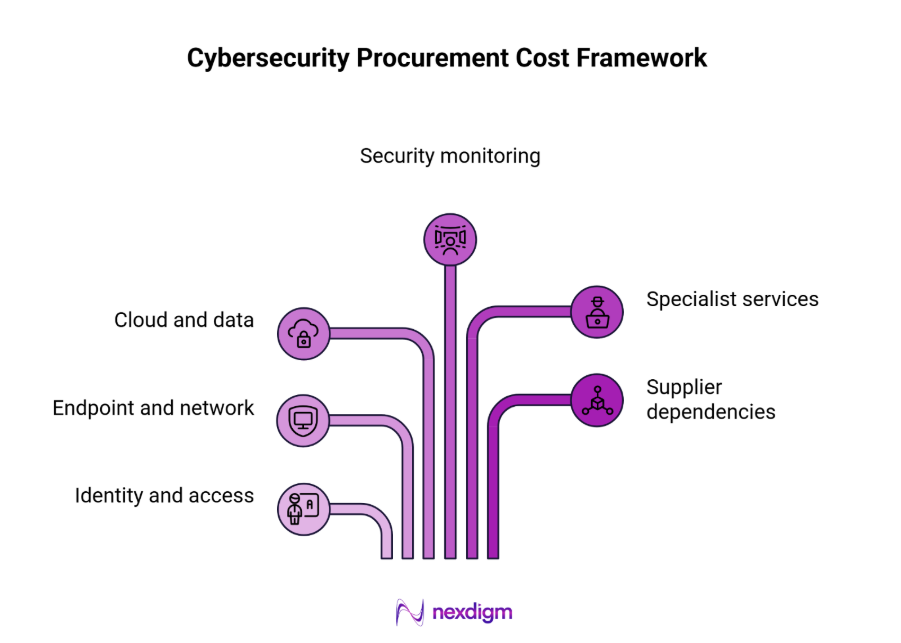
- Identity and access management: Compare user-based, account-based, and privileged access licensing, including additional modules and authentication capabilities.
- Endpoint and network security: Assess per-device and infrastructure-based pricing, product coverage, advanced protection features, and support costs.
- Cloud and data security: Examine workload-based charges, consumption models, storage requirements, encryption, and data protection capabilities.
- Security monitoring: Compare data ingestion, event volumes, retention periods, monitored assets, and service coverage.
- Specialist security services: Assess the scope and pricing of penetration testing, vulnerability assessments, incident response, and managed security services.
- Supplier and contract dependencies: Map overlapping products, third-party integrations, implementation requirements, renewal conditions, and expansion pricing.
Nexdigm’s market intelligence capabilities can support vendor mapping, capability profiling, licensing research, and commercial benchmarking. The resulting assessment provides a clearer view of expenditure and helps identify categories that may warrant further market evaluation.
Nexdigm’s Case: When Security Spend Mapping Revealed Contract Overlap
A financial institution reviewing its cybersecurity portfolio mapped 28 supplier agreements across identity management, endpoint protection, cloud security, and monitoring. Comparing licence metrics and service coverage highlighted overlapping platform capabilities and differences in how providers priced data retention and additional security modules.
To take the next step, simply visit our Request a Consultation page and share your requirements with us.
Harsh Mittal
+91-8422857704