

Cybersecurity market entry strategies are gaining importance as global threat levels continue to rise across enterprises, governments, financial systems, healthcare networks, and digital infrastructure. Increasing cyberattacks, data breaches, ransomware incidents, and cloud security risks are pushing organizations to invest in stronger protection solutions. For businesses entering this space, a structured market entry strategy is essential to assess customer demand, regulatory requirements, trust barriers, technology readiness, pricing models, and partner ecosystems.
A focused Cybersecurity solution market entry strategy helps companies position their offerings effectively, address compliance needs, reduce adoption risks, and capture opportunities in a fast-growing security-driven market.
Market data shows rising demand, the global cybersecurity market is projected to grow from approximately USD 227.59 billion in 2025 to USD 351.92 billion by 2030, supported by an expanding threat environment. Global cybercrime costs have also been projected to reach about USD 10.5 trillion annually by 2025, creating stronger demand for protection, monitoring, and compliance solutions.
Building a Market Entry Strategy for Cybersecurity Solutions
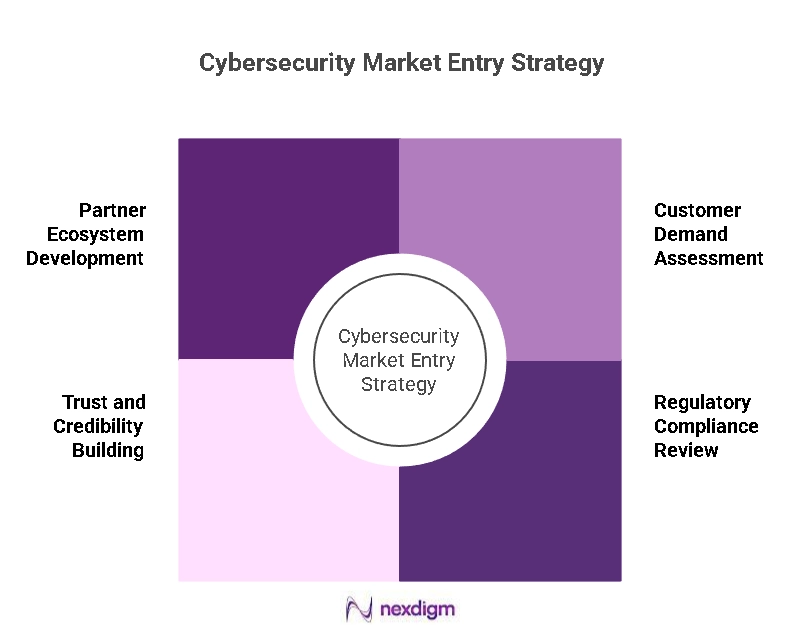
Building a market entry strategy for cybersecurity solutions helps businesses assess demand, regulations, customer trust, pricing models, partner ecosystems, compliance needs, and competitive positioning before entering high-growth security markets:
-
Customer Demand Assessment
Evaluate demand across enterprises, governments, healthcare, finance, and infrastructure sectors to identify priority cybersecurity solution opportunities.
-
Regulatory Compliance Review
Assess data protection laws, security standards, reporting obligations, and sector-specific compliance needs before entering cybersecurity markets.
-
Trust and Credibility Building
Develop proof points, certifications, case evidence, and transparent security practices to overcome buyer hesitation in cybersecurity adoption.
-
Partner Ecosystem Development
Identify channel partners, technology integrators, managed service providers, and consultants to support cybersecurity market reach and implementation.
Nexdigm’s Operational Readiness Support for Cybersecurity Market Entry
Nexdigm’s Operational Readiness Support for Cybersecurity Market Entry helps businesses plan workflows, staffing, vendor coordination, compliance processes, reporting systems, and implementation timelines for scalable cybersecurity solution expansion.
Nexdigm’s Risk Assessment Support for Cybersecurity Market Expansion
Nexdigm’s Risk Assessment Support for Cybersecurity Market Expansion helps identify compliance, operational, technology, and market risks before expansion decisions.
-
Compliance Risk Review
Nexdigm helps assess data protection rules, security standards, reporting duties, and regulatory gaps before cybersecurity market expansion.
-
Operational Risk Assessment
Nexdigm reviews staffing needs, delivery workflows, vendor dependencies, service capacity, and process gaps affecting cybersecurity business readiness.
-
Technology Risk Mapping
Nexdigm helps evaluate platform readiness, integration challenges, scalability limits, security controls, and technical risks before market entry.
-
Market and Competition Risk
Nexdigm assesses buyer expectations, pricing pressure, trust barriers, regional demand, and competitive intensity in cybersecurity solution markets.
Nexdigm’s case:
A cybersecurity solution provider planned expansion into two high-risk digital markets where security spending was expected to grow by over 9% annually. Nexdigm helped the company assess compliance risks, operational readiness, partner reliability, pricing exposure, and market barriers. With Nexdigm’s support, the company identified five key risk areas, reduced market entry planning time by 27%, and built a stronger expansion roadmap.
To take the next step, simply visit our Request a Consultation page and share your requirements with us.
Harsh Mittal
+91-8422857704