

Financial institutions increasingly depend on external providers for cloud hosting, software development, managed security, identity verification, payment processing and data analytics. These suppliers may have very different security programmes, even when they offer similar services. Comparing them through a single certification checklist can therefore create a misleading picture of relative risk.
Cybersecurity supplier benchmarking should establish whether each provider’s controls are appropriate for the service it delivers, the information it handles and the systems it can access.
Why Certification Alone Is An Incomplete Measure
Certifications such as ISO/IEC 27001 and independent assurance reports such as SOC 2 can help establish that a supplier has formalised aspects of its control environment. However, they differ in scope, assessment period, control coverage and applicability.
A certificate may cover a vendor’s corporate information security management system without covering the specific cloud environment, application or subcontractor involved in a proposed engagement. Procurement teams should therefore verify:
- The legal entity and service covered by the certification.
- The validity period and any exclusions.
- Whether the assessment includes the relevant hosting environment.
- Whether material subcontractors are included.
- Whether identified exceptions have been resolved.
For payment-related suppliers, PCI DSS may also be relevant where the vendor stores, processes or transmits payment card data, or can affect the security of the cardholder data environment. Its applicability should be determined by the actual service and data flow.
Comparing Suppliers Across Security Domains
A useful benchmark separates evidence into control areas rather than producing a single score from questionnaire responses.
- Identity and access management: Compare multifactor authentication, privileged access management, role-based permissions, periodic access reviews and controls for remote support.
- Data protection: Examine encryption in transit and at rest, key management, data classification, retention, deletion and segregation between customers.
- Vulnerability and patch management: Review scanning frequency, remediation timelines, penetration testing, secure development practices and management of unsupported components.
- Detection and incident response: Assess security monitoring coverage, incident escalation, forensic readiness, response exercises and notification commitments.
- Resilience and recovery: Compare backup protection, recovery testing, disaster recovery arrangements and dependencies on external infrastructure.
- Governance and accountability: Examine security ownership, board or senior-management oversight, policy review, employee training and subcontractor governance.
The comparison should distinguish between a control that exists on paper and one supported by operating evidence. A policy document does not demonstrate that access reviews happen on schedule or that vulnerabilities are remediated within agreed timelines.
Build a Benchmark That Reflects Supplier Criticality
Not every supplier needs identical security requirements. A provider with access to customer identity records or payment infrastructure should face more intensive scrutiny than a supplier with no access to sensitive systems.
A risk-weighted benchmark can group suppliers into tiers:
- Critical: Direct access to sensitive data, payment systems or essential business services.
- High: Material access to internal systems or customer information, but with limited operational substitutability.
- Moderate: Restricted access and limited impact if the service is disrupted.
- Low: Minimal system connectivity and no material access to sensitive information.
The institution can then define minimum control expectations, evidence requirements and reassessment frequency for each tier.
Nexdigm’s Cybersecurity Supplier Compliance Benchmarking Framework
A cybersecurity supplier compliance benchmarking BFSI programme should produce more than a ranking. It should explain why suppliers differ and whether those differences are acceptable for the intended engagement.
A practical comparison process includes:
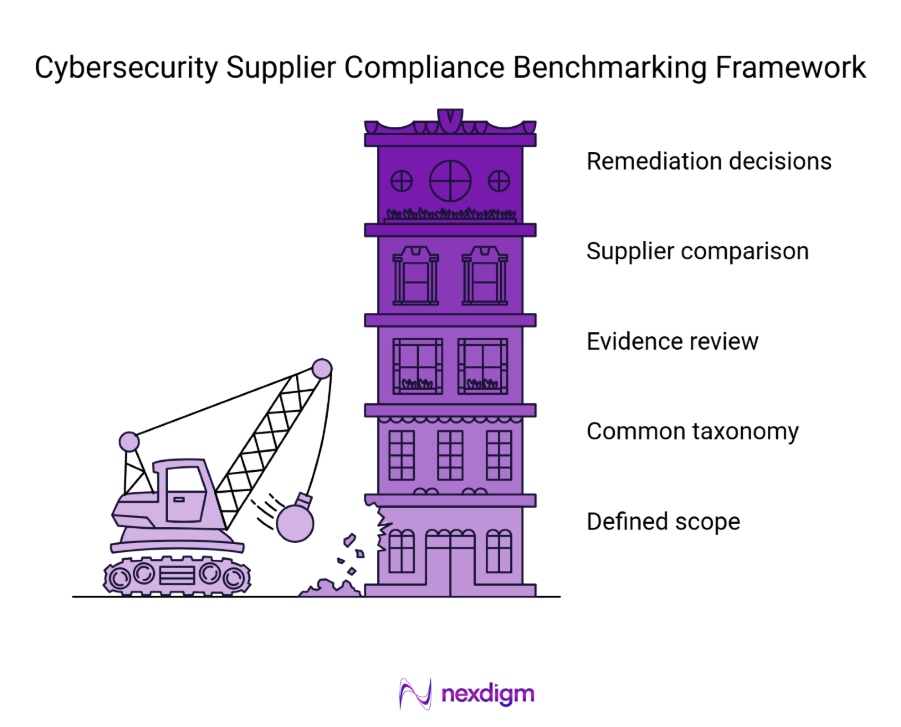
- Scope: Define the service, data classification, system access and supplier criticality.
- Standardise: Use a common control taxonomy while allowing service-specific requirements.
- Validate: Review certifications, audit reports, test results and evidence of control operation.
- Compare: Identify gaps, exceptions and differences in maturity across suppliers.
- Decide: Set remediation conditions, compensating controls, approval thresholds and monitoring requirements.
NIST’s Cybersecurity Framework 2.0 and its supply-chain guidance provide useful reference structures for integrating supplier cybersecurity into wider risk governance. They can support consistent comparison, but they do not replace regulatory obligations or institution-specific control requirements.
Nexdigm can assist with supplier security benchmarking, control-gap analysis and evidence-based vendor comparisons, giving procurement and risk teams a clearer basis for selection and remediation.
Nexdigm’s Case Study
A financial services group benchmarked 14 technology suppliers across 6 security domains. Although 9 held recognised security certifications, evidence reviews identified gaps in privileged access and subcontractor oversight at 4 providers. The group introduced remediation conditions before renewing the affected contracts.
To take the next step, simply visit our Request a Consultation page and share your requirements with us.
Harsh Mittal
+91-8422857704