

Entering a new dairy market presents significant opportunities, but it also comes with challenges such as regulatory compliance, supply chain complexities, consumer preferences, and competitive pressures. While businesses have multiple market entry options, a joint venture (JV) often emerges as a strategic choice when local expertise and shared investment are essential for success.
Businesses seeking sustainable growth frequently combine market intelligence with retail franchise entry strategy consulting to evaluate the most suitable path forward. In the dairy industry, where sourcing, processing, distribution, and quality management are closely interconnected, selecting the right entry model can determine long-term profitability. This is where Nexdigm helps businesses assess market realities and build entry frameworks designed for sustainable expansion.
Understanding Joint Ventures in the Dairy Sector
A joint venture is a business arrangement where two or more organizations collaborate to establish a separate entity, sharing resources, investments, risks, and rewards. In dairy markets, international brands often partner with local companies to gain faster access to supply networks, distribution channels, and consumer trust.
Unlike establishing a wholly owned subsidiary, a joint venture allows businesses to leverage local knowledge while minimizing operational uncertainties. This approach can be particularly effective when entering markets with complex dairy regulations, fragmented supplier ecosystems, or distinct consumer preferences.
When Is a Joint Venture the Right Choice?
When Local Market Knowledge Is Critical
Consumer preferences in dairy products vary significantly across regions. Product demand may differ based on factors such as taste preferences, dietary habits, pricing sensitivity, and purchasing behaviors. A local partner can provide:
- Consumer insights
- Established supplier relationships
- Regulatory understanding
- Distribution expertise
Nexdigm assists organizations in evaluating whether a local partnership can accelerate market penetration and reduce market entry risks.
When Regulatory Compliance Is Complex
The dairy industry is often heavily regulated, with requirements covering:
- Food safety standards
- Product labeling
- Import restrictions
- Quality certifications
- Environmental compliance
Companies entering unfamiliar markets may face delays without strong local support. A joint venture partner can help navigate compliance requirements efficiently.
Through detailed market assessments, Nexdigm helps businesses identify regulatory challenges before market entry, enabling informed investment decisions.
When Supply Chain Infrastructure Needs Local Support
Dairy operations depend on efficient procurement and cold-chain logistics. Building supplier networks from the ground up can be expensive and time-consuming. A joint venture may be preferable when:
- Existing dairy collection systems are needed
- Distribution networks already exist
- Cold storage infrastructure is available
- Local sourcing relationships are critical
Nexdigm’s market entry specialists evaluate operational readiness and identify partnership opportunities that support scalable dairy operations.
A Strategic Evaluation Framework
Before selecting a joint venture structure, businesses should evaluate five core dimensions. Before selecting a joint venture structure, businesses should evaluate five core dimensions. A successful joint venture depends not only on finding the right partner but also on ensuring strategic alignment, operational compatibility, and shared long-term objectives.
Market Readiness
- Demand growth potential
- Competitive intensity
- Consumer purchasing power
Partner Compatibility
- Operational capabilities
- Strategic alignment
- Financial stability
Risk Exposure
- Regulatory risks
- Market volatility
- Supply chain disruptions
Investment Requirements
- Capital expenditure
- Technology transfer needs
- Infrastructure commitments
Growth Potential
- Geographic expansion opportunities
- Product diversification possibilities
- Long-term scalability
Nexdigm integrates these considerations into its advisory approach to help dairy companies develop market entry strategies supported by practical execution plans.
Selecting Right Joint Venture for Dairy Brands
Joint ventures are often an attractive option for dairy brands looking to expand into new markets while balancing growth opportunities with operational and financial risks. They allow companies to combine local expertise, infrastructure, and market knowledge with their own capabilities and brand strengths. Several market conditions often make a joint venture attractive:
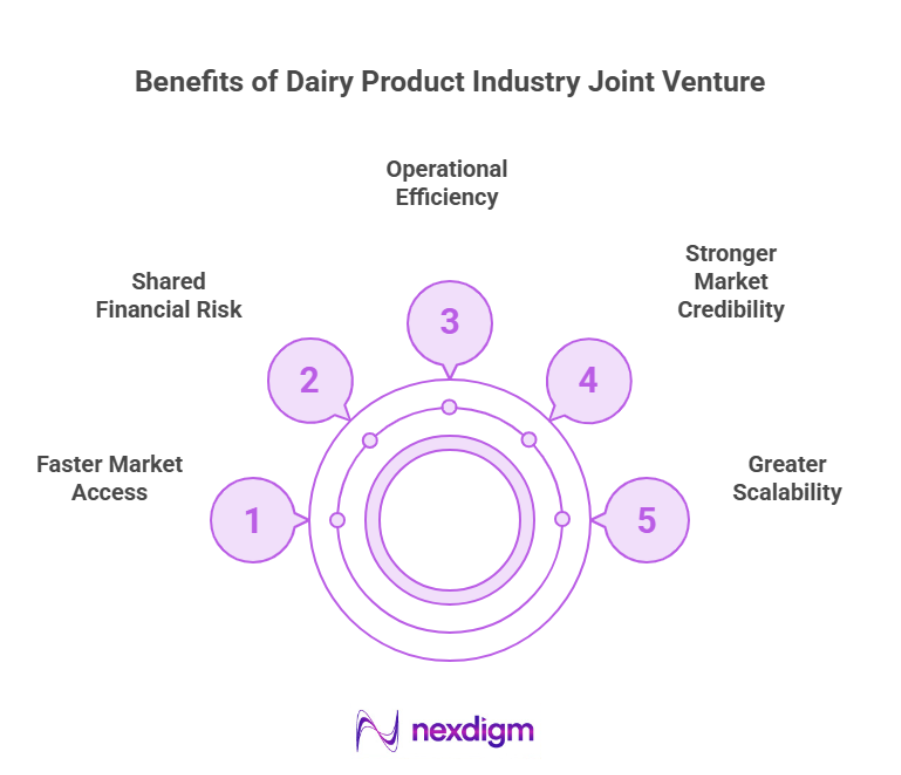
- Faster Market Access: Local partners provide immediate access to established networks.
- Shared Financial Risk: Investment responsibilities are distributed among partners.
- Operational Efficiency: Existing facilities and supplier ecosystems can be leveraged.
- Stronger Market Credibility: Local partnerships often improve brand acceptance among consumers and stakeholders.
- Greater Scalability: Joint ventures can create a strong foundation for future product and geographic expansion.
Nexdigm helps businesses evaluate whether these benefits outweigh the limitations associated with shared ownership structures.
How Nexdigm Supports Dairy Market Entry Decisions
Successful market entry requires more than selecting the right structure. It demands strategic planning, operational readiness, financial analysis, and continuous market evaluation. Nexdigm supports organizations through:
- Market Opportunity Assessment: Identifying growth potential and competitive positioning.
- Partner Due Diligence: Evaluating financial, operational, and strategic compatibility.
- Entry Model Evaluation: Comparing joint ventures, acquisitions, franchising, and direct investment options.
- Financial Feasibility Analysis: Assessing profitability, investment requirements, and return expectations.
- Growth Roadmap Development: Creating scalable expansion strategies aligned with long-term business goals.
Companies exploring retail franchise entry strategy consulting often rely on Nexdigm’s cross-functional expertise to identify entry models that balance growth ambitions with market realities.
Nexdigm’s Case
Nexdigm recently supported a dairy client in evaluating whether a joint venture was the right market-entry route. Real-time analysis improved partner-fit assessment by 34%, increased market access potential by 29%, reduced entry risks by 26%, and accelerated decision-making by 31%.
Nexdigm’s dairy market-entry assessment enabled the client to evaluate partner capabilities, market access, economics, and risks, supporting a confident and commercially viable joint-venture decision.
To take the next step, simply visit our Request a Consultation page and share your requirements with us.
Harsh Mittal
+91-8422857704